
How Electric Discharges Form in the Atmospheres of Other Planets
Space

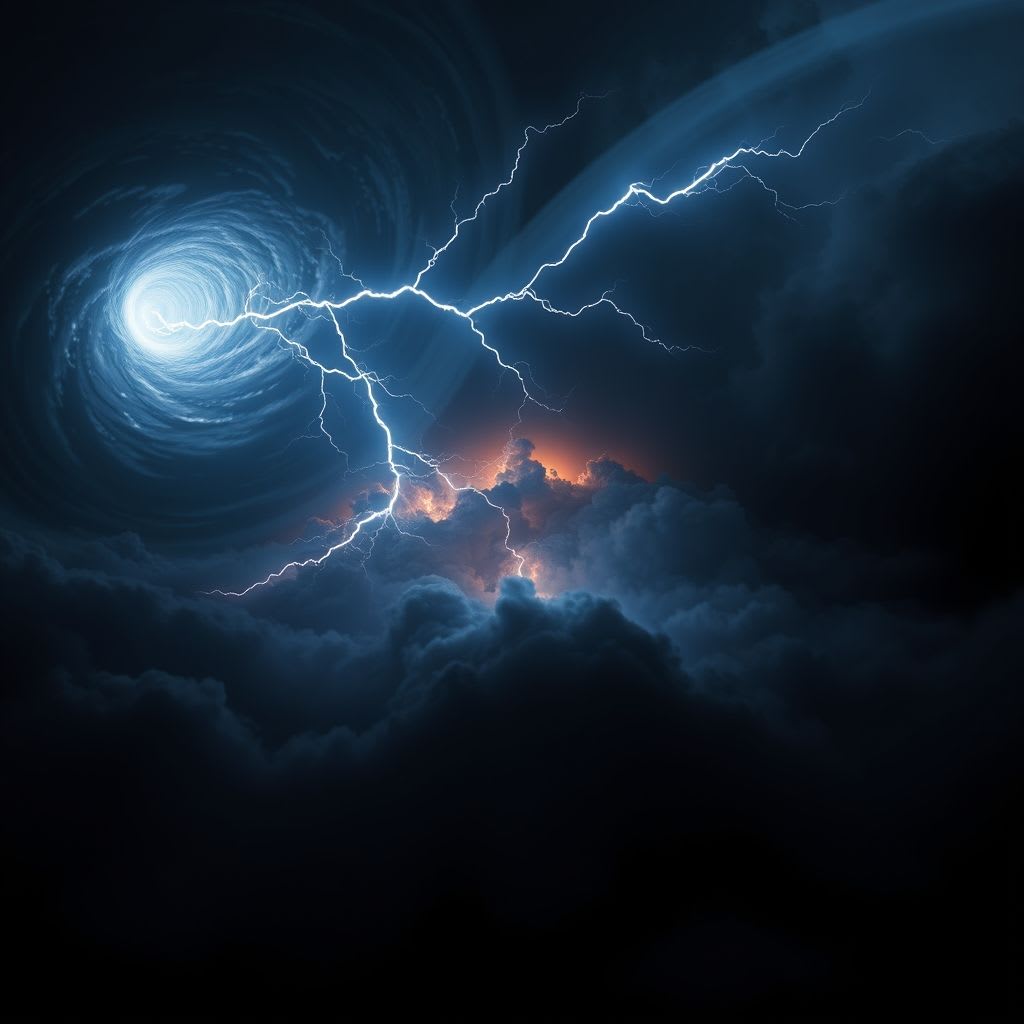
When we hear the word lightning, we usually picture a blinding flash slicing through a stormy sky, followed by a deafening roll of thunder. On Earth, lightning is a familiar natural spectacle. But beyond our planet, electric discharges can be far stranger, far more powerful, and, in some cases, even dangerous.
While the same basic physics applies everywhere in the universe, the exotic conditions on other planets different atmospheres, pressures, and chemical compositions turn lightning into something almost alien.
The Universal Recipe for Lightning
At its core, lightning is a sudden electrical discharge between regions of opposite electrical potential. On Earth, the potential builds when particles water droplets, ice crystals, or dust rub against one another inside a storm cloud, separating charges until the difference becomes great enough to cause a “breakdown” in the air.
Elsewhere, the actors in this drama can be very different. Instead of water and ice, the charge might come from grains of volcanic ash, methane droplets, sulfur crystals, or even alien ices. But the result is the same: a crackling burst of energy bridging the gap between charged regions.
Jupiter: Colossal Lightning in a Planet of Storms
Jupiter is the king of lightning. Its discharges are hundreds of times brighter and more powerful than those on Earth. Instead of pure water clouds, Jovian storms are made of a turbulent mix of ammonia, hydrogen, and water vapor. Massive atmospheric whirlpools like the iconic Great Red Spot, which is wider than our planet create relentless turbulence and collisions between particles.
Some Jovian lightning bolts stretch thousands of kilometers, so vast that their glow can be spotted by telescopes in Earth’s orbit. Spacecraft like Juno have recorded both their brilliant flashes and the eerie radio waves they produce.
Saturn: Lightning in Endless Megastorms
On Saturn, lightning often erupts during colossal “megastorms” that can rage for months. Deep within the planet’s thick clouds, powerful convection currents and turbulent layers create ideal conditions for electrical buildup.
Unlike Earth lightning, Saturn’s discharges often produce intense radio bursts that can be detected from millions of kilometers away. Scientists believe these lightning storms may also alter the local atmospheric chemistry, creating complex molecules that might otherwise never form.
Venus: Lightning in a Hellish Sky
The atmosphere of Venus is a furnace about 470°C (880°F) at the surface and 90 times denser than Earth’s, with clouds made not of water but of sulfuric acid. And yet, space probes such as the European Space Agency’s Venus Express have detected flashes of lightning within these toxic clouds.
Here, the charge likely builds up from the collision of acid droplets, and the resulting bolts may trigger unique chemical reactions involving sulfur, potentially influencing the planet’s already bizarre climate.
Mars: Dust Storms That Crackle with Electricity
So far, Mars has not revealed any traditional lightning bolts, but it has something else: dust storms that generate static electricity. When fine grains of Martian dust collide and rub together, they build up electrical fields strong enough to create coronal discharges bluish, ghost-like glows around objects or short, invisible bursts of electricity.
For future astronauts, these electric events could be more than just a curiosity they might interfere with equipment, communication systems, or even pose direct hazards during planet-wide dust storms.
Titan: Mystery in the Methane Clouds
Saturn’s largest moon, Titan, has a thick atmosphere of nitrogen and methane, with clouds that occasionally produce rain not of water, but of liquid methane. Scientists suspect that electrical discharges could form in these clouds, but so far, no direct observation has confirmed it.
If lightning does occur here, it could play a role similar to what some scientists believe happened on early Earth sparking chemical reactions that lead to the creation of complex organic molecules, possibly laying the groundwork for life.
Why Lightning Beyond Earth Matters
Studying electric discharges on other planets is not just an exercise in cosmic curiosity. Lightning can dramatically change a planet’s atmosphere, influence weather patterns, and even contribute to the chemistry of life’s building blocks. For space exploration, understanding these phenomena helps predict hazards for spacecraft and human explorers, ensuring future missions are better prepared.
By observing storms on Jupiter, Venus, or even Titan, scientists are not just learning about distant worlds they are also gaining insight into Earth’s own weather and climate history. Lightning, in its many alien forms, is a reminder that the forces shaping our skies are alive and well across the solar system, sparking energy in the most unexpected places.
About the Creator
Keep reading
More stories from Holianyk Ihor and writers in Futurism and other communities.
Colonizing the Moons of Uranus and Neptune: Life on the Edge of the Solar System
When most people imagine humanity colonizing space, they picture bustling cities on Mars, mining stations on the Moon, or scientific outposts on the icy moons of Jupiter and Saturn. But what if we dared to look even farther beyond Saturn’s majestic rings, past the edge of the familiar Solar System, to worlds so distant that the Sun appears as a pale star in the sky?
By Holianyk Ihor5 months ago in Futurism
About Binding Prometheus
I want to start actively advocating on behalf of my own work, and the most valuable part of my canon is, without a doubt, Binding Prometheus, the play I have been working on since 2019 and only finished in 2023 as part of my MA. The play itself is an amalgamation of a million different inspirations. On one end, it evokes the Ancient Greek myth-play, deriving its own title from the earliest extant work of Western drama we have, Aeschylus’s Prometheus Bound. On the other end, it borrows significantly from the sci-fi bulwarks from over the years, namely Mary Shelley’s Frankenstein and Karel Capek’s Rossum’s Universal Robots. The play could be an episode of Black Mirror, I fear. I don’t know. I’ve only ever seen one episode of Black Mirror.
By Steven Christopher McKnight17 days ago in Futurism
Australia Iron Ore Market: Global Supply Leadership, Steel Demand & Resource Security
In 2024, Australia iron ore market reached USD 8.34 Billion. Looking ahead, the market is projected to expand to USD 12.23 Billion by 2033, exhibiting a compound annual growth rate (CAGR) of 3.90% during 2025–2033.
By Kevin Cooper5 days ago in Futurism


Comments
There are no comments for this story
Be the first to respond and start the conversation.