
The Star That Spins Almost at the Speed of Light
Space

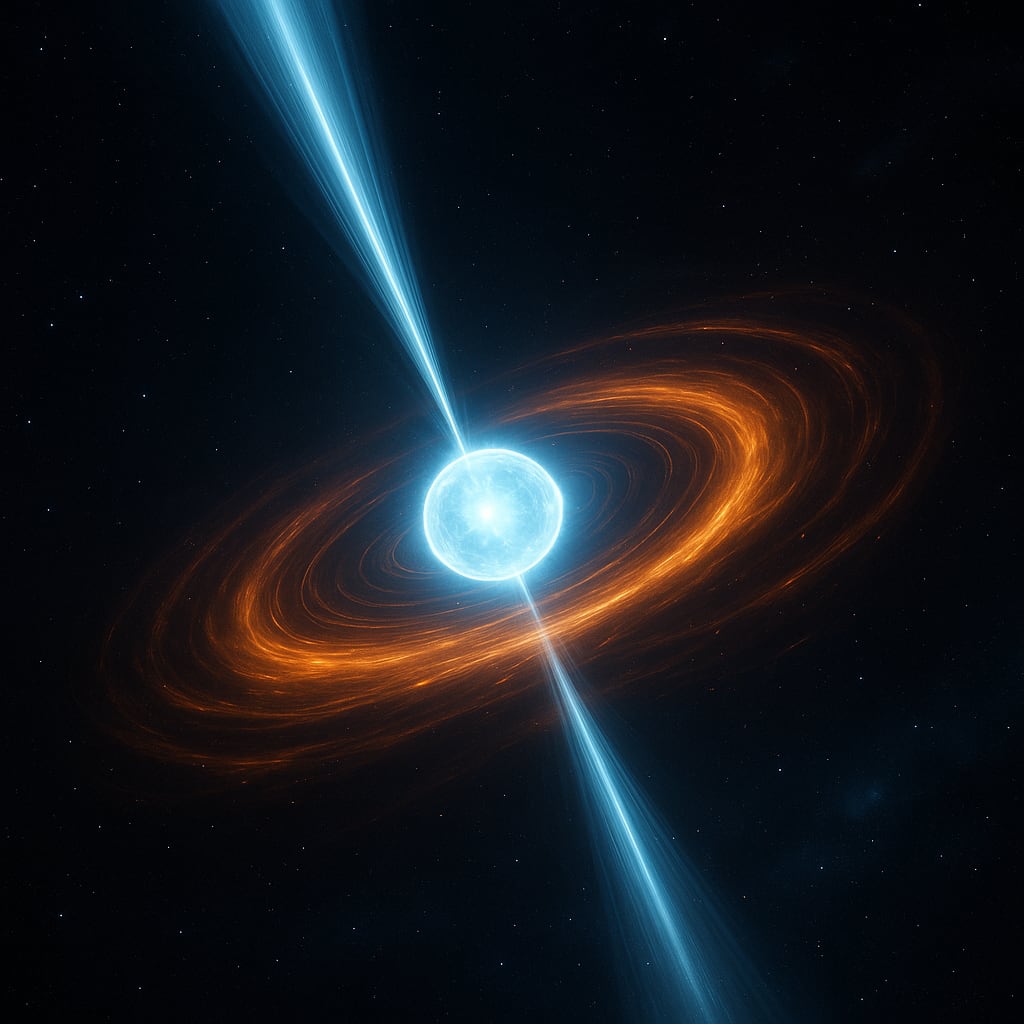
Astronomy never ceases to amaze us. Just when we think we’ve reached the limits of what the universe can throw at us, a new discovery bends our imagination. This time, scientists have detected a neutron star — specifically, a pulsar — spinning so fast that its surface is moving at a speed brushing against the ultimate cosmic speed limit: the speed of light itself.
This incredible find pushes the boundaries of what we thought was possible and raises exciting new questions about the physics of some of the most extreme objects in the cosmos.
The Cosmic Spinning Top
Neutron stars are among the strangest remnants in the universe. They are born in the violent deaths of massive stars, when a supernova explosion crushes the stellar core into something unimaginably dense. The result? An object packing more mass than the Sun into a sphere barely 12–20 kilometers across. To put that into perspective: a teaspoon of neutron star material would weigh more than a billion tons on Earth.
Pulsars are a special class of neutron stars. They spin rapidly, shooting out beams of radio waves (and sometimes X-rays or gamma rays) from their magnetic poles. As the star rotates, these beams sweep across space like the beam of a lighthouse, flashing past Earth with clockwork precision. Most pulsars rotate dozens or hundreds of times per second. That alone is impressive — but the newly discovered one makes those numbers look almost leisurely.
Pushing the Limits
This pulsar spins more than 700 times every second. Imagine that for a moment. That means one full rotation takes less than two-thousandths of a second. If Earth rotated that fast, a “day” would be over before you could blink.
At such incredible speeds, the surface of the star is moving at a velocity close to the speed of light. Nothing in the universe with mass can exceed that ultimate barrier, so this pulsar is teetering right at the edge of physical possibility.
What keeps it from flying apart? The crushing power of gravity. Neutron stars are so dense that even with such wild rotations, the star remains intact. But there is a hard limit, a maximum spin rate beyond which the outward pull would tear the star apart. This pulsar is skimming dangerously close to that cosmic threshold, turning it into one of the most extreme natural laboratories we’ve ever observed.
Why It Matters
Finding a pulsar spinning this fast isn’t just a fun cosmic fact — it’s a key to unlocking deeper mysteries. Pulsars serve as natural laboratories for testing the laws of physics under conditions we can’t replicate on Earth.
For one, they let scientists test Einstein’s theories of gravity. The timing of their pulses can reveal how space and time warp around massive objects. In addition, pulsars can help in the hunt for gravitational waves — the ripples in spacetime caused by colossal cosmic collisions. By monitoring tiny irregularities in their timing, researchers can detect the subtle tug of these waves as they wash through the galaxy.
And then there’s the question of how such a star gets to spin so insanely fast. Astronomers believe these “millisecond pulsars” are powered up through a process called accretion. In binary systems, a neutron star can siphon off matter from its companion star. This infalling gas forms a swirling accretion disk and, in the process, transfers angular momentum to the neutron star, spinning it up like a child winding a toy top. Over millions of years, this cosmic feeding frenzy can accelerate a pulsar to mind-bending speeds — until it becomes a near-light-speed whirlpool of matter and magnetic fields.
A Glimpse of the Extreme
Discoveries like this remind us how little we’ve truly mapped out the extremes of the universe. If we’ve found a pulsar spinning this close to the speed of light, could there be others spinning even faster, perhaps at the razor-thin boundary of physics itself?
Each discovery gives us a sharper look at where the rules bend and break. Understanding these extreme objects could reveal new insights into matter under crushing densities, the behavior of exotic particles, and even the ultimate fate of collapsing stars.
Neutron stars already stand as symbols of cosmic strangeness: tiny yet massive, dark yet flashing like celestial beacons. Now, with this record-breaking pulsar, we are reminded that nature can push its creations to almost unimaginable extremes. Out there, beyond the calm of our solar system, are stars that whirl so fast they make the very concept of time feel fragile, stars that embody the raw edge of possibility itself.
About the Creator
Keep reading
More stories from Holianyk Ihor and writers in Futurism and other communities.
A Potentially Habitable Exoplanet Around the Red Dwarf LHS 475c
The search for life beyond Earth has taken an exciting leap forward. For decades, astronomers have scanned the skies for rocky planets orbiting distant stars, hoping to find one with the right conditions to host life. Now, the James Webb Space Telescope (JWST) has delivered a groundbreaking discovery: a rocky exoplanet orbiting the red dwarf LHS 475, known as LHS 475c, shows signs of an atmosphere containing carbon dioxide and clouds. This finding not only reshapes our expectations of red dwarf planets but also adds a compelling candidate to the list of potentially habitable worlds.
By Holianyk Ihor4 months ago in Futurism
About Binding Prometheus
I want to start actively advocating on behalf of my own work, and the most valuable part of my canon is, without a doubt, Binding Prometheus, the play I have been working on since 2019 and only finished in 2023 as part of my MA. The play itself is an amalgamation of a million different inspirations. On one end, it evokes the Ancient Greek myth-play, deriving its own title from the earliest extant work of Western drama we have, Aeschylus’s Prometheus Bound. On the other end, it borrows significantly from the sci-fi bulwarks from over the years, namely Mary Shelley’s Frankenstein and Karel Capek’s Rossum’s Universal Robots. The play could be an episode of Black Mirror, I fear. I don’t know. I’ve only ever seen one episode of Black Mirror.
By Steven Christopher McKnight17 days ago in Futurism
Japan LED Modular Display Market Size & Forecast 2025–2033
Japan LED Modular Display Market at a Glance The Japan LED Modular Display market is anticipated to grow to US$ 1,009.54 million by 2033, rising from US$ 380.54 million in 2024, registering a robust CAGR of 11.45% during 2025–2033. This growth is driven by the increasing demand for high-resolution digital signage across retail, transportation, entertainment, and public infrastructure, combined with the adoption of energy-efficient, customizable display systems for Japan’s expanding smart city initiatives.
By Aaina Oberoia day ago in Futurism
Miss Persephone's Manual to a Seemingly Ordinary Life
Miss Persephone was found at the dining table, her blue eyes swollen, her tears arriving and retreating like the tides of the ocean. Earlier that day, her family had visited her in the retirement home where she had lived for eight years. It was her eightieth birthday.
By Imola Tóth2 days ago in Fiction


Comments
There are no comments for this story
Be the first to respond and start the conversation.