
Oxygen in the Atmosphere of Exoplanet K2-18b: A Possible Glimpse of Alien Life
Space

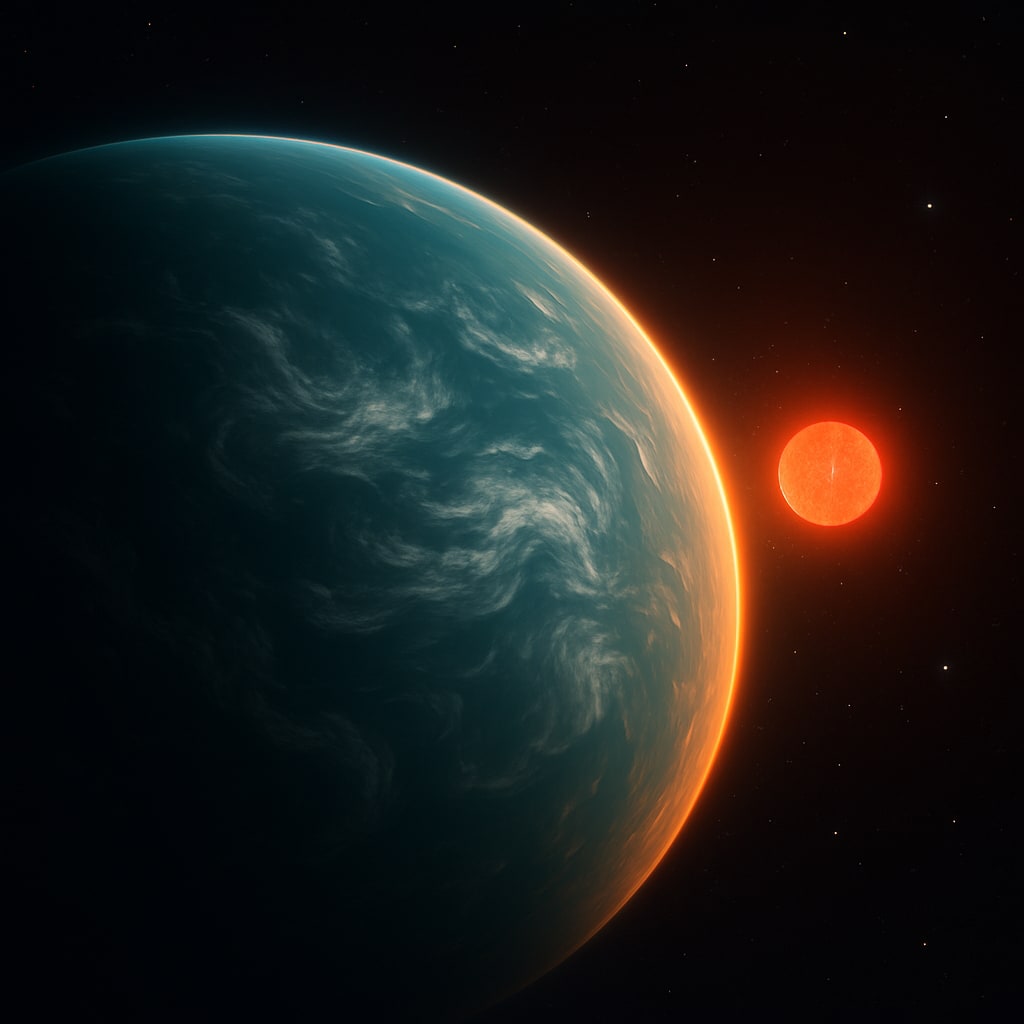
Astronomy never ceases to surprise us. Recently, researchers confirmed the presence of molecular oxygen in the atmosphere of a distant world: the exoplanet K2-18b. This discovery is more than just a scientific milestone—it raises profound questions about whether life, in some form, could exist far beyond our solar system.
A Planet Hidden in Leo
K2-18b was first identified in 2015 by NASA’s Kepler space telescope, a mission dedicated to hunting for worlds orbiting distant stars. The planet lies about 120 light-years away, nestled within the constellation of Leo. While this distance sounds enormous, on a cosmic scale it makes K2-18b one of our relatively “close” neighbors.
What makes this planet particularly interesting is its size and classification. K2-18b is what astronomers call a “super-Earth” or “mini-Neptune.” Its mass is about 8.5 times greater than Earth’s, and its radius is roughly 2.6 times larger. That means it’s too big to be Earth-like in the strict sense, but not quite as massive as a gas giant like Neptune.
Perhaps the most intriguing fact: the planet orbits within the habitable zone of its parent star, a cool red dwarf. The habitable zone is the “Goldilocks region,” where temperatures could allow for the presence of liquid water—a key ingredient for life as we know it.
The Oxygen Revelation
Until now, scientists had already detected signs of water vapor, methane, and carbon dioxide in K2-18b’s thick atmosphere. But the latest observations, made with powerful telescopes, went one step further: they revealed the presence of molecular oxygen within the planet’s cloud layers.
This is an electrifying find. On Earth, oxygen is intimately tied to life. Plants, algae, and cyanobacteria continuously replenish our atmosphere with oxygen through photosynthesis. Without living organisms, Earth’s oxygen would quickly react with other elements and vanish. That’s why the presence of oxygen elsewhere in the cosmos often sparks speculation about biology.
But here’s the catch: oxygen doesn’t always mean life. There are natural, non-biological processes that can produce it. For instance:
- Photolysis of water: ultraviolet radiation from the host star can split water molecules into hydrogen and oxygen, leaving oxygen behind.
- Geochemical reactions: processes inside a planet’s crust or mantle could, in theory, release oxygen.
- Atmospheric chemistry: interactions between gases in the upper atmosphere can also produce oxygen without biology.
The challenge for scientists is to determine whether the oxygen on K2-18b is the result of life—or something else entirely.
Could the Atmosphere Support Life?
The atmosphere of K2-18b appears to be a hydrogen-helium envelope laced with familiar gases such as water vapor, methane, and now oxygen. It is far denser than Earth’s, which raises questions about whether a solid, Earth-like surface even exists. If the surface is covered by a vast, high-pressure ocean, conditions might be too extreme for life as we know it.
Yet some researchers argue that the planet could host “habitable layers” within its atmosphere. Imagine floating microbial life forms in cloud decks, thriving at altitudes where the temperature and pressure resemble Earth’s more temperate zones. This concept isn’t entirely science fiction: even in our own solar system, some scientists speculate that Venus’s upper atmosphere could harbor microbial life in its cooler cloud layers.
If K2-18b does support life, it may not be on the surface at all—but drifting high in the skies, invisible to us except through the chemical fingerprints left behind in the air.
Why This Discovery Matters
Finding oxygen on K2-18b doesn’t confirm alien life, but it makes the planet a priority target for future exploration. The James Webb Space Telescope (JWST) and upcoming missions are already focusing on such exoplanets to better analyze their atmospheres. Every molecule detected—oxygen, water, methane—adds another piece to the puzzle.
Think of it this way: Earth itself would be a bright dot from light-years away. If alien astronomers pointed their telescopes at us, they might conclude that oxygen plus water equals life. Could we be on the verge of making the same discovery about another world?
A Broader Perspective
The universe is vast, containing billions of stars and, by extension, billions of planets. If one relatively nearby world like K2-18b already shows such tantalizing chemistry, how many others might be out there with even clearer signs of habitability?
Discoveries like this remind us that life—if it exists beyond Earth—might not be exotic or rare, but potentially common and diverse. Oxygen is only one clue, but it’s a clue that pushes us to keep searching, to keep asking questions, and to keep looking at the sky with both scientific rigor and childlike wonder.
Final Thoughts
K2-18b is no longer just a distant speck of light in Leo—it’s a world that challenges our understanding of habitability. The detection of oxygen in its atmosphere doesn’t solve the mystery of life in the universe, but it moves us a step closer.
Perhaps, in the coming decades, advanced telescopes will provide the decisive evidence we crave. Until then, K2-18b stands as a beacon, whispering a cosmic possibility: that we are not alone.
About the Creator
Keep reading
More stories from Holianyk Ihor and writers in Futurism and other communities.
The Star That Spins Almost at the Speed of Light
Astronomy never ceases to amaze us. Just when we think we’ve reached the limits of what the universe can throw at us, a new discovery bends our imagination. This time, scientists have detected a neutron star — specifically, a pulsar — spinning so fast that its surface is moving at a speed brushing against the ultimate cosmic speed limit: the speed of light itself.
By Holianyk Ihor4 months ago in Futurism
About Binding Prometheus
I want to start actively advocating on behalf of my own work, and the most valuable part of my canon is, without a doubt, Binding Prometheus, the play I have been working on since 2019 and only finished in 2023 as part of my MA. The play itself is an amalgamation of a million different inspirations. On one end, it evokes the Ancient Greek myth-play, deriving its own title from the earliest extant work of Western drama we have, Aeschylus’s Prometheus Bound. On the other end, it borrows significantly from the sci-fi bulwarks from over the years, namely Mary Shelley’s Frankenstein and Karel Capek’s Rossum’s Universal Robots. The play could be an episode of Black Mirror, I fear. I don’t know. I’ve only ever seen one episode of Black Mirror.
By Steven Christopher McKnight19 days ago in Futurism
Europe Green Building Market Size and Forecast 2025–2033
Introduction: Europe’s Construction Industry Enters a Green Era Europe’s construction industry is undergoing a profound transformation. Sustainability is no longer a niche preference—it is becoming the new standard. Driven by climate commitments, energy security concerns, and rising awareness among consumers and investors, green building practices are now embedded in the region’s development agenda.
By Marthan Sir5 days ago in Futurism


Comments
There are no comments for this story
Be the first to respond and start the conversation.