
Scientists discovered a fierce predator from Patagonia with bone-crushing jaws
Meet Kostensuchus atrox, a 70-million-year-old predator that feasted on dinosaurs

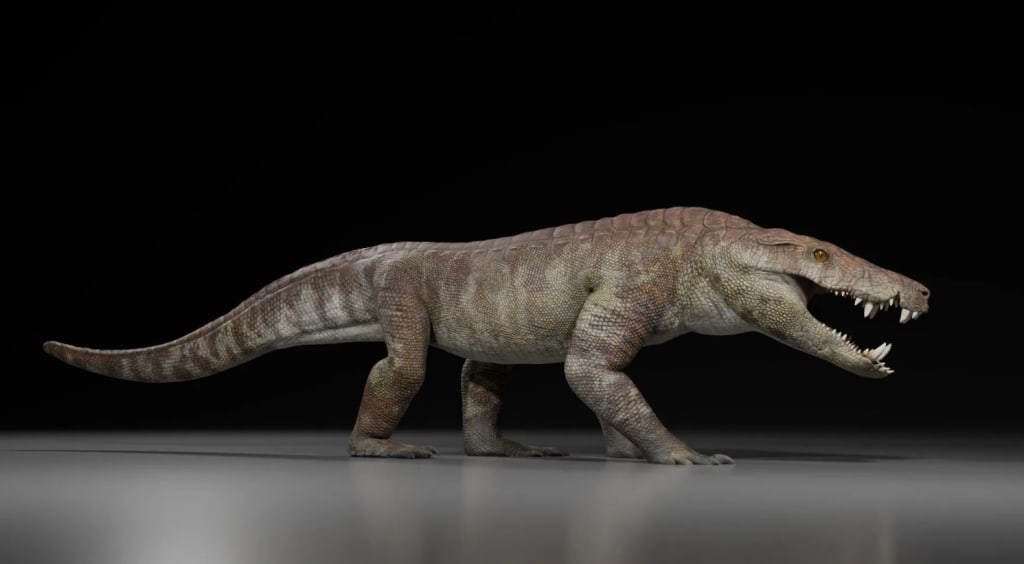
Seventy million years ago, in what is now southern Patagonia, a powerful predator lurked in the shadows of dinosaurs. It wasn’t a T. rex or a raptor, but a fierce crocodile relative with jaws strong enough to crush bones. Scientists have now unveiled this creature, named Kostensuchus atrox, in a study published on August 27, 2025, in the journal PLOS ONE. The discovery paints a vivid picture of the Late Cretaceous ecosystem, just before the asteroid strike that ended the age of dinosaurs.
The story of K. atrox begins in March 2020, when a team of paleontologists led by Fernando Novas from the Museo Argentino de Ciencias Naturales in Buenos Aires set out for the Chorrillo Formation in Argentina’s Santa Cruz province. This rugged site lies about 30 kilometers southwest of El Calafate, near the famous Lake Argentino and Perito Moreno Glacier. Reaching it was no easy task the team endured a three-hour trek across rivers, cliffs, and uneven terrain.
On their very first day, as the light faded, technician Marcelo Isasi spotted something unusual: dark bones sticking out of beige rock. He quickly showed them to his colleague, who recognized the significance. “Marcelo, those are teeth, and they’re very big!” the colleague exclaimed. What they had uncovered was extraordinary an almost complete skull and jaws, along with parts of the neck, back, hips, ribs, and forelimbs.
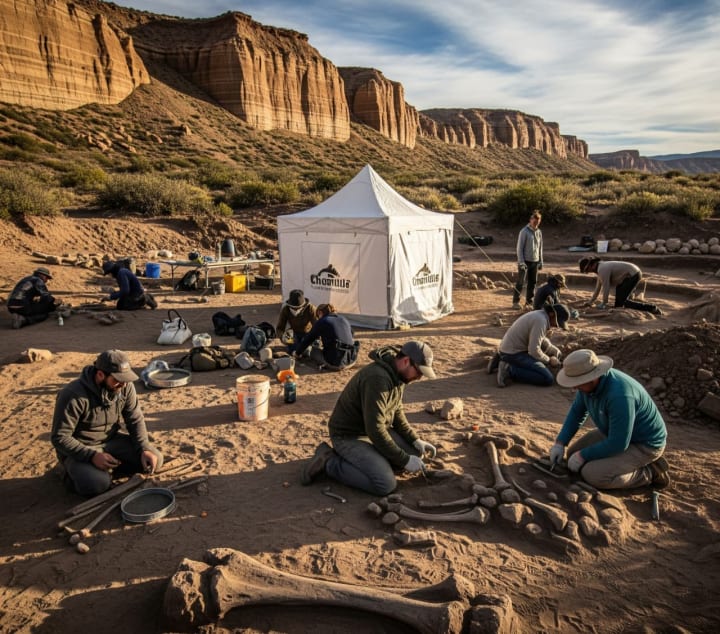
Getting the fossils back to Buenos Aires was an adventure of its own. Transporting them 1,500 miles during the COVID-19 pandemic required special effort. Once there, six months of careful preparation with pneumatic hammers revealed the creature in stunning detail.
The name Kostensuchus atrox carries layers of meaning. “Kosten” refers to the fierce Patagonian winds, “Suchus” comes from the crocodile-headed Egyptian god Sobek, and “atrox” means “fierce.” And fierce it certainly was. Measuring about 3.5 meters (11.5 feet) long and weighing 250 kilograms (550 pounds), this reptile belonged to the peirosaurid family, a now-extinct group of crocodyliforms distant cousins of today’s crocodiles, alligators, and gharials. Unlike many of its modern relatives, this predator was not tied to rivers and swamps. Its body suggests it was built for hunting on land.
The most striking feature of K. atrox is its skull. At nearly 20 inches long, the broad snout held more than 50 sharp, serrated teeth, some up to two inches in length. These teeth closely resembled those of Tyrannosaurus rex, giving the animal the ability to crush prey with devastating force. As paleontologist Diego Pol put it, “They can break you in two pieces with a single bite.”
Unlike modern crocodiles, which crawl and sprawl, K. atrox may have had a more upright stance and powerful forelimbs. This likely made it a fast, ambush-style hunter capable of taking down small to medium dinosaurs. Its diet was almost entirely meat, with over 70 percent of its nutrition coming from flesh. Dinosaurs like ankylosaurs or hadrosaurs, common in the region at the time, may have been its main prey.
The world K. atrox lived in was very different from the icy Patagonia we know today. Back then, the landscape was warm and humid, dotted with freshwater ecosystems full of dinosaurs, turtles, frogs, and early mammals. K. atrox wasn’t the only predator around either it shared its home with Maip macrothorax, a giant carnivorous dinosaur nearly 30 feet long, discovered in 2022. Together, these predators formed a delicate balance in a thriving prehistoric ecosystem.
From a scientific perspective, the discovery of K. atrox is hugely important. It is one of the most complete fossils of a broad-snouted peirosaurid ever found, offering fresh insight into a little-known branch of the crocodile family tree. It also highlights how diverse crocodyliforms once were. During the Cretaceous period in Gondwana (the ancient southern supercontinent), crocodile relatives came in many forms some meat-eating like K. atrox, others even adapted to eating plants.
This find also challenges the common idea that crocodiles are “living fossils” that have remained unchanged for millions of years. In reality, they were once far more diverse and adaptable than we tend to imagine. As Novas put it, the Chorrillo Formation offers a “window into an ancient ecosystem” that still has many secrets to reveal.
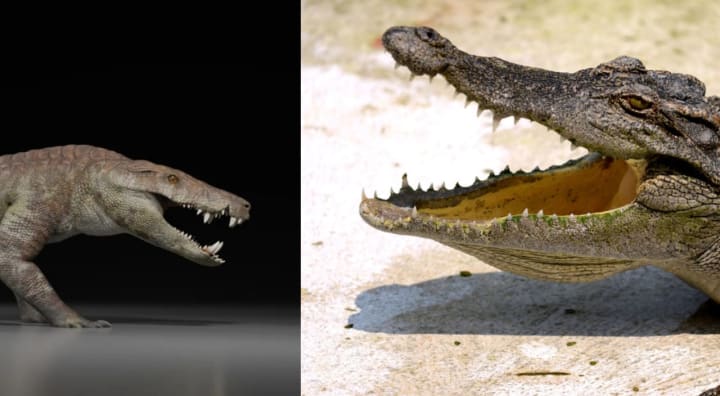
Kostensuchus atrox reminds us that the age of dinosaurs was not just about dinosaurs. It was a world where crocodile kin roamed the land as apex predators, competing with and preying upon the giants of their time. Today, its fossils give us a rare glimpse into that vanished world, where survival meant powerful jaws, sharp teeth, and the strength to stand toe-to-toe with dinosaurs.
About the Creator
Muzamil khan
🔬✨ I simplify science & tech, turning complex ideas into engaging reads. 📚 Sometimes, I weave short stories that spark curiosity & imagination. 🚀💡 Facts meet creativity here!
Keep reading
More stories from Muzamil khan and writers in Education and other communities.
Fish That Don’t Freeze: Nature’s Antifreeze Proteins
Imagine diving into the icy waters of the Antarctic Ocean. The temperature is about –1.9°C, so cold it could freeze human blood in seconds. Yet, in this frozen darkness, schools of fish swim freely as if nothing is wrong. Their secret? A natural survival tool called antifreeze proteins (AFPs) tiny molecules in their blood that stop ice from forming inside their bodies.
By Muzamil khan7 months ago in Education
Strategy Before Software: Why Content Strategy Matters More Than Platform Technology
A strong content strategy matters more than platform technology because strategy shapes every choice a team makes. It guides tone, purpose, structure, and audience focus. Technology can help with speed and reach, but it cannot replace direction. A tool only works well when someone uses it with a clear plan. Without a strategy, even the best systems fail to connect with real people.
By James Kaminsky3 days ago in Education
"Beware the Ides of March"
Superstitious people may believe some days are unlucky. For instance, some think Friday the 13th is an unlucky day. Another day some people consider unlucky is March 15 because the English playwright William Shakespeare said in his famous play, Julius Caesar:
By Margaret Minnicksabout 4 hours ago in Education



Comments
There are no comments for this story
Be the first to respond and start the conversation.