
Fish That Don’t Freeze: Nature’s Antifreeze Proteins
The Jaw-Dropping Science Behind Polar Survivors That Laugh in the Face of Freezing Death

Imagine diving into the icy waters of the Antarctic Ocean. The temperature is about –1.9°C, so cold it could freeze human blood in seconds. Yet, in this frozen darkness, schools of fish swim freely as if nothing is wrong. Their secret? A natural survival tool called antifreeze proteins (AFPs) tiny molecules in their blood that stop ice from forming inside their bodies.
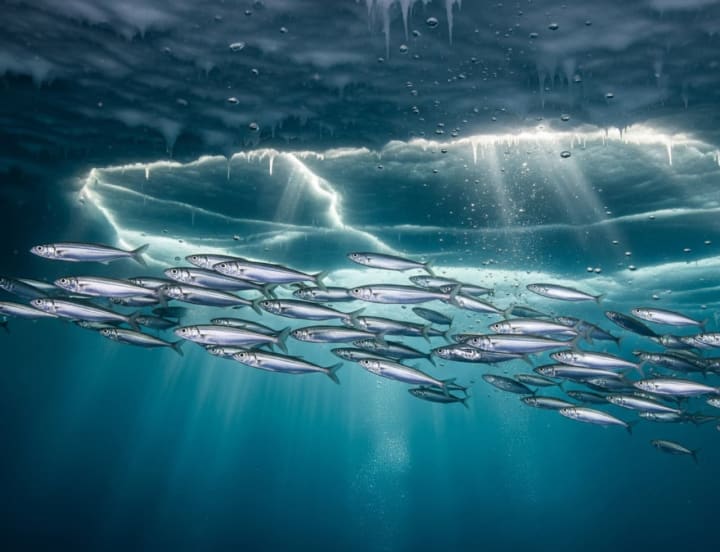
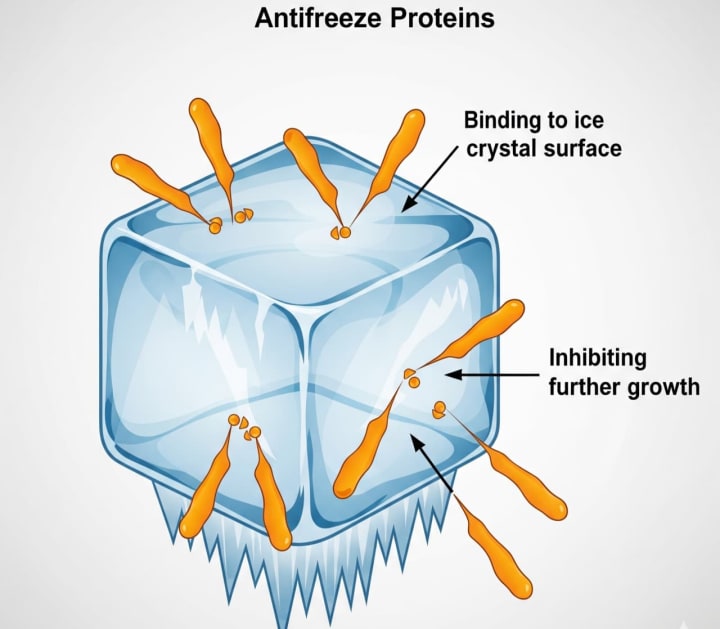
This story begins in the 1950s when Norwegian scientist Per Scholander wondered how Arctic fish could survive without freezing solid. A decade later, American biologist Arthur DeVries discovered the answer. He isolated special proteins from Antarctic fish, calling them antifreeze glycoproteins (AFGPs) because of their sugar-linked structure. His work showed that these proteins don’t melt ice, but instead lower the freezing point of fish blood, creating what scientists call thermal hysteresis. Simply put, AFPs act like shields that attach to tiny ice crystals and stop them from growing large enough to kill cells.
How Do They Work?
Unlike car antifreeze, these proteins don’t just dilute the blood. Instead, they attach directly to ice crystals. By binding to the surface of ice, they force it into curved, unstable shapes, making it harder for ice to grow. This means fish can cool their blood to -2.5°C, while the ocean around them is -1.9°C a narrow but life-saving margin. AFPs also stop small ice crystals from clumping into larger, deadly ones during temperature changes.
Types of Antifreeze Proteins
Not all AFPs are the same. Over time, fish in different parts of the world developed different versions:
Type I: Found in winter flounder and sculpin, shaped like a simple helix.
Type II: Rich in cysteine and globular, seen in smelt and herring.
Type III: Compact, with lots of beta-sheets, found in eelpouts.
Type IV: A four-helix bundle, seen in longhorn sculpins.
AFGPs: Found in Antarctic icefish and Arctic cod, these are the most powerful, lowering freezing points by up to 3.5°C.

Some Antarctic icefishes are so adapted to cold that they even lost hemoglobin, leaving them with almost clear blood. Without AFPs, they simply couldn’t survive.
Evolution’s Cold Lesson
One of the most fascinating things about AFPs is that they didn’t all come from a single ancestor. Instead, they evolved independently in different fish lineages about 30 million years ago, when polar oceans froze over. Antarctic notothenioids built their AFGPs from a digestive enzyme gene, while northern cod created theirs from noncoding DNA. It was truly a case of “adapt or die.” Even algae and insects have their own versions, but fish AFPs are some of the strongest known.
Why AFPs Matter to Us
These proteins aren’t just interesting they’re useful. Scientists and industries have already found ways to take advantage of them:
Agriculture: Adding AFPs to plants makes them more resistant to frost.
Aquaculture: Farmed fish survive better in cooler waters.
Medicine: AFPs improve cryopreservation, helping us store organs, blood, and even embryos for longer. They are also being tested in cryosurgery to freeze tumors without harming nearby healthy cells.
Food industry: Companies use AFPs to make smoother ice cream by stopping large ice crystals from forming.
Lessons From the Ice
Today, as climate change reshapes polar oceans, AFPs remind us of nature’s creativity under extreme pressure. In one of the harshest environments on Earth, fish didn’t just survive they evolved tiny molecular tools that science is now borrowing for human benefit. In the end, AFPs are more than just survival tricks. They are proof that life can invent remarkable solutions, even in places where it seems impossible to live. In the Antarctic’s frozen abyss, fish aren’t just enduring the cold they are thriving, thanks to evolution’s own antifreeze.
About the Creator
Muzamil khan
🔬✨ I simplify science & tech, turning complex ideas into engaging reads. 📚 Sometimes, I weave short stories that spark curiosity & imagination. 🚀💡 Facts meet creativity here!
Keep reading
More stories from Muzamil khan and writers in Education and other communities.
Deep-Sea Drilling Unveils the Mysteries of Mega-Earthquakes
In the depths of our oceans, where massive tectonic plates collide, Earth hides some of its most destructive secrets. These collisions can unleash mega-earthquakes and tsunamis that devastate coastlines and change lives forever. One tragic reminder came in 2011, when a magnitude 9.0 earthquake struck Japan’s Tōhoku region, triggering a massive tsunami that claimed over 18,000 lives.
By Muzamil khan7 months ago in Education
Foreclosure vs. Short Sale: 7 Key Differences Every Real Estate Pro MUST Know
You are driving through a target neighborhood and spot a classic "diamond in the rough." The lawn is overgrown, mail is spilling out of the box, and the shutters are hanging by a thread. To the untrained eye, it is just a neglected house. To a seasoned real estate professional, it is a potential high-margin opportunity.
By REI Data Solutions5 days ago in Education
Why Solar Gravity Bends Light: Gravitational Lensing, Einstein’s Theory of Relativity, and How the Sun Warps Space-Time
Introduction: When Light Does the Unexpected 🌌 Imagine staring at a distant star during a total solar eclipse. The Moon blocks the Sun’s bright glare, revealing stars that should not be visible in that exact position. Yet they appear slightly shifted—moved from where they “should” be.
By shahkar jalala day ago in Education
The First Rainbow Baby
Pitter-patter, pitter-patter. The rain fell in rhythmic splatters, slowly slowing, but still constant. Mira rolled onto her side pulling the blanket tight against her ears, but still she could hear chitter-chatter and scurrying feet of the creatures that refused to sleep in the lower decks.
By A. J. Schoenfeld2 days ago in Fiction


Comments
There are no comments for this story
Be the first to respond and start the conversation.