
The Invisible Assassin: Dengue's Deadly Grip on the World
Why a Single Mosquito Bite Could Turn Your Life Upside Down and How to Fight Back

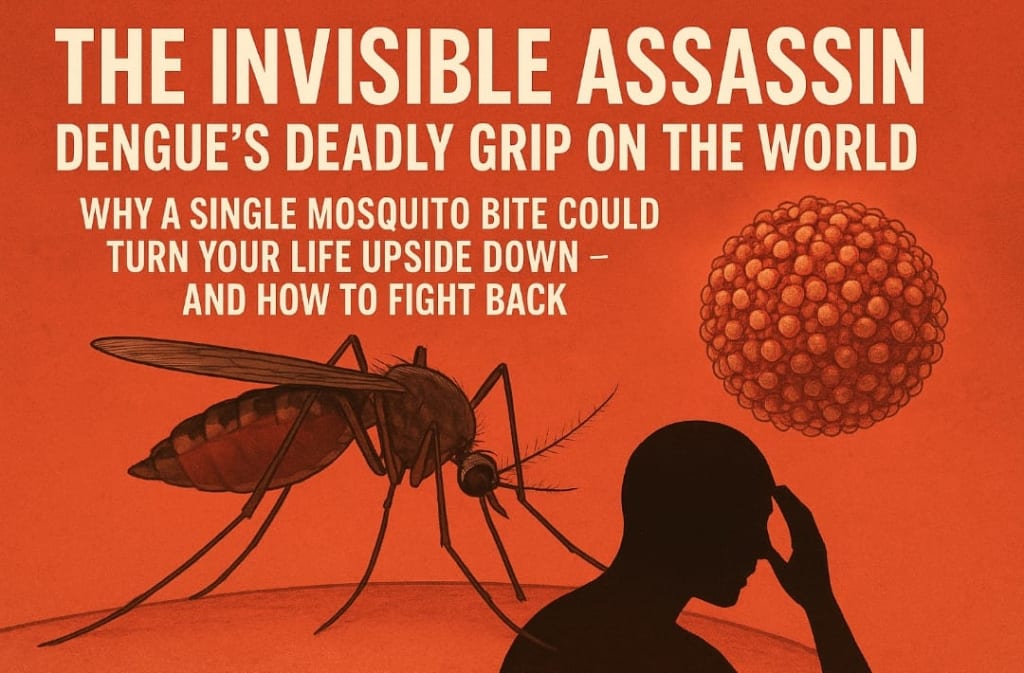
In the sticky heat of tropical cities, a tiny mosquito with striped legs becomes one of the deadliest creatures on Earth. It carries dengue fever a disease that has haunted humans for centuries. Many people think of it as just another flu-like illness, but dengue is far more dangerous. In the first half of 2025 alone, more than 3.6 million cases were reported, with nearly 2,000 deaths. And as climate change and rapid urban growth give mosquitoes more room to thrive, dengue is no longer limited to far-off villages. It’s spreading fast, knocking at the doors of cities worldwide.
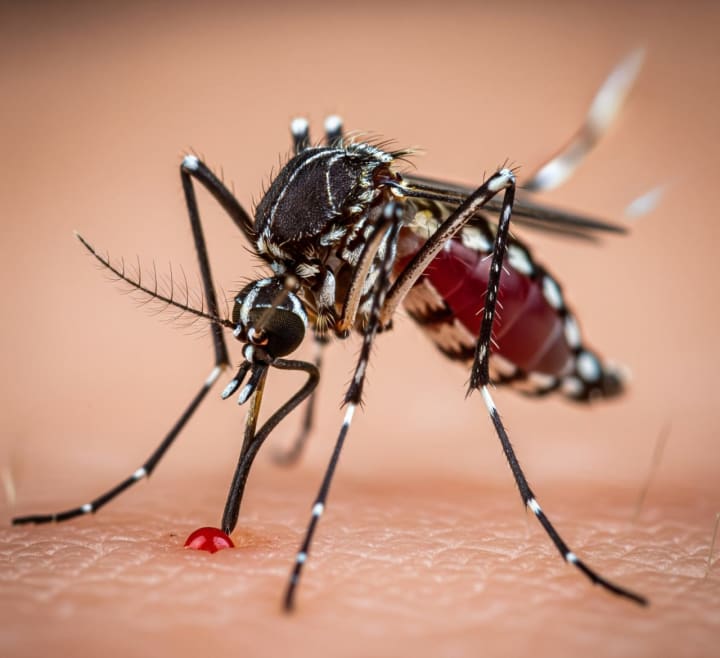
What makes dengue such a threat, and what can we do about it?
Dengue pronounced “DENG-gey,” is caused by a virus that spreads through the bite of the Aedes aegypti mosquito. Unlike the common night-biting mosquitoes, this one is most active during the day and loves city environments. There are four types of dengue viruses, known as DENV-1 to DENV-4. If you catch one, your body becomes immune to that type for life. But here’s the cruel part: if you’re later infected by a different type, your chances of developing severe dengue rise sharply because of a process called antibody-dependent enhancement. In simple terms, your own immune system can make things worse the second time around.
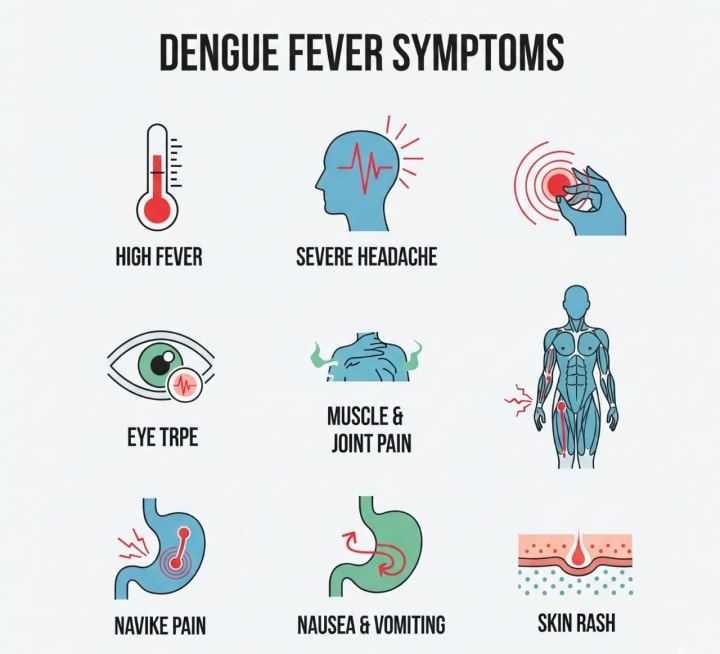
The illness starts suddenly. Within days of being bitten, people often develop a very high fever (up to 40°C), sharp headaches, pain behind the eyes, muscle and joint aches so intense the disease is nicknamed “breakbone fever,” along with nausea, vomiting, and a rash. For most, symptoms last a week before recovery. But in about 1 in 20 cases, dengue takes a dangerous turn. After the fever drops, some people develop severe abdominal pain, persistent vomiting, bleeding gums, or extreme tiredness. This stage, once called dengue hemorrhagic fever, can cause fluid leakage, organ failure, and even death if not treated quickly. Children and people with previous infections are especially at risk.
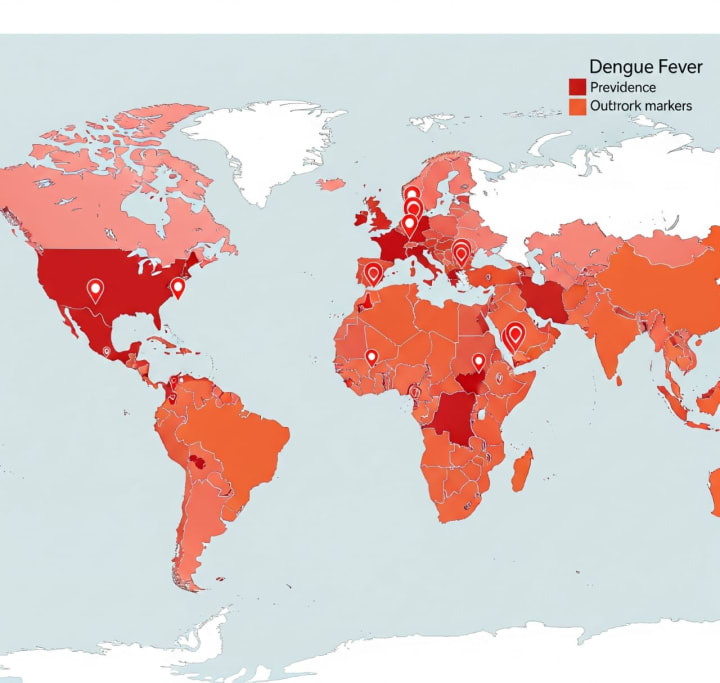
The spread of dengue depends entirely on mosquitoes. A female Aedes mosquito bites an infected person, picks up the virus, and then passes it to others when she feeds again. These mosquitoes don’t need much water to breed; even a bottle cap filled with rainwater is enough. That’s why outbreaks often explode in crowded urban neighborhoods with poor waste management. Traditionally, dengue was found in tropical areas like Southeast Asia, Latin America, and parts of Africa. But today, thanks to warmer climates and global travel, cases are appearing in Europe and the United States. In 2024, the world saw a record 14.1 million infections, and 2025 is set to rise even higher.
Fighting dengue starts with prevention. Communities must remove stagnant water from places like flowerpots, old tires, or open tanks. Spraying insecticides helps, but long-term success depends on keeping living spaces clean. On an individual level, wearing long sleeves, using mosquito repellents, and sleeping under nets provide protection. Vaccines like Dengvaxia exist, but they’re only recommended for people who have already had dengue once, because giving it to those who haven’t can make a future infection more dangerous. Exciting new methods, like releasing mosquitoes infected with a natural bacterium called Wolbachia, show promise since these mosquitoes can’t spread dengue at all.
There’s no specific cure for dengue yet. Treatment is supportive: rest, plenty of fluids, and paracetamol for pain (aspirin and ibuprofen are risky because they can increase bleeding). Severe cases require hospital care, where doctors monitor patients and provide IV fluids. The earlier severe symptoms are recognized, the better the chances of survival. The impact of dengue goes beyond health. Each year it costs billions in medical bills and lost work, hitting low-income countries the hardest. With climate change predicted to spread it even further, experts stress the need for better surveillance, stronger public health systems, and more research into vaccines and treatments.
Dengue may be small in size, carried by a mosquito no bigger than a fingernail, but its impact is massive. The best weapon we have is knowledge. By understanding how it spreads and taking steps to protect ourselves and our communities, we can slow its advance. Vigilance, awareness, and community action are what turn the tide against this invisible enemy.
About the Creator
Muzamil khan
🔬✨ I simplify science & tech, turning complex ideas into engaging reads. 📚 Sometimes, I weave short stories that spark curiosity & imagination. 🚀💡 Facts meet creativity here!
Keep reading
More stories from Muzamil khan and writers in Earth and other communities.
Do Smartphones Spy on You Even When Turned Off?
Privacy has become one of the biggest concerns of our time. With smartphones in our pockets every day, many people wonder if these devices could still be listening or tracking us even when powered off. It sounds like something straight out of a spy movie, but the question keeps coming up: do phones actually spy on you when they’re switched off?
By Muzamil khan5 months ago in Futurism
US Lawmakers Arrive in Copenhagen to Counter Trump’s Greenland Threats
In a high-stakes diplomatic maneuver, a delegation of U.S. lawmakers recently arrived in Copenhagen to discuss Greenland’s future, aiming to counteract the aggressive rhetoric and territorial ambitions expressed by former President Donald Trump. The visit comes amid rising concerns over Greenland’s strategic importance in the Arctic and the implications of any unilateral moves by the United States. For Denmark, Greenland’s autonomous territory, the presence of U.S. lawmakers underscores both Washington’s interest in Arctic security and the need to maintain strong transatlantic ties. For the United States, the visit signals a delicate recalibration of policy following Trump’s controversial proposals regarding Greenland, including his infamous attempt to buy the island outright during his presidency. Why Greenland Matters Geopolitically Greenland is more than a frozen expanse of ice; it is a geopolitical prize. Strategically located between North America and Europe, Greenland is key to: Arctic shipping routes that are becoming increasingly navigable due to melting ice Natural resources, including rare earth minerals, oil, and gas reserves Military and surveillance installations, notably the Thule Air Base, which is critical to U.S. missile warning systems and space surveillance The Arctic region is warming faster than any other part of the planet, making Greenland both a resource hub and a potential flashpoint for international competition. Trump’s proposals had alarmed Denmark and other NATO allies, raising questions about the United States’ long-term commitment to respecting international norms and allied sovereignty. The Lawmakers’ Mission The delegation, composed of senators and representatives from both political parties, is tasked with: Reassuring Denmark that the U.S. government respects Greenland’s autonomy Discussing security cooperation, particularly regarding Arctic defense and NATO commitments Exploring economic partnerships that benefit Greenland while maintaining regional stability Officials emphasize that this visit is not about reversing Trump’s statements retroactively, but about ensuring that future U.S. policy reflects diplomatic consensus rather than unilateral ambition. Denmark’s Response Denmark has maintained a firm stance on Greenland’s sovereignty, consistently stating that the island is not for sale. Danish leaders have welcomed the U.S. delegation as a positive step toward strengthening trust and clarifying intentions. Copenhagen also hopes to use the opportunity to reinforce cooperative approaches to Arctic security, particularly in light of growing Russian and Chinese interest in the region. For Denmark, maintaining strong relations with the United States — while safeguarding Greenland’s autonomy — is a balancing act that requires careful diplomacy. Greenland’s Perspective Greenlanders themselves are increasingly vocal in the debate over their future. Many support greater economic independence and political autonomy, and local leaders insist that Greenlanders should have the final say over any decisions affecting their land and resources. The U.S. delegation’s visit highlights the need to consult Greenlandic authorities directly, rather than negotiating solely with Denmark. This approach is seen as a step toward more inclusive, respectful diplomacy, which acknowledges Greenland’s status as more than just a strategic asset. The Role of NATO and Transatlantic Relations Trump’s proposals regarding Greenland strained transatlantic relations, raising concerns among NATO members about the reliability of U.S. commitments. The arrival of bipartisan lawmakers in Copenhagen aims to reaffirm NATO solidarity and demonstrate that U.S. policy is consistent with alliance obligations. By engaging Denmark directly, Congress seeks to prevent miscommunication and maintain stability in a region that is increasingly vital for global security. Analysts note that Greenland’s location provides the United States with a critical vantage point for Arctic monitoring and missile defense, making cooperative relations essential. Global Implications The Greenland issue has broader consequences for international geopolitics and Arctic governance. Key points include: Resource security: Greenland’s rare earth minerals are essential for electronics, renewable energy, and defense technologies, making control and access highly strategic. Climate change and navigation: Melting ice is opening new shipping lanes, which could shift global trade patterns and increase competition for influence. Power dynamics in the Arctic: Russia and China have also shown growing interest in the Arctic, prompting the United States and Europe to strengthen alliances and prevent unilateral exploitation. The lawmakers’ visit signals to the international community that the U.S. is committed to diplomatic solutions rather than transactional or coercive strategies. Challenges Ahead Despite the visit’s diplomatic intent, challenges remain: Political polarization in the U.S.: Future administrations may have different approaches to Greenland, raising uncertainty about long-term commitments. Geopolitical competition: Russia and China continue to advance their presence in the Arctic, complicating cooperative efforts. Local autonomy: Greenlandic voices must be prioritized, or any policy may face resistance at the local level. Successfully navigating these challenges will require transparent dialogue, careful planning, and sustained international cooperation. The Path Forward The visit of U.S. lawmakers to Copenhagen is a cautionary and corrective measure. It signals that while Greenland is strategically important, it is not a bargaining chip. Future cooperation will likely focus on: Strengthening Arctic security frameworks Promoting economic development for Greenlanders Maintaining stability in U.S.-European relations Ensuring that Greenlandic voices remain central to decision-making This proactive approach reflects a broader understanding that diplomacy, not unilateral action, is essential in regions of high strategic value. Final Thoughts Greenland has moved from the margins of global attention to the forefront of geopolitical strategy and climate concern. The arrival of U.S. lawmakers in Copenhagen underscores the importance of measured, inclusive diplomacy in the Arctic, contrasting sharply with the impulsive rhetoric that characterized Trump’s Greenland proposals. As nations navigate the Arctic’s emerging opportunities and challenges, Greenland’s sovereignty and the voices of its people will remain central to regional stability, global security, and international cooperation. The lawmakers’ visit represents a step toward rebuilding trust, reinforcing alliances, and charting a sustainable path forward for one of the planet’s most strategically vital territories.
By Muhammad Hassanabout 18 hours ago in Earth



Comments
There are no comments for this story
Be the first to respond and start the conversation.