A História
Bio
"Hi. My name is Wellington and I'm a passion for general history. Here, I publish articles on different periods and themes in history, from prehistory to the present day.
Stories (165)
Filter by community
Yasuke
Yasuke's beginnings are shrouded in mystery, yet historical accounts indicate that he arrived in Japan in 1579 with the Italian Jesuit missionary Alessandro Valignano. This was a tumultuous time in Japan, known as the Sengoku or "Warring States" period, characterized by fierce battles among powerful landowners, or daimyōs, who were competing for dominance and shaping the nation's political future. Valignano aimed to spread Christianity throughout East Asia, but it was Yasuke's striking height—reportedly around 1.90 meters (6'2")—that captivated many, including the prominent daimyō Oda Nobunaga, as he was one of the few Black men they had ever encountered.
By A Históriaabout a year ago in History
Who Were the Aryans?
Embark on an exploration of the historical narrative surrounding the Aryans, an ancient linguistic community that has significantly influenced civilization, spanning from the Central Asian steppes to contemporary regions. This article aims to investigate the origins, migrations, and cultural contributions of the Aryans, while also addressing the ancient history and the misconceptions that have obscured their legacy throughout the ages.
By A Históriaabout a year ago in History
The Titanomachy
In Greek mythology, the Titans are frequently portrayed as colossal and formidable entities that embody the elemental forces of nature. They emerged from the union of Uranus, the personification of the sky, and Gaia, the embodiment of the earth, symbolizing fundamental powers and the vast unpredictability of the natural world. Among their progeny were various deities, some of whom would ultimately rebel against their forebears and contest the Titans' supremacy in a renowned conflict known as the Titanomachy, or the War of the Titans.
By A Históriaabout a year ago in History
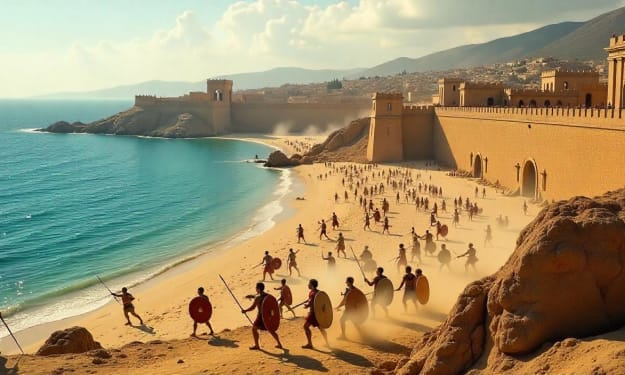
The Epic of the Trojan War
Over centuries, nations have risen and fallen, leaving their mark on history through stories and legends. Among these tales, the Trojan War stands out as a timeless narrative blending heroism, divine intervention, and human tragedy. The story, immortalized in Homer’s Iliad, captures the essence of ancient Greek beliefs and values, exploring the motives, battles, and heroes involved in a war that may be as much myth as reality. The primary source of knowledge about the Trojan War is Homer’s Iliad, written in the 8th century BCE, which recounts the final 52 days of a conflict lasting ten years. The term Iliad derives from Ilion, the ancient name for Troy. Although Homer’s account is our most detailed source, the tale of Troy was preserved through a rich oral tradition and other epic poems that preceded his work.
By A Históriaabout a year ago in History
Yemanjá
Yemanjá, also known as Iemanjá in Brazil, is a prominent figure in Afro-Brazilian religions and cultural expressions, recognized as the powerful and nurturing goddess of the sea. Revered in Candomblé and Umbanda, Yemanjá is known as the "Queen of the Ocean," embodying themes of motherhood, protection, and transformation. Her influence extends far beyond religious boundaries, touching Brazilian art, music, and annual celebrations that draw millions of devotees and tourists alike. In this article, we explore Yemanjá's origins, her symbolic role in Brazilian culture, and how her annual festival continues to inspire a sense of connection and renewal. Yemanjá originates from the Yoruba religion of West Africa, where she was venerated as one of the Orishas, powerful deities connected to nature. In the Yoruba tradition, Yemanjá is associated with rivers and motherhood, symbolizing fertility, nurturing, and emotional depth. The transatlantic slave trade, however, brought Yoruba practitioners to Brazil, where they adapted their religious practices in the face of colonial oppression. Over time, the worship of Yemanjá blended with local indigenous beliefs and elements of Catholicism, leading to the vibrant, syncretic Afro-Brazilian religious traditions we see today.
By A Históriaabout a year ago in History
Exploring the Brazilian Folklore
In the vibrant landscape of Brazilian folklore, a multitude of captivating and unsettling characters exists. The Cuca, in particular, emerges as one of the most compelling and formidable figures. Renowned for her terrifying aura and association with childhood anxieties, the Cuca has established herself as a prominent element in Brazilian cultural narratives, evoking feelings of fear, reverence, and intrigue. This article will explore the origins, characteristics, and cultural importance of the Cuca, examining the reasons behind her enduring influence in Brazilian folklore. The Cuca is a mythical entity frequently portrayed as a witch or a terrifying old woman. In various narratives, she is described as a woman with reptilian characteristics or is envisioned as a creature resembling a crocodile, possessing the power to transform. Unlike numerous other folkloric beings tied to specific locations or items, the Cuca is predominantly feared for her tendency to abduct misbehaving children or those who remain awake too late. Similar to the Bogeyman in Western folklore, the Cuca serves as a daunting figure employed by parents to discipline their children. The origins of Cuca are deeply intertwined with a fusion of Brazilian indigenous, African, and Portuguese legends. Some interpretations suggest that her character may be linked to the ancient Portuguese tale of Coca, a dragon or monster symbolizing evil, which was vanquished by St. George in medieval narratives. Over time, this figure evolved, becoming an integral part of Brazilian folklore, uniquely adapted to the nation's cultural landscape.
By A Históriaabout a year ago in Horror
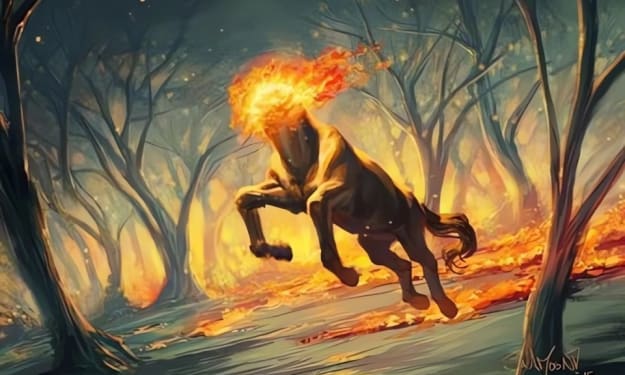
The Headless Mule
In the rich landscape of Brazilian folklore, the tale of the "Headless Mule," known as Mula sem Cabeça in Portuguese, remains a source of intrigue for audiences of all ages. This mythical being, which roams the rural areas of Brazil with its blazing breath and resounding hooves, embodies both fascination and fear. Let us explore the origins, symbolism, and cultural significance of this remarkable supernatural narrative. The story of the Headless Mule has its origins in Brazil's colonial era, with roots that stretch back several centuries. It is believed to be a blend of Indigenous folklore and European traditions introduced by Portuguese colonizers and African slaves. Many think that this legend was created to deter immoral conduct, particularly within the Catholic-centric society of colonial Brazil.
By A Históriaabout a year ago in Horror
Curupira
Brazilian folklore is abundant with mythical characters that reflect the vibrant and enigmatic qualities of the nation’s diverse ecosystems. One such figure is the Curupira, an intriguing protector of the forests who represents the ideals of safeguarding, honoring, and valuing nature. Characterized by his striking red hair and feet that point in reverse, the Curupira is both elusive and formidable, instilling fear in those who seek to damage the environment. However, who is this mysterious entity, and what significance does he hold within Brazilian folklore? In Brazilian mythology, the Curupira is a supernatural entity responsible for safeguarding the forest and its creatures. Unlike many other mythical beings, the Curupira actively protects the environment, employing tricks and illusions to mislead hunters and loggers who violate the natural order. He is typically portrayed as a small, child-like figure with striking red hair, symbolizing his untamed spirit and deep connection to the earth.
By A Históriaabout a year ago in History
The Enchanting Iara of Brazilian Folklore
In the rich landscape of Brazilian folklore, the figure of Iara stands out with her enchanting presence and poignant backstory. Frequently depicted as a captivating mermaid inhabiting the Amazonian rivers, Iara (also known as Uiara) is an intriguing character in Brazilian mythology, with narratives that have been shared through the ages. Her tale intertwines themes of allure, peril, and enigma, creating a profound impact on Brazilian cultural heritage and oral storytelling. Iara is an enchanting water nymph, often illustrated as a mermaid with flowing dark hair, olive-toned skin, and striking green eyes. Her captivating beauty is said to enthrall anyone who crosses her path, leading many to speculate that she possesses otherworldly abilities. Typically, she is depicted sitting by riverbanks, delicately combing her hair and singing mesmerizing songs that draw in those who listen.
By A Históriaabout a year ago in History
Alamoa
The Alamoa, a haunting figure in Brazilian folklore, embodies an enigmatic blend of mystery and sorrow. Celebrated for her ethereal beauty, the legend of Alamoa originates from Fernando de Noronha, a secluded island located off Brazil's northeastern shore. Enveloped in myth, she serves as both a chilling cautionary tale and a reflection of Brazil's rich cultural heritage, intertwining indigenous, African, and European elements into a captivating narrative. The legend of the Alamoa is rooted in the stunning yet remote island of Fernando de Noronha, which historically served as a prison colony due to its seclusion. The island's breathtaking landscapes, characterized by rugged cliffs and azure waters, have naturally inspired numerous ghostly tales. In Portuguese, "Alamoa" can be interpreted as "the white lady" or "foreign woman," though her backstory is more complex. According to folklore, the Alamoa manifests as an enchanting woman clad in white, with skin as pale as ivory and long, cascading hair.
By A Históriaabout a year ago in Horror
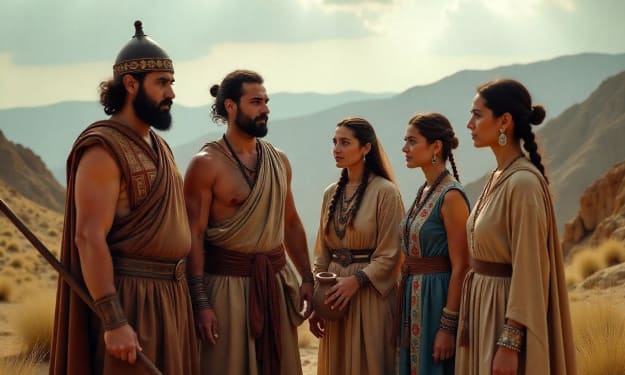
The Mysterious Heritage of the Anasazi
Throughout the course of human history, societies have typically flourished in regions characterized by plentiful water, food resources, and natural defenses. However, certain groups have demonstrated remarkable success in environments that would be deemed nearly uninhabitable by contemporary standards. One notable example is the Anasazi, also known as the Ancestral Puebloans, a Native American culture that thrived over a millennium ago in the arid terrains of the American Southwest. Through remarkable ingenuity, the Anasazi constructed stone and adobe settlements on cliff faces and plateaus, establishing an architectural and cultural heritage that continues to captivate historians and archaeologists to this day.
By A Históriaabout a year ago in History
Pelagius of Asturias
The narrative of Spain is characterized by extraordinary accounts of perseverance, leadership, and endurance. Among its initial heroes was Pelagius of Asturias, referred to as Pelayo in Spanish. Despite his humble origins, he rose to prominence as a revered king and emblem of defiance against the Moorish invasion of the Iberian Peninsula. The significance of Pelagius' tale lies in its initiation of the lengthy Reconquista, a Christian effort to reclaim territories governed by Muslim authority.
By A Históriaabout a year ago in History