
The Mysterious Heritage of the Anasazi
Architects of the Southwestern United States.

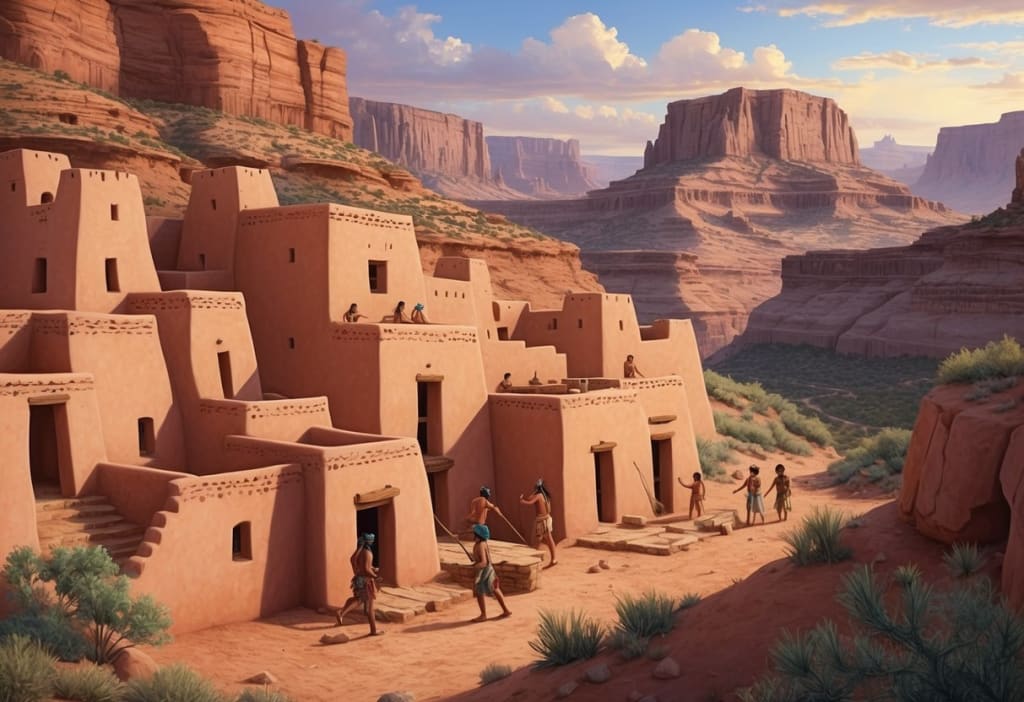
Throughout the course of human history, societies have typically flourished in regions characterized by plentiful water, food resources, and natural defenses. However, certain groups have demonstrated remarkable success in environments that would be deemed nearly uninhabitable by contemporary standards. One notable example is the Anasazi, also known as the Ancestral Puebloans, a Native American culture that thrived over a millennium ago in the arid terrains of the American Southwest. Through remarkable ingenuity, the Anasazi constructed stone and adobe settlements on cliff faces and plateaus, establishing an architectural and cultural heritage that continues to captivate historians and archaeologists to this day.
The Anasazi, an ancient civilization that predates numerous indigenous cultures in North America, are thought to have descended from early hunter-gatherer groups such as the Oshara Tradition, which occupied the southwestern United States approximately 6,000 years ago. Gradually, these initial populations transitioned from a nomadic existence to established agricultural communities. This significant shift was crucial for the development of Anasazi culture, facilitating the construction of permanent dwellings and, ultimately, intricate settlements.
Beginning around 500 BCE, the Anasazi culture underwent various developmental phases, initiating with the Basketmaker period. By the time of the Pueblo I period (circa 700–900 CE), the Anasazi had started to build small, isolated homes where they cultivated essential crops such as corn, beans, and squash. Additionally, they participated in textile production, weaving cotton and other fibers for everyday use. This agricultural foundation was instrumental in the evolution of their society, which became increasingly complex in the subsequent centuries.
One of the most notable features of Anasazi culture was their architectural prowess. The Anasazi exhibited exceptional building skills, adapting to the difficult terrain of the Southwest by creating remarkable cliff dwellings in locations such as Mesa Verde in present-day Colorado and Chaco Canyon in New Mexico. These edifices functioned as residences, communal areas, and even as defensive strongholds.
At the peak of their civilization during the Pueblo II period (900–1100 CE), the Anasazi erected extensive, multi-room structures embedded within the cliffs, which could only be accessed via narrow staircases or ropes. This degree of architectural sophistication, along with a comprehensive network of roads linking numerous communities, illustrated not only their expertise in construction techniques but also their grasp of urban planning and defensive strategies.
The Anasazi civilization exhibited a profound richness in cultural and spiritual practices, many of which continue to be upheld by contemporary Pueblo tribes such as the Hopi and Zuni. Renowned for their craftsmanship, the Anasazi produced exquisite pottery, textiles, and elaborate jewelry utilizing materials such as turquoise, shell, and copper. Their artistic legacy is further exemplified by their rock art, which includes petroglyphs and pictograms that frequently illustrate celestial phenomena, fauna, and human figures, underscoring their intimate relationship with the natural environment.
Spirituality was integral to Anasazi existence, with kivas—subterranean ceremonial chambers—serving as focal points for religious activities. These circular edifices facilitated community gatherings, spiritual rituals, and astronomical studies. Notable sites like Pueblo Bonito in Chaco Canyon reveal their sophisticated understanding of astronomy, as the architectural alignments enabled accurate solar observations, which were essential for determining agricultural cycles vital for their sustenance.
By approximately 1300 CE, the Anasazi commenced the abandonment of their cliffside habitations, relocating to new regions within the Rio Grande Valley and certain areas of Arizona. This movement, frequently characterized as an "exodus," is believed to have been influenced by a variety of factors. A significant drought, referred to as the Great Drought, which occurred from 1276 to 1299, likely disrupted their agricultural practices and depleted essential resources. This environmental challenge, in conjunction with potential conflicts with neighboring tribes such as the Navajo and Apache, may have compelled them to search for more fertile and defensible territories.
Additionally, there are compelling spiritual interpretations regarding their migration. Oral traditions among the Pueblo peoples indicate that supernatural elements, associated with the misuse of spiritual authority, could have contributed to their departure. While these notions remain largely speculative, they underscore the Anasazi's deep-rooted connection to their surroundings and the spiritual forces they believed influenced their existence. Although the Anasazi seem to have “disappeared” from their initial settlements, their descendants, known as the Pueblo peoples, continue to uphold numerous traditions, languages, and agricultural methods that originated with the Anasazi. Tribes such as the Hopi, Zuni, and Keres can trace their ancestry back to particular Anasazi groups and consider themselves the inheritors of the Anasazi heritage. The building methods, pottery designs, and cultural principles of the ancient Anasazi are intricately woven into Pueblo culture, serving as a connection between historical and contemporary practices.
The narrative of the Anasazi offers significant insights into resilience, adaptability, and sustainable coexistence with the environment. Analyzing their accomplishments and difficulties allows us to understand how ancient civilizations responded to extreme environmental conditions, created advanced agricultural and architectural innovations, and upheld intricate social systems. In a time when climate change and resource management pose critical challenges globally, the legacy of the Anasazi serves as a testament to the creativity and flexibility that characterize human societies.
The heritage of the Anasazi persists through contemporary Pueblo tribes, whose lifestyles continue to embody the principles, wisdom, and spiritual beliefs of their forebears. Investigating the history of the Anasazi is not merely an exploration of the past; it is also a tribute to human resilience and a reminder of the profound connections that exist between communities and the landscapes they inhabit.
About the Creator
A História
"Hi. My name is Wellington and I'm a passion for general history. Here, I publish articles on different periods and themes in history, from prehistory to the present day.
Keep reading
More stories from A História and writers in History and other communities.
Pelagius of Asturias
The narrative of Spain is characterized by extraordinary accounts of perseverance, leadership, and endurance. Among its initial heroes was Pelagius of Asturias, referred to as Pelayo in Spanish. Despite his humble origins, he rose to prominence as a revered king and emblem of defiance against the Moorish invasion of the Iberian Peninsula. The significance of Pelagius' tale lies in its initiation of the lengthy Reconquista, a Christian effort to reclaim territories governed by Muslim authority.
By A Históriaabout a year ago in History
The Great Gold Coin Heist: $4 Million Treasure Stolen from German Museum
In one of the most astonishing museum thefts in recent history, a massive gold coin valued at nearly $4 million was stolen from a museum in Germany. The dramatic robbery captured international attention due to the coin’s enormous size, historical importance, and the audacity of the criminals who managed to escape with such a valuable artifact.
By Irshad Abbasi 5 days ago in History
The Forsyth House Fire
Since 1851, Forsyth House has stood on the corner of Union Street and Gordon Street in the heart of Glasgow. Its iconic, or was... because on Sunday 8th of March, 2026, a fire broke out in a small, seemingly un-named shop in the building and tore all that history down. As I write, the rubble is still unsettled and the street is still blocked off. Central Station is quiet on the upper level, and around 30 small businesses have quite literally gone up in smoke.
By S. A. Crawford3 days ago in The Swamp


Comments
There are no comments for this story
Be the first to respond and start the conversation.