
The Titanomachy
The Epic Clash Between Titans and Olympians in Greek Mythology

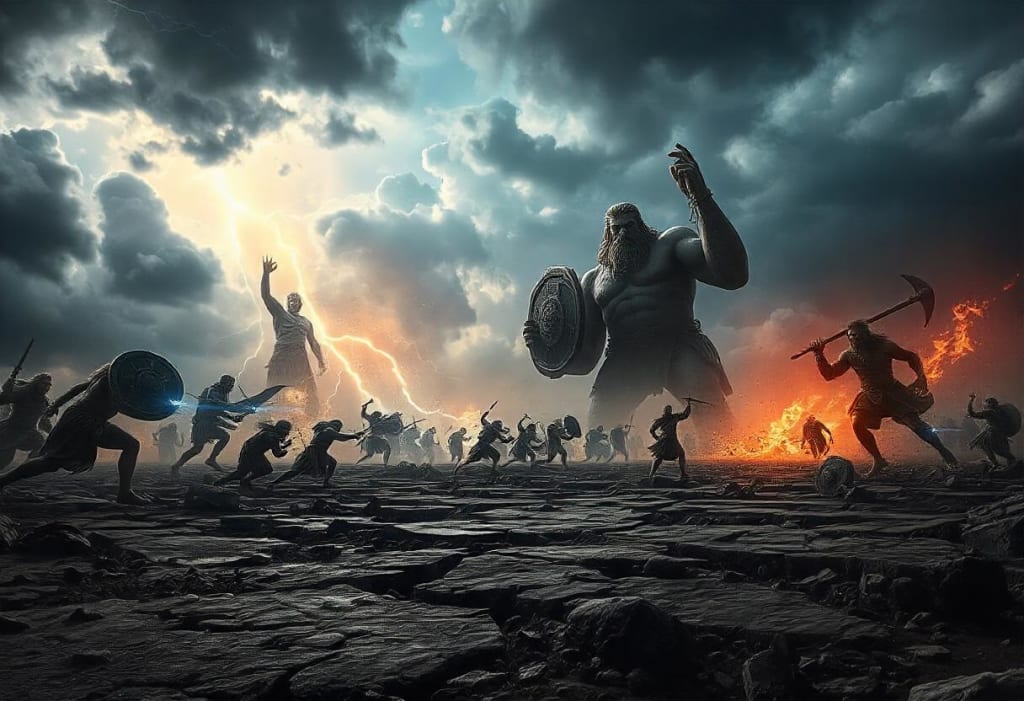
In Greek mythology, the Titans are frequently portrayed as colossal and formidable entities that embody the elemental forces of nature. They emerged from the union of Uranus, the personification of the sky, and Gaia, the embodiment of the earth, symbolizing fundamental powers and the vast unpredictability of the natural world. Among their progeny were various deities, some of whom would ultimately rebel against their forebears and contest the Titans' supremacy in a renowned conflict known as the Titanomachy, or the War of the Titans.
The ancient mythology narrates that Uranus and Gaia were the progenitors of twelve offspring, comprising six males and six females, who would later be recognized as the first Titans. However, Uranus, fearing that one of his children might usurp his power, confined them within Gaia, inflicting great anguish upon her. In response to this torment, Gaia fashioned a scythe and implored her youngest son, Cronus, the Titan associated with time, to use it. In a decisive confrontation, Cronus ambushed Uranus and castrated him. The blood that spilled from Uranus gave rise to seas, mountains, and new deities, thereby enhancing the mythological landscape.
Following this event, Cronus ascended to the leadership of the Titans, governing the cosmos alongside his sister and consort, Rhea, the Titaness symbolizing motherhood. Nevertheless, as foretold by Gaia, Cronus was destined to be overthrown by one of his own offspring. In a bid to avert this prophecy, Cronus consumed each of his children immediately after their birth. However, Rhea, heartbroken by the loss of her progeny, devised a plan to rescue her youngest child, Zeus. She concealed Zeus on the island of Crete and deceived Cronus by presenting him with a stone wrapped in swaddling clothes, which he ingested without suspicion.
Zeus was raised in secrecy and, upon reaching adulthood, aimed to rescue his siblings and dethrone his despotic father. With the assistance of Metis, the most astute of both mortals and deities, he formulated a strategy. Metis provided him with a potion designed to compel Cronus to regurgitate his offspring. Disguised as a servant, Zeus gained access to Cronus’ court and administered the potion, liberating his siblings—Hades, Poseidon, Hestia, Hera, and Demeter—who emerged fully matured and prepared for battle.
This event initiated the Titanomachy, a monumental conflict that set the Olympians, under Zeus's leadership, against the Titans, commanded by Cronus. The Olympians symbolized more human-like and idealized aspects of civilization, while the Titans represented the primal, unrefined forces of nature.
Despite their youth and relative inexperience, the Olympians secured significant backing. The goddess Styx, along with her offspring, including Nike (Victory) and Kratos (Power), allied with them. Additionally, two nephews of Cronus, Prometheus and Epimetheus, chose to support Zeus, as did Nyx, the goddess of night.
Recognizing the necessity for enhanced strength, Zeus descended into Tartarus, the most profound region of the underworld, where the Cyclopes and Hecatoncheires had been confined by Gaia and Uranus. Upon their liberation, these formidable entities—one-eyed giants and multi-armed titans—swore allegiance to Zeus, equipping the Olympians with formidable armaments: Zeus received the thunderbolt, Poseidon was granted a trident to command the oceans, and Hades was bestowed with the Helm of Darkness, which conferred invisibility.
As the Olympians equipped themselves with newfound weapons, the conflict escalated into a series of intense confrontations characterized by fluctuating fortunes. Poseidon summoned immense waves to crash upon the adversaries, while Hades employed his Helm of Darkness to covertly sabotage the Titans. Concurrently, Zeus unleashed his thunderbolts, wreaking havoc among the Titan ranks. Atlas, a formidable Titan and military commander, stood firm in his defense of Cronus; however, even his considerable power could not endure the united force of the Olympians and their allies.
The pivotal moment of the battle occurred when Zeus faced Cronus in direct combat. The poet Nonnus of Panopolis recounts that Cronus hurled icy missiles in an effort to envelop Zeus in a blizzard. In response, Zeus unleashed a devastating thunderbolt, which melted the ice and fulfilled Gaia's prophecy by toppling Cronus.
Following the defeat of Cronus, the remaining Titans were sentenced to Tartarus, where they would be monitored by the Hecatoncheires. As a consequence of his involvement in the conflict, Atlas was assigned the eternal burden of supporting the heavens. Meanwhile, Zeus, Poseidon, and Hades partitioned the cosmos through a process of drawing lots. Zeus secured dominion over the skies, Poseidon took control of the seas, and Hades was granted authority over the underworld.
In this manner, the Olympians achieved victory, thereby reinforcing their dominion and inaugurating a new epoch of divine governance. Their ascendancy signified the conclusion of the primordial chaos embodied by the Titans, paving the way for a framework of law, rationality, and the emergence of a mythological universe that mirrored more anthropocentric ideals.
The legacy of the Titans, despite the conclusion of their era, persisted in the annals of Greek mythology. The narrative of the Titanomachy serves not only to elucidate the origins of the Olympian deities but also to represent the victory of order over chaos. Esteemed Greek poets such as Hesiod and Homer captured this epic conflict, each employing their unique stylistic approaches, thereby crafting a complex and nuanced understanding of this ancient cosmic battle. The triumph of the Olympians solidified their status as the dominant forces within Greek mythology, establishing a new pantheon that would govern human civilization for many generations.
About the Creator
A História
"Hi. My name is Wellington and I'm a passion for general history. Here, I publish articles on different periods and themes in history, from prehistory to the present day.
Keep reading
More stories from A História and writers in History and other communities.
The Epic of the Trojan War
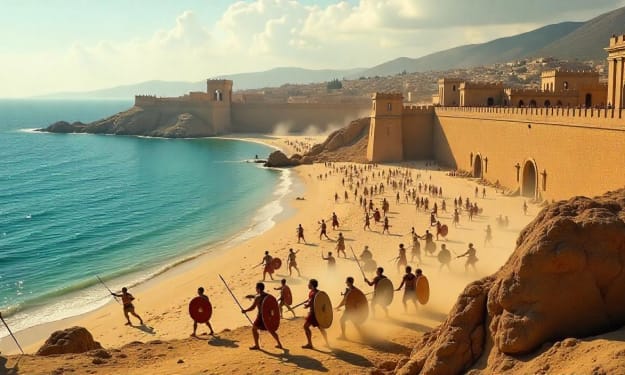
Over centuries, nations have risen and fallen, leaving their mark on history through stories and legends. Among these tales, the Trojan War stands out as a timeless narrative blending heroism, divine intervention, and human tragedy. The story, immortalized in Homer’s Iliad, captures the essence of ancient Greek beliefs and values, exploring the motives, battles, and heroes involved in a war that may be as much myth as reality. The primary source of knowledge about the Trojan War is Homer’s Iliad, written in the 8th century BCE, which recounts the final 52 days of a conflict lasting ten years. The term Iliad derives from Ilion, the ancient name for Troy. Although Homer’s account is our most detailed source, the tale of Troy was preserved through a rich oral tradition and other epic poems that preceded his work.
By A Históriaabout a year ago in History


Comments
There are no comments for this story
Be the first to respond and start the conversation.