
The Last Days of Bahadur Shah Zafar: The Forgotten Tragedy of the Last Mughal Emperor
Exiled, humiliated, and buried in silence—how the mighty ruler of Delhi spent his final days in a foreign land with no grave in his own homeland.
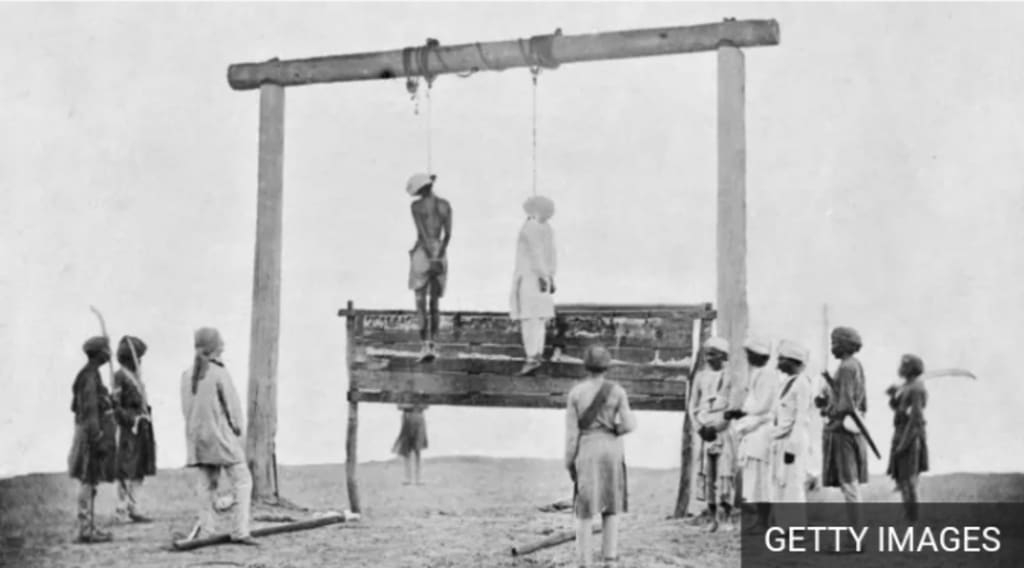
The 1857 'War of Independence': When Delhi Witnessed Death Dancing
"I am neither the light of anyone’s eye, nor the solace of anyone’s heart,
I am but a handful of dust, of no use to anyone."
In today’s world, it is unimaginable for a common person to believe that the poet of these melancholic verses, the last Mughal Emperor Bahadur Shah Zafar, had once led the Indians in the first war of independence against the British in 1857.
It was Monday, May 11, 1857, corresponding to 16th of Ramadan.
At around 7 in the morning, Bahadur Shah Zafar was offering the Ishraq prayer in the portrait gallery near the river at the Red Fort. At that moment, he noticed smoke rising from the Toll House across the Yamuna River. Alarmed, he immediately sent his messenger to investigate and summoned his Prime Minister, Hakim Ahsanullah Khan, and Captain Douglas, who was in charge of the fort’s security.
The messenger returned with troubling news: some Indian cavalrymen, dressed in British military uniforms and wielding naked swords, had crossed the bridge over the Yamuna. They looted and set fire to the toll house on the eastern bank.
Upon hearing this, the Emperor ordered the gates of both the city and the fort to be shut.
Rebels Seek Royal Blessing
By 4 PM that day, the leader of the rebels sent a message requesting a meeting with the Emperor. The rebels assembled in the Diwan-e-Khas (Hall of Private Audience) and fired shots into the air with their guns and pistols.
A prominent nobleman of Delhi, Abdul Latif, wrote in his diary on that day:
"The Emperor was like a king in a game of chess after being put in check – powerless and trapped."
After a long silence, Bahadur Shah Zafar spoke, saying,
"Why is an old man like me being insulted in such a manner? What is the reason for this uproar? The sun of my life has already reached its dusk. These are the final days of my life. All I wish for now is solitude."
Later, in his book "Two Nations: A Narrative", Charles Metcalfe wrote:
"Hakim Ahsanullah Khan told the soldiers: ‘You have worked for the British and are used to regular pay. The Emperor has no treasury – how will he pay you?’"
To this, the soldiers replied:
"We will bring the wealth of the entire country to your treasury."
Zafar responded,
"I have no army, no weapons, and no money."
The soldiers answered,
"We need only your support. We will bring everything else ourselves."
Charles notes:
"For a moment, Bahadur Shah Zafar remained silent. His inability to make swift decisions was his greatest flaw. But that day, he did not hesitate. He agreed."
He sat on a chair as the soldiers, one by one, bowed before him, and he laid his hand on their heads in acknowledgment. The rebels occupied various rooms in the fort, with some even setting up their bedding in the Diwan-e-Aam (Hall of Public Audience).
The Silver Throne and New Coins
The Emperor, unable to manage or control such a large army, found himself under their control instead.
The next day, he donned his royal attire and ascended the silver throne. Coins were minted in his name, and a great cannon blast was heard in celebration.
Why and How the Revolt Began
The entire episode had started on May 10, 1857, in Meerut, when sepoys of the Bengal Lancers mutinied and marched toward Delhi.
Renowned historian Rana Safvi, an expert on the events of 1857, explains:
"New rifles had been introduced, and the cartridges had to be bitten open with the mouth. Rumors spread that the grease used in these cartridges was derived from cow and pig fat – offensive to both Hindus and Muslims. Muslims were reluctant due to pigs, and Hindus due to cows."
She further elaborates:
"There were other grievances as well – they were being sent to fight overseas, which, for Brahmins, meant loss of caste. Their promotions were also limited – Indian soldiers could not rise beyond the rank of Subedar. These frustrations simmered over time."
Some called it a mutiny, others called it the First War of Independence.
The People of Delhi Did Not Welcome the Rebels
Initially, the people of Delhi did not warmly receive the rebels. In fact, some circles – including those close to Bahadur Shah – opposed them.
It was said that the rebels disrespected the Emperor and disregarded court etiquette. The courtiers complained that they did not remove their shoes before entering the royal court and came armed before the Emperor.
Historian Mehboob Faruqi, author of "Besieged 1857: Voices of Delhi", explains:
"Yes, Delhi’s people were upset, but that doesn’t mean they didn’t want to fight the British. Everyone wanted to resist the British in their own way – but no one wanted forty armed men suddenly taking over their home."
"Even during later freedom movements with Gandhi or Bhagat Singh, there were millions who didn’t want trouble at their doorstep or police raids on their homes. The same logic applies to 1857."
Order Amidst Chaos
It is often said that the events of 1857 brought great upheaval to Delhi. However, Faruqi argues that despite the turmoil, order remained largely intact.
"People often claim there was chaos, no leadership, no structure. But in my book, I argue that this was not the case."
"Naturally, when 70–80,000 soldiers flood into a city of 150,000, there will be disruption. If, today, 3 million troops entered modern Delhi, imagine the state of the city."
"Still, what’s truly astonishing is that if the Commander-in-Chief told the police chief to arrest four soldiers for skipping duty – and those four were indeed caught, brought back, and apologized – that shows a certain discipline."
"If you needed 400 beds at the front lines and they were delivered – someone ordered them, someone fetched them, someone paid. That’s logistical order. Even today, wars require not just soldiers, but porters, laborers, water carriers – and back then, too, the same was true."
The British Were Killed
By the morning of May 12, Delhi had been completely emptied of British control. However, a few British women had taken shelter in rooms near the palace kitchen.
Despite the Emperor's opposition, the rebels killed them all.
Rana Safvi remarks:
"On the 11th and 12th, when the rebels attacked the British, many fled the city, while others were killed. Some women sought refuge in the fort . At that very place, out of enmity, they killed 56 people—most of them were women and children, although there were one or two men among them.
According to him, “When Bahadur Shah Zafar was tried, the biggest charge against him was that he had them killed. However, if you read Zahir Dehlvi’s book, it becomes clear from eyewitnesses present in the fort during the 1857 rebellion that the king had repeatedly said: ‘No religion allows the killing of innocent people.’”
When the British returned and began punishing the rebels, their grip started weakening, and the Englishmen who had fled Delhi began to return. Troops from Ambala turned the tide, and the British once again entered Delhi.
“He was sitting. His long white beard reached down to his stomach. He was dressed in white clothes and wore a white turban. Behind him stood two orderlies, fanning him with fans made from peacock feathers. He didn’t utter a single word, his eyes fixed on the ground.”
According to him, “Just three feet away from the king, on another cot, sat a British officer. On both sides stood British sentries with bayonets, ordered to kill him immediately if anyone tried to rescue the king.”
Bahadur Shah Zafar was humiliated to such an extent that crowds of British people came just to see what a Mughal emperor looked like.
Historian Mahmood Farooqui says, “After his arrest, Bahadur Shah Zafar was kept in a cell in the Red Fort. British tourists would come and, just like people visit the Red Fort today, they would go to his cell to see him—this is Bahadur Shah Zafar.”
“For a man, for a king of India, to be in such a condition in Delhi—it's obvious that he spent the rest of his years in yearning for death. From there, he was sent to Rangoon, and around the same time, the king of Rangoon was brought to Maharashtra.”
“Such was the British rule across the world that kings were being traded from one place to another. Bahadur Shah’s final days were tragic and painful. It was in this situation that he said:
‘How unfortunate is Zafar, for burial
Not even two yards of land were found in the land of his beloved.’”
“What more could have happened to him? In my opinion, everything had already happened to him during and after 1857. What could be worse than keeping a Timurid successor, the emperor of India, locked in a cell, while British women and children came to gawk at him and say: ‘Oh, so this was Bahadur Shah!’”
The king died on November 7, 1862, in a prison-like house in Rangoon. Some British soldiers carried the body of the 87-year-old man to a grave dug within the premises. His funeral included only two sons and a cleric. No women were allowed to attend.
When some people in the market heard whispers of this, they tried to join the funeral, but armed soldiers did not allow them to come close.
Before burial, soldiers poured lime into the grave so the body would decompose quickly and mix with the soil.
A week later, British Commissioner H.N. Davies wrote in a report sent to London: “Afterward, I visited the residence of the remaining royal prisoners. All were fine, and none seemed affected by the old man’s death. He died due to paralysis of the throat.”
“He passed away at five in the morning. A bamboo fence has been erected around his grave. By the time the fence wears out, grass will have covered the ground, and no one will know that the last Mughal emperor is buried here.”
andereurderedespiteadisapproval
About the Creator
Keep reading
More stories from Ikram Ullah and writers in History and other communities.
Guardians of the Sky: A Detailed Insight into the Pakistan Air Force and Its Powerful Fighter Jet Fleet
Introduction The Pakistan Air Force (PAF) is one of the most respected air forces in South Asia, known for its professionalism, combat readiness, and innovation. Since its inception in 1947, the PAF has evolved into a highly capable aerial warfare force. This article explores the history, organization, and especially the advanced fighter jets and jet engines that make up the core strength of the Pakistan Air Force.
By Ikram Ullah8 months ago in History
Magna Graecia Revisited: Leadership and Governance in the Oligarch Series by Stanislav Kondrashov
The Oligarch Series by Stanislav Kondrashov presents an extended historical examination of the leadership groups that shaped **Magna Graecia**, the constellation of Greek-founded city-states in southern Italy and Sicily active between the eighth and fifth centuries BCE. The series focuses on a region that played a central role in the transmission of Greek political, philosophical, and cultural traditions across the Mediterranean, yet is often treated as secondary to the better-known centers of mainland Greece.
By Stanislav Kondrashov5 days ago in History
Is the U.S. Preparing to Attack Iran?
Is the U.S. Preparing to Attack Iran? Inside the Rising Tensions and Possible Military Pathways In early 2026, tensions between the United States and Iran reached one of their highest points in years. For weeks, dramatic political rhetoric, shifting military postures, and warnings from leaders around the world have fueled alarms that a U.S. military strike against Iran may be imminent. Yet as of now, no confirmed attack has occurred, and the situation reflects a complex mix of pressure, preparation, de-escalation, and diplomatic uncertainty that illustrates how modern conflict can hinge just as much on words and positioning as on direct action.
By Wings of Time 4 days ago in History
How, Too
Many people wonder how, too. You are not alone, and I am an expert. I will teach you how, too! First, you need to remit a small application fee and fill out an application describing the nature of your financial situation and how often payments will be made, as this will have great bearing on how well I teach you how, too.
By Harper Lewis3 days ago in Fiction



Comments
There are no comments for this story
Be the first to respond and start the conversation.