
Guardians of the Sky: A Detailed Insight into the Pakistan Air Force and Its Powerful Fighter Jet Fleet
Exploring the Jets, Engines, and Technological Advancements of the Pakistan Air Force (PAF)
Introduction
The Pakistan Air Force (PAF) is one of the most respected air forces in South Asia, known for its professionalism, combat readiness, and innovation. Since its inception in 1947, the PAF has evolved into a highly capable aerial warfare force. This article explores the history, organization, and especially the advanced fighter jets and jet engines that make up the core strength of the Pakistan Air Force.
---
1. Historical Background of the Pakistan Air Force
1.1 Birth and Early Years (1947–1965)
The Pakistan Air Force was established on August 15, 1947, following the partition of British India. Initially, it inherited limited aircraft and personnel from the Royal Indian Air Force, such as Hawker Tempest and Dakota transports.
1.2 Evolution through Conflicts
1947–48 Kashmir War: The PAF played a logistical and reconnaissance role.
1965 War: The PAF performed exceptionally well, with legends like M.M. Alam gaining fame.
1971 War: Despite strategic losses, the PAF remained operationally effective.
Kargil Conflict and War on Terror: The PAF adapted to modern warfare and counterinsurgency operations.
---
2. Organizational Structure of the PAF
The Chief of Air Staff (CAS) currently is Air Chief Marshal Zaheer Ahmed Baber Sidhu.
The PAF is organized into:
Central Air Command (CAC)
Northern Air Command (NAC)
Southern Air Command (SAC)
Training Command (TC)
Main roles include air defense, ground support, ISR (intelligence, surveillance, reconnaissance), and strategic deterrence.
---
3. PAF's Modernization Strategy
In recent decades, the PAF has focused on:
Indigenous aircraft production (like JF-17 Thunder)
Upgrading legacy aircraft (e.g., F-16s)
Developing UAVs and drones
Enhancing training and research capabilities
Strategic collaborations with China, Turkey, and others
---
4. Fighter Jets of the Pakistan Air Force
4.1 List of Key Fighter Jets in PAF
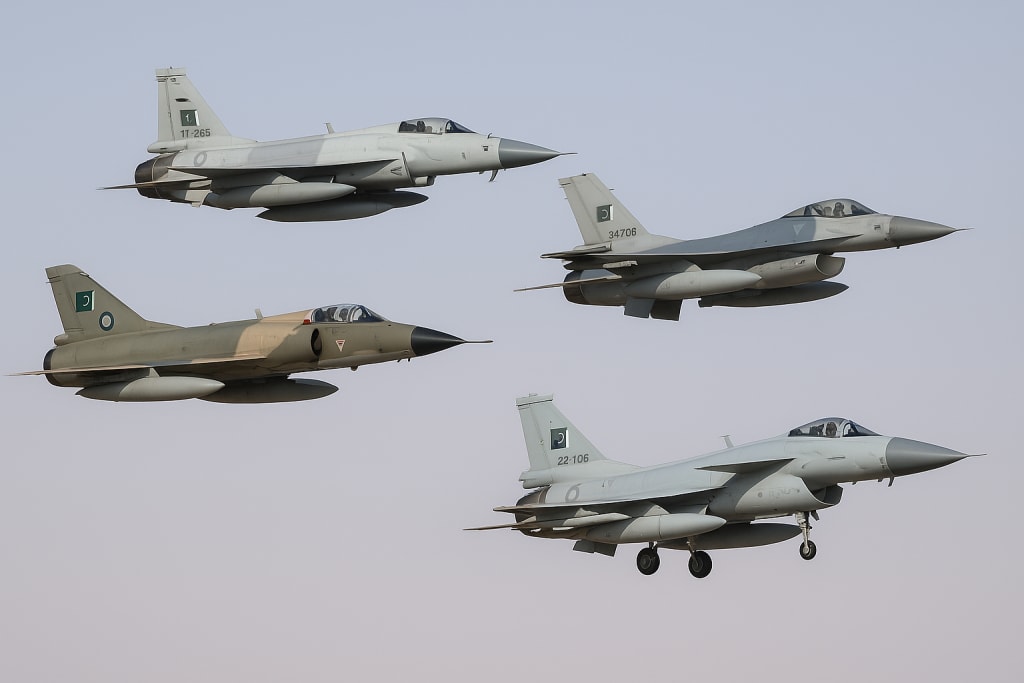
JF-17 Thunder (Pakistan-China): Multirole fighter powered by RD-93 or WS-13 engine
F-16 Fighting Falcon (USA): Multirole, powered by Pratt & Whitney F100-PW engines
Mirage III and V (France): Interceptor and strike roles, powered by Atar 09C engines
J-10C Vigorous Dragon (China): Modern multirole fighter, powered by WS-10B engines
F-7PG (China): Interceptor, powered by WP-13F engine
---
5. JF-17 Thunder – The Backbone of the PAF
5.1 Overview
The JF-17 Thunder is a 4th-generation multirole fighter jointly developed by Pakistan and China. It is lightweight, cost-effective, and equipped with modern avionics.
5.2 Engine Details
RD-93 Turbofan Engine (Russian)
Thrust: Approx. 8,300 kgf with afterburner
Max speed: Mach 1.6
WS-13 Engine (Chinese variant)
Enhanced fuel efficiency and thrust
Expected to replace RD-93 in future variants
5.3 Variants
Block I and II: Initial production batches with operational capabilities
Block III: Includes AESA radar, helmet-mounted display, and improved electronic warfare systems
---
6. F-16 Fighting Falcon – The American Powerhouse
6.1 Overview
The F-16 is a high-performance multirole fighter. Pakistan operates several versions acquired from the USA, and the aircraft is used for both air-to-air and air-to-ground missions.
6.2 Engine Details
Pratt & Whitney F100-PW-200/220E Engine
Thrust: Approx. 23,770 lbf
Capable of Mach 2+ speeds
Known for high agility and combat readiness
6.3 Upgrades
Mid-Life Upgrade (MLU) program
Improved avionics and radar
BVR missile capability
Enhanced survivability systems
---
7. Mirage III and Mirage V – The Classic French Fighters
7.1 Role and Capabilities
These aircraft have served in PAF for decades. They are still operational due to local upgrades and are mainly used for ground attack and reconnaissance missions.
7.2 Engine
Atar 09C Turbojet Engine (French)
Speed: Mach 2.2
Thrust: Approx. 14,100 lbf
Modified variants in Pakistan can carry cruise missiles like RA’AD
---
8. J-10C Vigorous Dragon – A Strategic Addition
8.1 Overview
The J-10C is a 4.5-generation fighter acquired from China and is considered a competitor to India’s Rafale.
8.2 Engine
WS-10B Turbofan Engine (China)
Thrust: Approx. 13,200 kgf
Features supercruise capability and stealth airframe
Equipped with PL-15 long-range missiles and AESA radar
---
9. F-7PG and Other Legacy Aircraft
9.1 F-7PG
A Chinese variant of the MiG-21
Engine: WP-13F Turbojet
Speed: Mach 2.0
Service Ceiling: 58,000 feet
Being retired gradually
9.2 Retired Aircraft
Sabre, MiG-19, MiG-21, Canberra, and others
Super Mushshak used as a trainer aircraft
---
10. Future Aircraft Projects
10.1 Project AZM – Pakistan’s 5th Generation Jet
Under development by Pakistan Aeronautical Complex (PAC)
Expected to include stealth features, advanced radar, and twin engines
Likely to be powered by WS-15 or Turkish TF6000 engines
10.2 UAVs and Drones
Burraq: Armed UAV used in counter-terror operations
Shahpar-II: ISR and ground attack drone
Kamra Research Center is leading UAV development
---
11. Engine Summary Table
Note: Plain text version for easier copying.
JF-17 Thunder: RD-93 or WS-13 (Russia/China), 8,300 kgf thrust
F-16 Fighting Falcon: F100-PW-200/220E (USA), 23,770 lbf thrust
Mirage III/V: Atar 09C (France), 14,100 lbf thrust
J-10C: WS-10B (China), 13,200 kgf thrust
F-7PG: WP-13F (China), 6,220 kgf thrust
---
12. Training and Maintenance
PAF Academy Risalpur and Combat Commanders School train pilots and officers
Pakistan Aeronautical Complex (PAC) Kamra handles aircraft manufacturing and overhauls
Collaborations exist with China, Turkey, and the USA for training and development
---
13. International Relations and Exports
Joint exercises with Turkey, Saudi Arabia, Qatar, and China
Exports of JF-17 to Nigeria and Myanmar
Defense diplomacy to enhance regional ties
---
Conclusion
The Pakistan Air Force stands tall among global air forces with its commitment to innovation, excellence, and aerial supremacy. With a strong mix of foreign and indigenous fighter jets, advanced jet engines, and upcoming stealth projects, the PAF is poised to secure the skies of Pakistan for decades to come.
As regional dynamics evolve, the PAF’s role in deterrence, defense, and diplomacy becomes more vital than ever.
About the Creator
Keep reading
More stories from Ikram Ullah and writers in History and other communities.
1945: The Syrian Crisis That Nearly Sparked War Between Britain and France
I. The Decline of French Colonial Power World War II inflicted a severe blow to French colonial authority. After decades of expanding its empire, France faced a humiliating defeat by Nazi Germany in 1940, leading to the establishment of the Vichy regime. Although Free French forces, led by Charles de Gaulle, continued to fight alongside the Allies, France's global influence was significantly diminished.
By Ikram Ullah9 months ago in History
A Story of the World
The history of the world is the longest story ever told—a vast journey that began long before written words, long before cities, and even before humans themselves. It is a story shaped by nature, driven by curiosity, and transformed by ideas, power, faith, and struggle. The Dawn of Life and Early Humanity Billions of years ago, the Earth was a violent and restless place. Volcanoes erupted, oceans formed, and the first simple life appeared in the seas. Over immense stretches of time, life evolved from single-celled organisms into complex plants and animals. Eventually, a branch of primates learned to walk upright, use tools, and think beyond survival. These were the early humans. For tens of thousands of years, humans lived as hunters and gatherers. They followed animals, gathered plants, and learned to cooperate in small groups. Fire changed everything—it provided warmth, protection, and a way to cook food. Language allowed ideas to pass from one generation to the next. Slowly, humans spread across continents, adapting to deserts, forests, mountains, and ice. The Agricultural Revolution and the First Civilizations Around 10,000 years ago, a turning point arrived: agriculture. Humans learned to grow crops and domesticate animals. This allowed them to settle in one place, build villages, and increase their population. Farming began independently in regions such as Mesopotamia, the Indus Valley, China, Egypt, and Mesoamerica. With settled life came civilization. Cities rose near rivers that provided water and fertile soil. Governments formed to organize labor and protect land. Writing was invented to record trade, laws, and stories. The first legal codes appeared, such as the Code of Hammurabi, which tried to define justice. Religion became organized, explaining the mysteries of life and death and giving meaning to human existence. Empires, Power, and Belief As civilizations grew, so did conflict. Powerful kingdoms expanded into empires through conquest and control. The Egyptian, Persian, Greek, Roman, Mauryan, and Han empires shaped large parts of the ancient world. Roads, armies, taxes, and laws connected millions of people under a single rule. Ideas traveled along with armies and traders. Greek thinkers explored philosophy, science, and democracy. In India and China, deep philosophies like Hinduism, Buddhism, Confucianism, and Taoism offered guidance on morality and harmony. In the Middle East, monotheistic faiths emerged, teaching belief in one God and emphasizing justice and compassion. The Roman Empire became a bridge between ancient and modern worlds. It spread law, engineering, and language across Europe and the Mediterranean. Yet no empire lasts forever. Over time, internal weakness, economic strain, and outside pressures caused great empires to fall. The Middle Ages and the Flow of Knowledge After the fall of Rome in the West, Europe entered a period often called the Middle Ages. Power was divided among kings, nobles, and the Church. Life was difficult for many, but this era was not without progress. Universities formed, architecture flourished, and faith shaped daily life. Meanwhile, the Islamic world experienced a golden age. Scholars preserved and expanded knowledge in mathematics, medicine, astronomy, and philosophy. Cities like Baghdad and Cordoba became centers of learning, where ideas from Greece, India, and Persia were studied and improved. Trade routes connected Asia, Africa, and Europe, allowing goods and cultures to mix. In Asia, powerful dynasties ruled China, advancing technology such as paper, printing, gunpowder, and the compass. These inventions would later transform the world. The Renaissance and the Age of Exploration Around the 14th century, a rebirth of learning began in Europe: the Renaissance. Artists, scientists, and thinkers looked back to classical knowledge while pushing forward with new ideas. Figures like Leonardo da Vinci and Galileo challenged old beliefs and celebrated human potential. At the same time, explorers set sail across unknown oceans. The Age of Exploration connected the world as never before. Europeans reached the Americas, Africa, and Asia, creating global trade networks. This brought wealth and knowledge—but also suffering. Indigenous civilizations were destroyed, millions were enslaved, and colonial empires rose through exploitation. Revolutions and the Modern World The 18th and 19th centuries were ages of revolution. Political revolutions in America and France challenged absolute monarchy and promoted ideas of liberty, equality, and rights. The Industrial Revolution transformed economies, as machines replaced manual labor and cities grew rapidly. Life improved for some, but workers often faced harsh conditions. New ideologies emerged—capitalism, socialism, nationalism—each offering different visions of society. Nations formed and competed, leading to global conflicts. The 20th century witnessed two devastating world wars that reshaped borders and shattered illusions of progress. Yet from the ruins came international cooperation, technological leaps, and movements for independence and civil rights. The World Today and Beyond In recent decades, technology has accelerated history. Computers, the internet, and artificial intelligence have changed how humans communicate, learn, and work. Globalization has connected economies and cultures, while also creating new challenges. Climate change, inequality, and conflict remind humanity that progress is fragile. The history of the world is not just a record of kings and wars—it is the story of ordinary people: farmers, thinkers, builders, dreamers. It is a story of mistakes and lessons, destruction and hope. Each generation inherits this long journey and adds its own chapter. The future remains unwritten. Like those who came before, humanity stands at a crossroads—guided by the past, tested in the present, and responsible for what comes next.
By The best writer 5 minutes ago in History
Martin Luther King Jr.: The Voice of Peace and Justice
Martin Luther King Jr. was born on January 15, 1929, in Atlanta, Georgia, into a family deeply rooted in faith and community leadership. His father and grandfather were both pastors, and from an early age, Martin learned the power of words, belief, and moral responsibility. Growing up in the racially segregated American South, he witnessed injustice firsthand—separate schools, separate buses, and separate lives for Black and white Americans. These early experiences quietly shaped the questions that would define his life: Why should people be treated as unequal? And how could such injustice be peacefully undone?
By The best writer 5 days ago in History



Comments
There are no comments for this story
Be the first to respond and start the conversation.