World History
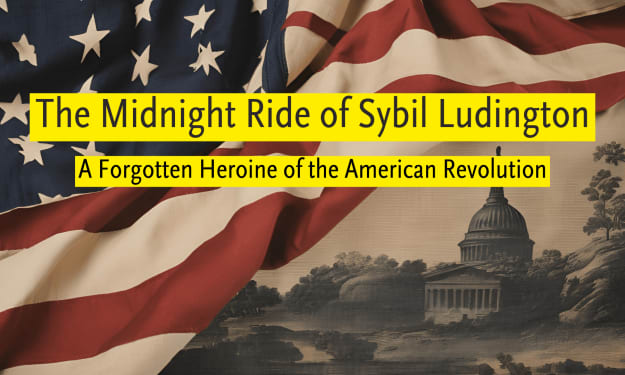
The Midnight Ride of Sybil Ludington: A Forgotten Heroine of the American Revolution . AI-Generated.
In the early years of the American Revolution, heroes emerged in many forms—soldiers, generals, and even ordinary citizens. But one hero stood out, not because of her battlefield achievements or political influence, but because of her unwavering courage on a dark, rainy night. This is the remarkable story of Sybil Ludington, a 16-year-old girl who, in April 1777, rode through the perilous wilderness to rally militia forces in defense of her town and her country.
By Rousela Funfactsabout a year ago in History
Why Everything We Know About the Black Death Is Wrong
The Black Death – the pandemic that decimated Europe in the mid-14th century – has always been portrayed as a catastrophic event that shaped much of human history. We’ve long been taught that it was the bubonic plague, spread by fleas on rats, that killed millions across Europe, Asia, and Africa. But what if this narrative is a little... off? Could it be that what we think we know about this deadly event might not be the full story?
By Marveline Merababout a year ago in History
The Myth of the Amazons
Throughout history, ancient mythologies often attributed natural phenomena like lightning, volcanoes, and rivers to divine origins. Many legends revolved around powerful characters, some of divine descent, who interacted with both gods and humans. In Greek mythology, which holds a special place in cultural history, one of the most fascinating legends is that of the Amazons, a tribe of fierce warrior women. Renowned for their mastery of horseback riding, archery, and bravery in battle, the Amazons have sparked the imagination for centuries. But were these legendary women real? What do historical records say about them? In mythology, the Amazons were said to be the daughters of Ares, the god of war. They formed an all-female society where men were welcome solely for reproduction purposes. These warrior women lived on the fringes of what the Greeks considered the "civilized" world, often depicted as residing in distant regions near the southern shores of the Black Sea. According to the playwright Aeschylus (c. 525-456 BCE), the Amazons once lived in Scythia, near the Meotis Lake, now known as the Sea of Azov, before moving to the city-state of Themiscyra by the Thermodon River. Interestingly, the Thermodon is a real river in northern Turkey, now called the Terme River.
By A Históriaabout a year ago in History
Is There a Lost Continent Beneath Japan? The Yonaguni Monument Mystery
If there’s one place on Earth that could make you question everything you thought you knew about human history, it’s the Yonaguni Monument. This underwater formation off the coast of Japan has stirred up an intense debate among archaeologists, geologists, and adventurers since its discovery in 1987. Could it be the remnants of an ancient civilization, or is it just a natural rock formation that happens to look a little too much like human handiwork?
By Marveline Merababout a year ago in History
Archaeologists Uncover One of the World's Oldest Churches: A Testament to Early Christianity
In an extraordinary archaeological find, researchers have uncovered the remains of an ancient Armenian church believed to be nearly 2,000 years old. This remarkable discovery, made in the city of Artaxata, sheds new light on the early spread of Christianity in the region and stands as one of the oldest known Christian churches in the world. Described as a "sensational testimony to early Christianity" by the University of Münster, this finding is a significant contribution to understanding both Armenia’s religious history and the broader history of early Christianity.
By Global News Updateabout a year ago in History
The Discovery of Prehistoric Giants: Four Glyptodon Shells Found in Argentina
In 2021, Argentine farmer Juan de Dios Sota made an astonishing discovery that instantly captured the attention of the scientific community. While working on his field near Rincón de Valle, located in central Argentina, Sota unearthed four massive Glyptodon shells, each over 10,000 years old. These prehistoric creatures, resembling giant armadillos, roamed the Earth during the Pleistocene epoch, or the last Ice Age. The chance discovery of four Glyptodon shells together has raised exciting questions about these ancient animals, the environment they lived in, and the circumstances of their sudden burial.
By Deji Akomolafeabout a year ago in History
The Great Emu War: Australia’s Strangest Battle . AI-Generated.
In the aftermath of World War I, Australia faced not just economic challenges but also a peculiar enemy—one that no military strategist could have anticipated. By 1932, the country was in the grip of the Great Depression, and Western Australian farmers, especially in the wheat-growing regions, were struggling. Despite government promises of financial support, the promised subsidies never materialized. To make matters worse, an unexpected adversary arrived in the form of thousands of emus.
By Rousela Funfactsabout a year ago in History
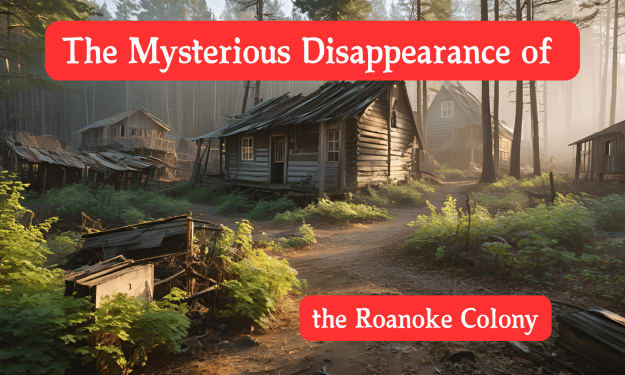
The Mysterious Disappearance of the Roanoke Colony. AI-Generated.
In 1587, over a hundred men, women, and children set sail from England to the New World, filled with hope and dreams of a new life. Their destination: Roanoke Island, off the coast of what is now North Carolina. But when their leader returned three years later, they had vanished without a trace. What happened to the Lost Colony of Roanoke?
By Rousela Funfactsabout a year ago in History
Dolmen de Soto: A Megalithic Masterpiece of 3000 B.C.
Nestled in the southwest of the Iberian Peninsula, Dolmen de Soto stands as a monument to the ancient civilizations that once thrived in this region. This impressive megalithic structure, dating back to around 3000 B.C., is a testament to the architectural ingenuity and cultural significance of its builders. As one of the most important megalithic monuments in the area, Dolmen de Soto offers a fascinating glimpse into prehistoric life, particularly in terms of ritualistic practices and early astronomical observation.
By Deji Akomolafeabout a year ago in History
Why the Curse of Tutankhamun Might Be Real
In the early 20th century, a dramatic tale unfolded in Egypt that captured the imagination of the world—a curse that was said to doom anyone who dared to disturb the tomb of the ancient Egyptian pharaoh, Tutankhamun. Fast forward nearly a century, and the Curse of Tutankhamun still intrigues and terrifies, with many wondering: could there be any truth behind this mysterious curse?
By Marveline Merababout a year ago in History