
The Myth of the Amazons
Warrior Women of Legend and History

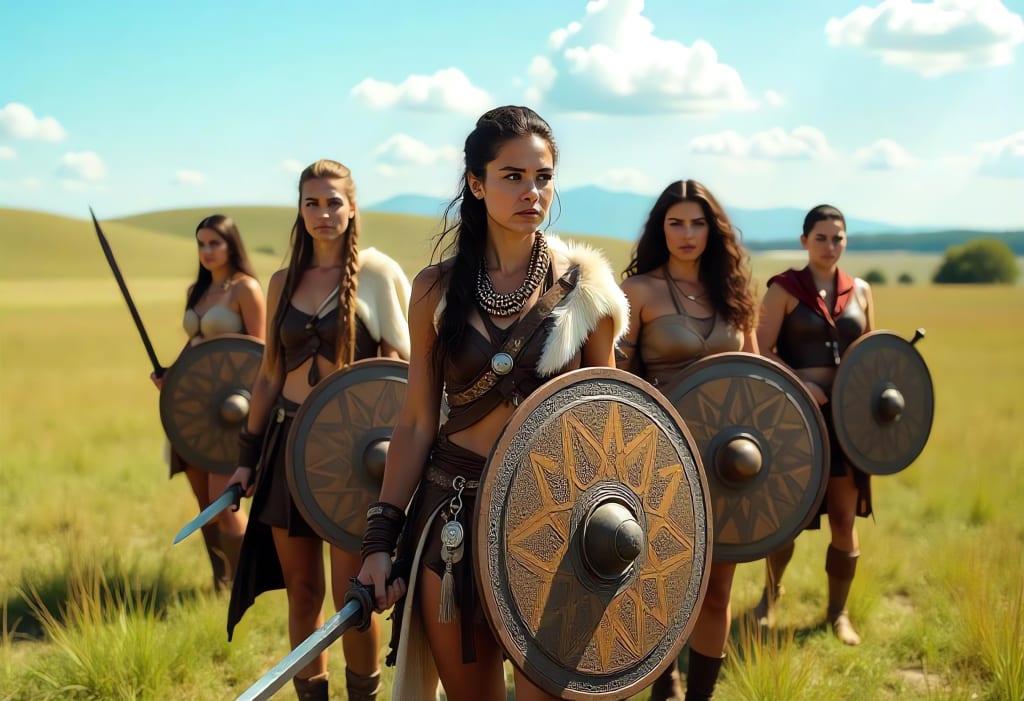
Throughout history, ancient mythologies often attributed natural phenomena like lightning, volcanoes, and rivers to divine origins. Many legends revolved around powerful characters, some of divine descent, who interacted with both gods and humans. In Greek mythology, which holds a special place in cultural history, one of the most fascinating legends is that of the Amazons, a tribe of fierce warrior women. Renowned for their mastery of horseback riding, archery, and bravery in battle, the Amazons have sparked the imagination for centuries. But were these legendary women real? What do historical records say about them? In mythology, the Amazons were said to be the daughters of Ares, the god of war. They formed an all-female society where men were welcome solely for reproduction purposes. These warrior women lived on the fringes of what the Greeks considered the "civilized" world, often depicted as residing in distant regions near the southern shores of the Black Sea. According to the playwright Aeschylus (c. 525-456 BCE), the Amazons once lived in Scythia, near the Meotis Lake, now known as the Sea of Azov, before moving to the city-state of Themiscyra by the Thermodon River. Interestingly, the Thermodon is a real river in northern Turkey, now called the Terme River.
The Amazons were credited with founding several important cities in Anatolia, such as Ephesus, Sinope, Priene, and Smyrna, cities that had strong ties to the worship of Artemis, the Greek goddess of the hunt and war. The Greek historian Herodotus (c. 484-425 BCE) also chronicled encounters between the Amazons and the Scythians. According to his "Histories," the blending of these two groups eventually gave rise to the Sarmatians, a people famous for their horseback riding and battle prowess.
To the Greeks, the Amazons represented the inverse of their own society. These women pursued traditionally masculine activities like hunting, riding, and waging war. In one popular interpretation, the name "Amazon" derives from the Greek words meaning "without breast," a reference to the myth that they removed one breast to better wield a bow. However, ancient Greek art doesn’t depict them this way; instead, they are often shown wearing hoplite armor and riding horses, with bows, spears, or axes in hand. The first mentions of the Amazons in Greek literature come from myths about the demigod Heracles (Hercules), son of Zeus. In one of his famous Twelve Labors, Heracles was tasked with retrieving the magic girdle of the Amazon queen, Hippolyta. In some versions of the story, Hippolyta willingly gave the girdle to Heracles, but in others, the goddess Hera incited the Amazons against him, leading to a violent conflict.
Another hero, Theseus, also had a significant encounter with the Amazons. After aiding Heracles, Theseus fell in love with and abducted the Amazon princess Antiope, sparking a war between the Amazons and the Greeks. Though Theseus ultimately triumphed, Antiope was killed in battle. The abduction of Antiope is a common theme in Greek art, featured on temples and vases, such as the famous Black-Figure Vase by Exekias.
The Amazons also appeared in stories about the hero Bellerophon, who was sent to fight them as part of his quests. Lastly, in the Trojan War saga, the Amazon queen Penthesilea fought on the side of the Trojans, only to be slain by Achilles. According to legend, Achilles was so struck by her beauty that he fell in love with her as she died. The Amazons were a popular subject in Greek art, particularly in the form of "Amazonomachies"—artistic depictions of battles between Greeks and Amazons. These scenes were used to symbolize the Greek struggle against foreign invaders, most notably the Persians during the Persian Wars. In these portrayals, the Amazons, often depicted in Persian attire, represented the "barbaric" enemy.
Famous examples of Amazonomachies can be found on the shield of the statue of Athena Parthenos in the Parthenon and in other temples throughout Greece. These depictions served not only as cultural markers but also as political propaganda, reminding the Greek people of their victories against foreign invaders. In recent decades, archaeological discoveries have shed light on the possible real-life counterparts to the mythic Amazons. Excavations in the southern Russian steppes, Ukraine, and Kazakhstan have revealed burial mounds (kurgans) containing female skeletons buried with weapons such as bows, spears, and armor. These findings, which date from the 6th to 3rd centuries BCE, suggest that some women in these nomadic societies fought alongside men and held positions of power.
One notable site is near Pokrovka, on the border between Russia and Kazakhstan, where weapons were found in female graves. Some of these women showed signs of battle-related injuries, lending credence to the idea that they lived martial lives similar to their mythical counterparts. These findings support the accounts of Herodotus, who linked the Sarmatians to the Amazons. Genetic studies conducted by archaeologist Jeannine Davis-Kimball have even traced descendants of these warrior women to modern-day Mongolia, further blurring the lines between myth and reality. The discovery of female warriors buried with weapons throughout the Eurasian steppe indicates that the legend of the Amazons may have been inspired by real historical events and people.
The legacy of the Amazons has endured for millennia, captivating historians, artists, and audiences alike. During the European Renaissance, scholars revisited the stories of these warrior women, while explorers in the Age of Discovery reported encounters with similar tribes in distant lands. In 1542, the Spanish explorer Francisco de Orellana named the Amazon River after a tribe of women warriors he claimed to have fought during his journey through South America.
In the 20th century, the image of the Amazons experienced a revival, not only through archaeological discoveries but also through social and political movements. Today, these legendary warriors continue to inspire books, movies, and even comic books, keeping the story of these powerful women alive in popular culture.
The myth of the Amazons, like many Greek myths, blends elements of imagination with historical reality. Whether they were entirely mythic or based on real-life warrior women, the Amazons remain an enduring symbol of strength, independence, and defiance.
About the Creator
A História
"Hi. My name is Wellington and I'm a passion for general history. Here, I publish articles on different periods and themes in history, from prehistory to the present day.
Keep reading
More stories from A História and writers in History and other communities.
The Tale of the Mischievous Badger
Many years ago, a peaceful elderly couple decided to leave behind the chaos of city life and settle in the quiet, remote mountains, far from any other civilization. They longed for a life of tranquility, where they could tend to their farm and enjoy the beauty of nature. For a while, their life was peaceful, and their rice and vegetable fields flourished. But their serenity was shattered by an unexpected and persistent visitor: a mischievous badger.
By A Históriaabout a year ago in History
Royal Blood and the Survival of the Throne: The Ottoman Tradition of Fratricide
Among the many powerful dynasties in world history, the Ottoman Empire stands out for its longevity, political sophistication, and vast territorial reach. At its peak, the empire stretched across parts of Europe, Asia, and Africa, ruling over diverse peoples and cultures for more than six centuries. Yet behind the grandeur of its palaces and the power of its sultans lay a grim and controversial tradition: the execution of royal brothers to secure the throne.
By Irshad Abbasi 7 days ago in History



Comments
There are no comments for this story
Be the first to respond and start the conversation.