
The Mysterious Disappearance of the Roanoke Colony
Funfacts that you need to know

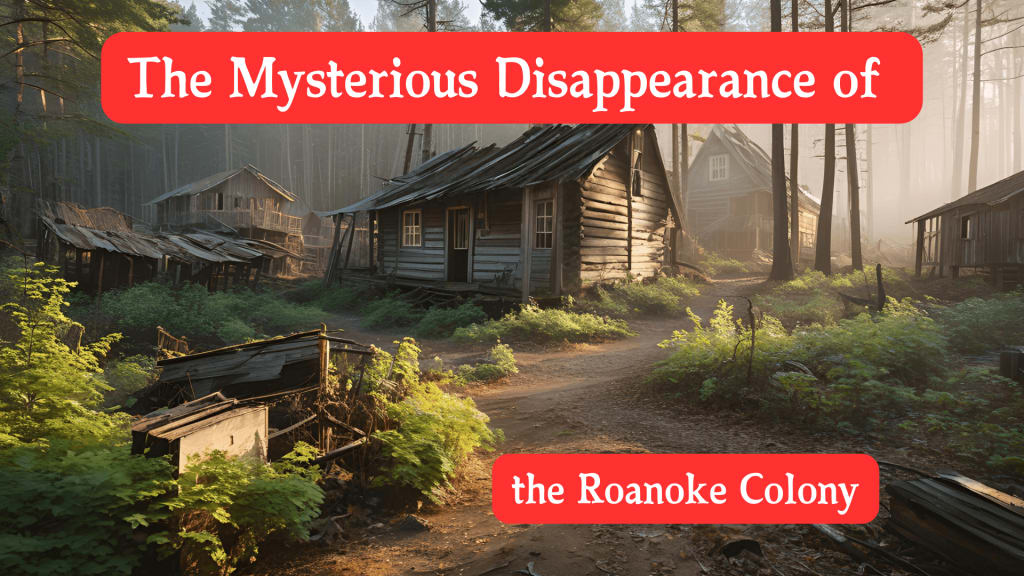
In 1587, over a hundred men, women, and children set sail from England to the New World, filled with hope and dreams of a new life. Their destination: Roanoke Island, off the coast of what is now North Carolina. But when their leader returned three years later, they had vanished without a trace. What happened to the Lost Colony of Roanoke?
It all began with Sir Walter Raleigh, a close confidant of Queen Elizabeth I. In 1584, Raleigh was granted a charter to establish a colony in the New World, hoping to expand English influence and search for gold. The first expedition arrived on Roanoke Island in 1585, led by Sir Richard Grenville and Ralph Lane. Life was harsh for these early settlers. They struggled with limited supplies, harsh weather, and tension with local tribes. A year later, Sir Francis Drake offered to take the struggling colonists back to England, and they accepted. The colony was temporarily abandoned. Despite the setbacks, Raleigh was determined to establish a permanent colony. In 1587, a new group of settlers, led by John White, arrived on Roanoke Island. This group included families, hoping to make this new land their home. Among them was John White's daughter, Eleanor Dare, who gave birth to Virginia Dare the first English child born in the New World.
Shortly after their arrival, White sailed back to England to gather more supplies. But due to the ongoing war with Spain, his return was delayed for three years. When he finally came back in 1590, what he found was beyond comprehension. The settlement was deserted. There were no signs of struggle, no bodies only the word 'CROATOAN' carved into a post and the letters 'CRO' on a nearby tree. The Lost Colony had vanished. So, what happened to the Roanoke colonists? Historians and archaeologists have proposed several theories over the centuries.
One theory suggests that the settlers moved south to live with the Croatoan tribe on Hatteras Island. This would explain the carved word, as ‘Croatoan’ was both the name of the island and the people who lived there. Another theory, supported by the 'Zuniga Map,' suggests that the colonists moved inland to merge with friendly tribes. In 1608, a group of Jamestown settlers reported seeing Europeans living among the Iroquois, further fueling speculation that the Roanoke settlers had integrated with native communities.
Recent archaeological discoveries have added more pieces to the puzzle. In 2015, researchers found European artifacts on Hatteras Island, such as a gold ring and a rapier hilt, indicating possible contact between the Roanoke settlers and the Croatoan tribe. DNA testing has also been used to explore the mystery. Researchers have tested the descendants of the Lumbee tribe, who have oral histories claiming descent from the Lost Colonists. While no definitive connection has been found, the research is ongoing.
Other theories are more sinister. Some believe the settlers were wiped out by hostile tribes, while others speculate they tried to sail back to England and were lost at sea. Whatever the truth may be, the disappearance of the Roanoke Colony remains one of America’s oldest unsolved mysteries. It’s a tale that has captivated imaginations for over 400 years and continues to inspire questions and investigations. The Lost Colony has inspired countless books, films, and even plays, like Paul Green’s 'The Lost Colony,' which has been performed every summer on Roanoke Island since 1937. The mystery is as much a part of American folklore as the colony itself.
oday, Roanoke Island is a peaceful, picturesque destination, attracting thousands of visitors each year, all eager to catch a glimpse of where history was made and where it was lost. What do you think happened to the Lost Colony of Roanoke? Was it a peaceful assimilation, a desperate escape, or something more tragic? Let us know your theories in the comments below!
About the Creator
Rousela Funfacts
🎉 Dive into a world of mind-blowing facts and fascinating trivia! From the weird to the wonderful, we've got the fun facts that will make you say, 'Whoa, I didn't know that!'
Keep reading
More stories from Rousela Funfacts and writers in History and other communities.
The Midnight Ride of Sybil Ludington: A Forgotten Heroine of the American Revolution
In the early years of the American Revolution, heroes emerged in many forms—soldiers, generals, and even ordinary citizens. But one hero stood out, not because of her battlefield achievements or political influence, but because of her unwavering courage on a dark, rainy night. This is the remarkable story of Sybil Ludington, a 16-year-old girl who, in April 1777, rode through the perilous wilderness to rally militia forces in defense of her town and her country.
By Rousela Funfactsabout a year ago in History
🅼🅸🅳🅽🅸🅶🅷🆃 🆂🅽🅰🅲🅺🆂
"It's 10 in Tuscon! We all know what that means... It's Time for Midnight Snacks with your man, Gerald Gee! Ready to spend the night together? Me too! I'm full of snacks and can't wait to regurgitate them all back into your hungry ears. Crack a brew! Pop some corn! Anything to get ready for one hell of a show where the talk maybe cheap but the words cut deep...
By Lamar Wiggins3 days ago in Fiction


Comments
There are no comments for this story
Be the first to respond and start the conversation.