
Why Everything We Know About the Black Death Is Wrong
Debunking the Plague

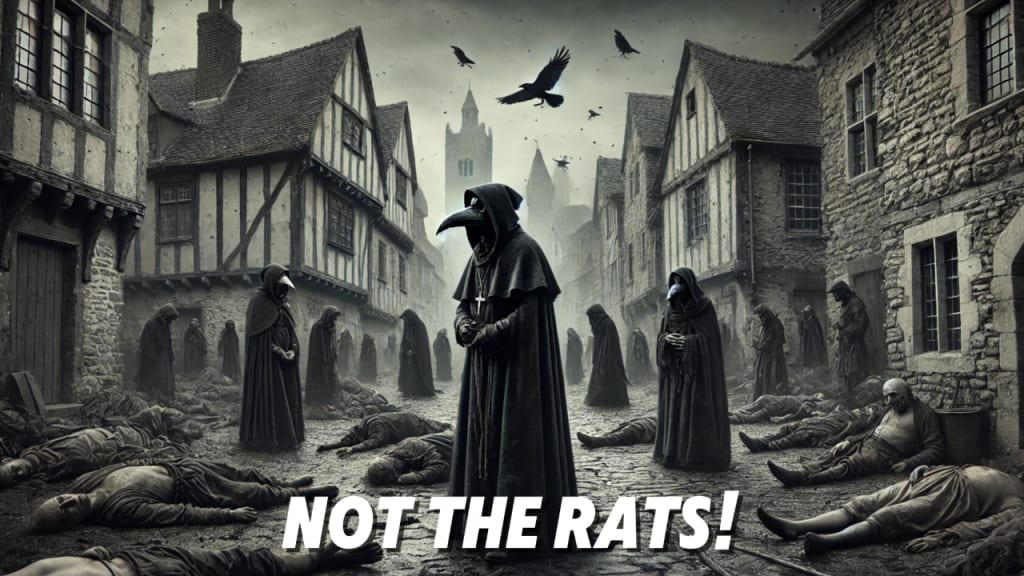
The Black Death – the pandemic that decimated Europe in the mid-14th century – has always been portrayed as a catastrophic event that shaped much of human history. We’ve long been taught that it was the bubonic plague, spread by fleas on rats, that killed millions across Europe, Asia, and Africa. But what if this narrative is a little... off? Could it be that what we think we know about this deadly event might not be the full story?
Let's embark on a deep dive into why everything we know about the Black Death might be wrong.
1. The Traditional Story – Fleas, Rats, and Buboes
Before debunking popular beliefs, let's recap the traditional account. The Black Death, also known as the Great Plague, swept across Europe from 1347 to 1351. Historical records suggest it claimed the lives of 25 to 50 million people, about 30-60% of Europe's population.
The standard theory has always been that Yersinia pestis – the bacterium responsible for bubonic plague – spread through flea bites. These fleas supposedly traveled on rats, jumping ship from trade vessels and into Europe’s bustling cities. The most visible symptom was the bubo, a large, swollen lymph node, usually in the groin or armpit. Other symptoms included fever, chills, and eventual death.
But, here's the twist: new research is challenging almost every part of this narrative.
2. Ratting Out the Rats: Are They Really to Blame?
Historically, rats have borne the brunt of the blame for the spread of the Black Death. But here's where it gets interesting. A growing body of evidence suggests that rats might not have played the leading role in the spread of the plague.
In 2018, researchers conducted studies on the spread of Yersinia pestis and found that the speed at which the Black Death spread was far too rapid for a rat-flea transmission model. Rats may have been involved, but they likely weren’t the primary culprits. Instead, it's becoming clear that human fleas and lice might have been much more significant vectors in spreading the disease.
Plus, if you think about it, the rats would have likely succumbed to the plague before they could spread it far and wide. Dead rats can’t exactly travel across countries!
3. The Speed of the Spread: Was It Airborne?
Even if human fleas and lice were more responsible than rats, there’s still the question of how fast the plague spread. In just a few short years, the Black Death had crossed continents, wiping out populations at an alarming rate.
One of the more controversial theories posits that the pneumonic plague – a form of plague that spreads via airborne droplets – might have played a more prominent role. Pneumonic plague is far more contagious and deadly than bubonic plague, spreading directly from person to person through coughs and sneezes. This airborne version could explain how the plague managed to decimate entire villages and towns within days or weeks.
4. Was It Even the Plague?
Here’s where the mystery deepens. Some scholars argue that the disease responsible for the Black Death may not have been Yersinia pestis at all! While DNA analysis of plague victims has confirmed the presence of Y. pestis, not all victims show traces of the bacterium. Additionally, modern outbreaks of bubonic plague (which still occur in places like Madagascar and the western U.S.) aren’t nearly as deadly or widespread as the Black Death.
This raises the possibility that another pathogen, perhaps even a virus, was involved. Some have suggested that the Black Death may have been a hemorrhagic fever, similar to Ebola, due to the rapid spread, high mortality rates, and descriptions of some victims bleeding from various orifices.
5. The Role of Climate: A Perfect Storm?
The medieval climate anomaly, a period of unusual weather patterns, might have set the stage for the Black Death. In the years leading up to the outbreak, Europe experienced unusually cold weather, failed harvests, and widespread famine. These conditions weakened populations, making them more susceptible to diseases.
Recent studies also suggest that climate patterns in Asia – where the plague likely originated – might have triggered the disease’s spread. Changes in rainfall and temperature could have caused a population boom in rodents (yes, back to the rats), which eventually carried the disease to human populations. So, while rats may not have been as crucial in Europe, they might have played a more significant role in Asia.
6. The Black Death’s Real Legacy: More Than Just Death
Why Everything We Know About the Black Death Is Wrong. You'll definitely enjoy this!
It’s easy to focus on the death toll when discussing the Black Death, but this pandemic’s impact stretched far beyond the grave. The plague reshaped Europe’s economy, society, and even politics in ways that are still being felt today.
- Labor Shortages: With so many people dead, there were massive labor shortages, leading to higher wages for workers and a decline in serfdom. The feudal system began to crumble as peasants gained more leverage over their lords.
- Religious Upheaval: The Church, which had previously held a tight grip on European society, faced increasing scrutiny. Many believed that the plague was a divine punishment for sin, but as the Church failed to protect people, disillusionment grew, sowing the seeds for the Reformation.
- Scientific Advancements: The devastation caused by the Black Death also led to a greater emphasis on medicine and science. Medieval doctors, struggling to understand the disease, began to question traditional medical practices, paving the way for the Renaissance.
7. Revisiting Historical Sources: Are They Reliable?
Many of the accounts we rely on to understand the Black Death come from medieval chroniclers, who might not have had the most scientific methods of recording information. In fact, some of their descriptions are so dramatic and contradictory that they raise doubts about how accurately they reflect reality.
Take, for instance, Giovanni Boccaccio’s description in his famous work “The Decameron,” where he details how the disease spread like wildfire and claimed lives in droves. While these accounts are invaluable in understanding the human experience of the plague, they must be taken with a grain of salt when reconstructing the specifics of the disease.
Conclusion: The Black Death, A Mystery That Endures
Despite centuries of research, the Black Death continues to baffle historians, scientists, and curious minds alike. Whether it was bubonic, pneumonic, or something entirely different, the plague’s effects on human history are undeniable.
What we do know is that the world in the aftermath of the Black Death was a very different place. It ushered in a new era of social, economic, and religious changes. The questions surrounding its exact nature and spread, however, remind us that history is full of uncertainties – and sometimes, what we think we know turns out to be wrong.
So, the next time someone confidently tells you that the Black Death was simply the result of flea-bitten rats, you can raise an eyebrow and ask, “But is it really that simple?”
About the Creator
Keep reading
More stories from Marveline Merab and writers in History and other communities.
Is There a Lost Continent Beneath Japan? The Yonaguni Monument Mystery
If there’s one place on Earth that could make you question everything you thought you knew about human history, it’s the Yonaguni Monument. This underwater formation off the coast of Japan has stirred up an intense debate among archaeologists, geologists, and adventurers since its discovery in 1987. Could it be the remnants of an ancient civilization, or is it just a natural rock formation that happens to look a little too much like human handiwork?
By Marveline Merababout a year ago in History
THE GRAND EGYPTHION MUSEUM
Let’s be real for a second. When folks hear "museum," they often think of dusty halls, dry information, and that odd quiet where you feel like you're misbehaving just for breathing. But the Grand Egyptian Museum isn't like that. I really don't think that's it. It's not accurate at all. This just seems wrong. This place is really nice. Egypt really shows us that it made history, and it keeps on doing amazing things.
By Beshoy Zayerabout 10 hours ago in History



Comments
There are no comments for this story
Be the first to respond and start the conversation.