Ancient
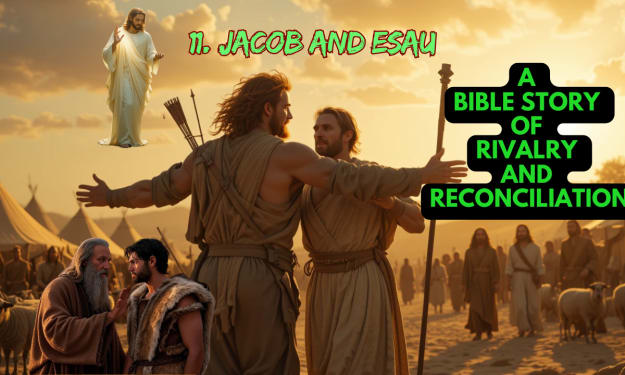
11. Jacob and Esau: A Bible Story of Rivalry and Reconciliation. AI-Generated.
In the ancient land of Canaan, around 1800 BC, a man named Isaac and his wife Rebekah lived as nomads, blessed by God with twin sons, Esau and Jacob. The story of Jacob and Esau, found in the Book of Genesis (25:19-34, 27:1-45, 33:1-20), is a dramatic tale of sibling rivalry, deception, and eventual reconciliation, revealing God’s sovereignty over human flaws and His power to bring healing to broken relationships. This narrative, a cornerstone of biblical history, offers timeless lessons on forgiveness, faith, and the unfolding of God’s plan.
By David Andrews9 months ago in History
The unique skull of an extinct, enormous "thunderbird" has been discovered by archaeologists.
The Australian Outback once trembled beneath a ball. He was bigger than one person and five times heavier than Cassobary. For over a century, scientists have known these giants (called dromaeosaurus) only from scattered and often cut bones. The crushed skull that appeared in 1913 led to wild assumptions about what Zenonis Newton, the last of the string, looked, fed, and squealed. Now, the newly excavated skull bones have been transformed by blowing one from the dry bed of Lake Carabona.
By Francis Dami9 months ago in History
"The Rise and Fall of the Ottoman Caliphate"
History of Khilafat-e-Usmania (Ottoman Caliphate) The Khilafat-e-Usmania, or the Ottoman Caliphate, was the last widely recognized Islamic Caliphate and one of the most enduring empires in world history. Established at the dawn of the 14th century, it lasted over 600 years, exerting tremendous influence across Europe, Asia, and Africa. It began as a small principality in Anatolia under Osman I, and by the 16th century, it had evolved into a global empire and the political center of the Muslim world.
By Haris khan9 months ago in History
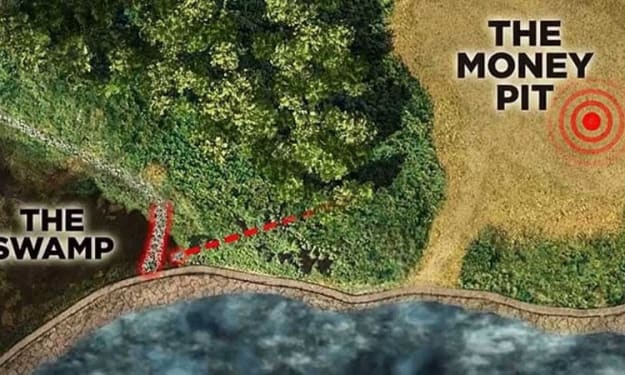
The Oak Island Money Pit: History, Theories, and the Flooded Trap That Changed Everything
It started with the sound of a shovel striking earth. What followed would become the longest-running treasure hunt in modern history — filled with mystery, death, obsession, and one maddening, elusive promise: that somewhere beneath Oak Island, something extraordinary lies buried.
By Rukka Nova9 months ago in History
Top 5 Ancient Inventions Still Used Today
Human civilization has been shaped by groundbreaking inventions that emerged thousands of years ago. Many of these innovations were so advanced that they continue to influence modern technology, infrastructure, and daily life. From the wheel to paper, ancient inventors laid the foundation for the world we know today.
By Himadri Niloy9 months ago in History
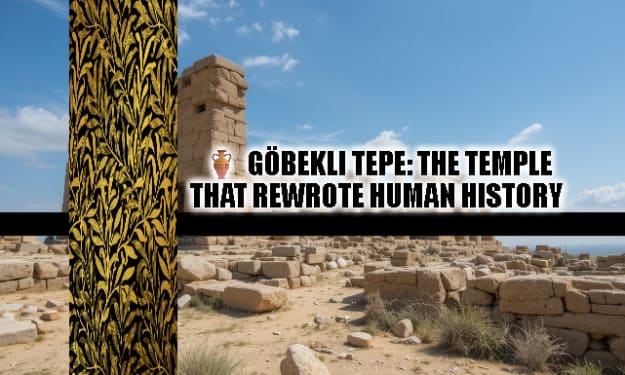
🏺 Göbekli Tepe: The Temple That Rewrote Human History
🏺 Göbekli Tepe: The Temple That Rewrote Human History I. Discovery and Location Göbekli Tepe, which translates from Turkish as “Potbelly Hill,” sits quietly in the dry, rolling hills of southeastern Turkey, near the modern city of Şanlıurfa. Though it had long appeared on maps as a minor mound — a common sight in the region — its true significance wasn’t understood until the mid-1990s. In fact, for decades, local farmers and researchers assumed the mound was a simple Bronze Age burial site or a ruined Byzantine outpost. But in 1994, the German archaeologist Klaus Schmidt, who had worked at nearby Neolithic sites, re-examined the mound and recognized that the flint tools and carved stones scattered across the surface pointed to something far older and more significant.
By Kek Viktor9 months ago in History
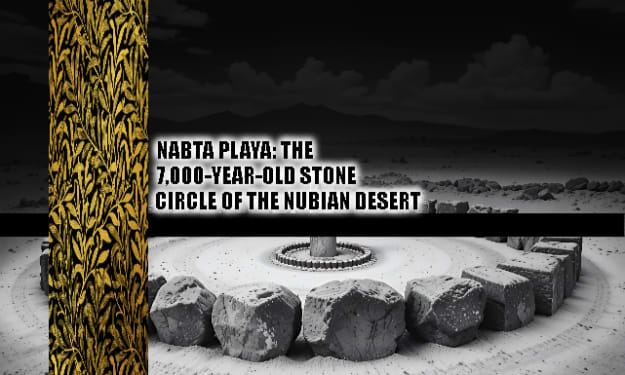
⛏️Nabta Playa: The 7,000-Year-Old Stone Circle of the Nubian Desert
⛏️Nabta Playa: The 7,000-Year-Old Stone Circle of the Nubian Desert Discovery and Location Nabta Playa lies hidden deep within the Nubian Desert, an arid and inhospitable region in southern Egypt, close to the border with Sudan. This vast desert landscape today is characterized by harsh winds, blazing sun, and seemingly endless sand dunes, but approximately 7,000 to 8,000 years ago, this area was dramatically different.
By Kek Viktor9 months ago in History
Inferno rising
Inferno Rising: The Lost Day of Peshtigo In the fading heat of the summer of 1871, the small lumber town of Peshtigo, Wisconsin, lay on the brink of catastrophe. The land was hardened by an unyielding drought, the forests once lush now brittle against a relentless blue sky, and the very earth seemed to whisper warnings of impending doom. Peshtigo, built around the timber mills and sustained by a close-knit community, was unaware that nature’s fury was gathering for a devastating climax.
By Saroj Kumar Senapati9 months ago in History
Andalusia: The Forgotten Beacon of Civilization
The Forgotten Glory of Andalusia: A Legacy of Civilization, Now Overshadowed It is a historical fact that when the streets of Europe were overflowing with filth and plagued by disease—when people in many European cities were compelled to wear high wooden clogs just to avoid stepping in their own waste—Andalusia stood as a beacon of cleanliness, culture, and unparalleled development. In that golden era of Islamic Spain, not only did every Muslim household boast a private bath, but a well-structured sewage and drainage system also existed—an advanced infrastructure that was centuries ahead of its time and of anything found in Europe.
By Ikram Ullah9 months ago in History
The Overlooked Treasures of the Khmer Empire: Cambodia's Concealed Wealth
The Overlooked Treasures of the Khmer Empire: Cambodia's Concealed Wealth When discussing the world's most affluent ancient empires, names such as Rome, Persia, and Mali often take precedence. However, nestled deep within the jungles of Southeast Asia lies an unrecognized giant—the Khmer Empire, whose lavishness once matched the greatest empires globally. Spanning across present-day Cambodia, Thailand, Laos, and Vietnam, the Khmer Empire thrived between the 9th and 15th centuries, leaving behind treasures—both material and spiritual—that astonish contemporary observers.
By Say the truth 9 months ago in History
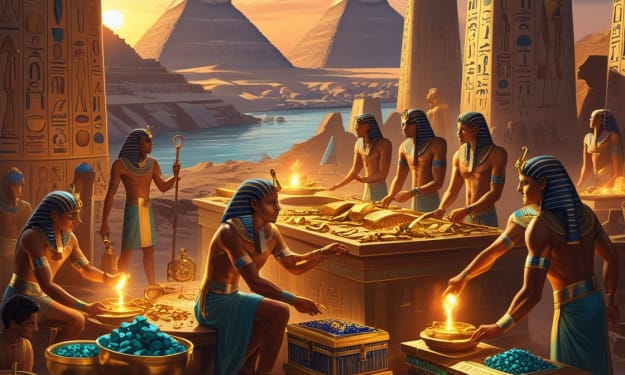
The Treasure Beneath the Nile: Egypt's Lost Gold Mines and Ancient Wealth. AI-Generated.
The Golden Legacy of the Nile The Nile River is justifiably regarded as the lifeblood of Ancient Egypt. Spanning over 6,600 kilometers, it not only facilitated agriculture in the arid desert but also functioned as a trade artery and spiritual thoroughfare. However, what rests beneath the deserts encircling the Nile has intrigued archaeologists and historians for centuries—gold.
By Say the truth 9 months ago in History