
Caravans of Light
How Islam Traveled the World Through Hearts, Not Swords

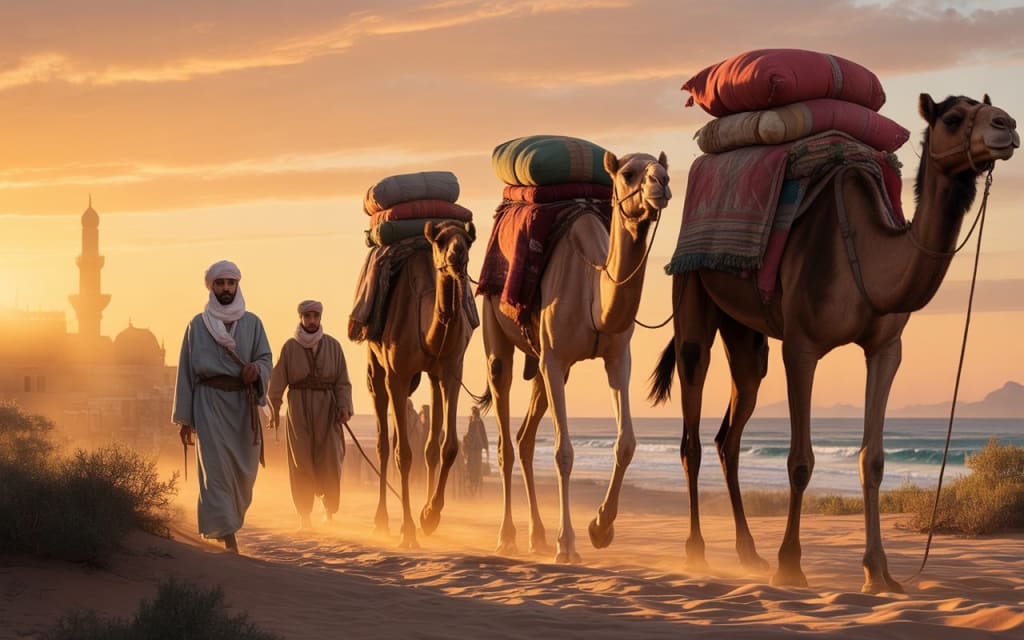
The wind was heavy with the scent of spice and sea.
Along the ancient trade routes, where dust kissed the horizon, a caravan moved slowly through the golden dunes — merchants draped in white, their camels swaying under the weight of silk, amber, and faith.
They were not soldiers.
They carried no banners, no swords — only the words of the Qur’an, folded gently within their hearts:
> “Invite to the way of your Lord with wisdom and good character.”
This is how Islam traveled — not through conquest, but through character.
From the ports of Arabia to the coasts of Africa, from the markets of India to the islands of the Malay world, it spread quietly — like dawn light seeping into a room, unnoticed until everything glowed.
In the 7th century, the Red Sea shimmered with ships from Yemen, Oman, and Hejaz. Their sails caught the monsoon winds, carrying traders east toward Zanzibar, Malabar, and Java. Wherever they anchored, they brought more than goods — they brought trust.
In bustling markets, they were known for their honesty. When they weighed spices, they gave a little extra. When they sold silk, they spoke truthfully of its worth. People noticed something rare in them — a calm integrity amid the chaos of trade.
> “Why do you deal so justly?” a man once asked a Muslim trader in East Africa.
> He smiled and replied, “Because our Prophet ﷺ taught us that the truthful merchant will stand with the prophets on the Day of Judgment.”
It was not argument that convinced people — it was example.
The call to prayer would rise softly from the ports, echoing between palm trees and masts, and locals would pause to watch these men bow together, shoulder to shoulder, facing a distant Kaaba they had never seen.
Some drew nearer. They asked questions. They listened.
And soon, they began to believe.
In Mombasa and Kilwa, Islam took root in coral-stone mosques by the sea. Sailors carved Qur’anic verses above doorways, believing that the same God who guided them across the ocean also guided hearts toward truth.
Further east, on the coast of Malabar, faith blossomed.
A story tells of Cheraman Perumal, a Hindu king who saw the moon split — a miracle performed by the Prophet Muhammad ﷺ in faraway Arabia. When traders recounted it, his heart trembled. He crossed the sea, embraced Islam, and never returned — but sent a letter urging his people to welcome this faith of peace.
From there, the call of Islam rode every wind.
By the 14th century, Muslim merchants had reached Indonesia, Malaysia, and the Philippines.
They built wooden mosques with thatched roofs — humble, open to air and rain. Villagers learned that faith was not foreign; it arrived with kindness, not conquest.
A Javanese farmer once said,
> “They prayed before dawn, traded with fairness, and shared food with the poor. We saw their God before we heard His name.”
As centuries passed, these traders became "teachers".
They built schools beside markets, taught children the Qur’an and mathematics, and married into local families. Cultures intertwined, giving rise to new expressions of Islam — woven into art, music, and language.
In "West Africa", Islam followed the great caravans of salt and gold across the Sahara. The city of "Timbuktu" rose from the sands — its mosques becoming beacons of learning, where thousands of manuscripts still sleep beneath the desert dust.
What united these lands — from the Swahili coast to the Malay archipelago — was not empire, but "ethics".
It was the belief that 'faith meant integrity', that 'trade was worship', and that 'every honest deal was a prayer.'
When the world speaks of Islam’s expansion, it often remembers armies — but "history whispers a gentler truth":
that beyond the reach of swords, Islam spread through the "hands of merchants", the "hearts of travelers", and the "smiles of strangers."
It moved not through power, but through patience — not through command, but through compassion.
And though empires have risen and fallen, those ancient trade routes still live — unseen, yet echoing in the rhythm of the "adhan" that carries from Africa to the Pacific.
It is the same call that once rose from the lips of a traveler long ago, standing beside his camel at sunset, watching the light fade over the dunes.
He turned toward the horizon and whispered:
> “There is no god but Allah.”
And with that whisper, another corner of the world found peace.
About the Creator
Nusuki
I am a storyteller and writer who brings human emotions to life through heartfelt narratives. His stories explore love, loss, and the unspoken, connecting deeply with listeners and inspiring reflection.
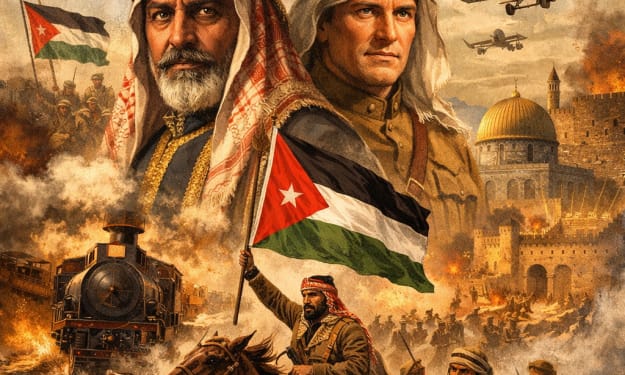
The Arab Revolt: How Arab Forces Allied with the British to Defeat the Ottoman Empire and Create Transjordan
During the early twentieth century, the Middle East was largely under the control of the Ottoman Empire, which had ruled Arab lands for nearly four centuries. However, the outbreak of World War I dramatically changed the political landscape of the region. One of the most significant developments of the war in the Middle East was the Arab Revolt, a rebellion led by Arab leaders with the support of the British. This revolt ultimately contributed to the defeat of Ottoman forces in the region and laid the groundwork for the creation of Transjordan.
By Irshad Abbasi 5 days ago in History
Early March 2026: 4 Goals Accomplished
It's early March and I've now accomplished my 4th writing goal for the year of 2026. Before diving into the behind-the-scenes of it... why not tell you up front what that accomplishment was? I was published in a 2nd publication for this year. Published in Helix Literary Magazine out of Central Connecticut State University. You can read it for free right now!
By Stephen Kramer Avitabile5 days ago in Writers


Comments
There are no comments for this story
Be the first to respond and start the conversation.