

In an age when empires rose and fell, as easily as shifting dunes, came a civilization that built not for kings but for God.
Their monuments were not born of pride, but of faith—stones laid with hands that whispered Bismillah before every strike.
Carrying one single idea from the deserts of Arabia to the green valleys of Spain, the Muslims of the Golden Age held the conviction that beauty is a manner of worship and to build with veracity is to praise the Creator through the very act of creation.
It had begun at Jerusalem, upon the high plateau of Al-Haram al-Sharif. There, the Caliph Abd al-Malik had ordered the building of a shrine—not to himself but to memory. The Dome of the Rock rose like the sun from the heart of the earth, its roof of gold shining bright against the blue of the sky. Inside, the verses of the Qur’an danced around the walls in graceful Arabic script, proclaiming the unity of Allah. Pilgrims entered and felt the stillness of the world—as if heaven had gently lowered itself onto the land.
A century later, across the ocean, in Al-Andalus, another miracle was to take shape. Exiled Prince Abd al-Rahman I wandered in the fields of Córdoba, far from his home in Damascus. A refugee, yet his faith never wavered. “If Allah has taken my homeland,” he said, “He will give me a purpose.” That purpose materialized as the Great Mosque of Córdoba — a forest of arches that stretches to infinity into light and shade.
When the sun poured through its windows, its varicolored red and white stones seemed to glow with embers, as prayers rose as waves against its marble pillars. And beneath its arches, scholars pored over books of geometry and theology and astronomy beside the Qur'an. In that holy space, the sacred and the secular merged, each enriching the other.
To the east, in Baghdad, the Abbassid caliphs envisioned an urban center that reflected perfection—embodying divine order. They called it Madinat al-Salam, the City of Peace. Within its confines, craftsmen projected mosques with courtyards open to the heavens, fountains murmuring verses of serenity. In nearby Samarra, they created a minaret that spirals upward in a circle, like a stairway to the stars. It is said that when the muezzin mounted to herald the prayer, his voice projected over the Tigris, swept over gardens and palaces and libraries—a sound that entered the rhythm of creation.
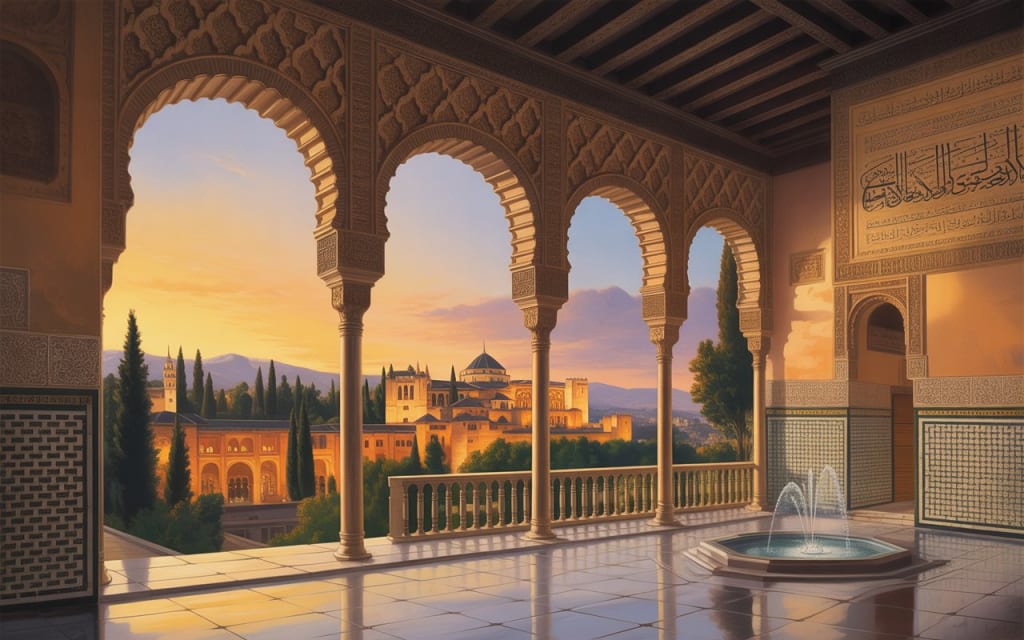
But it was in Granada, centuries later, that faith and beauty achieved their most delicate harmony. The Alhambra Palace shimmered like a dream atop a red hill. Its courtyards were full of water and light — reflections dancing across arabesque walls smeared with verses of the Qur’an. Every tile, every arch, every fountain was a whisper: “No conqueror but Allah.”
Here, architects did not work as a servant for kings; here, they worked as servants of God. They refused to sign their names to it. Their art was not for celebrity-ness; it was for remembrance. They carved infinite patterns that mirrored the divine order—geometry repeating endlessly, like the cycle of creation itself. Light poured through lattice windows, breaking into fragments that moved with the day, as though the building breathed with time.
As one traveler once of the Alhambra had written: “It is not a palace, but a prayer in stone.”
And indeed, it was what it was — a prayer time could not erase.
When the final kingdom of the Muslims fell in Spain, and the builders were gone with it, their walls stood—once again—telling verses to the wind. They could take the land, but not the soul that built it.
Centuries pass, and scholars come from afar to study them. They trace the arches, the domes, the mosaics—and within them, they find not just art, but mathematics, philosophy, devotion. From Córdoba to Granada, their knowledge bursts into Europe, shaping nothing less than the Renaissance itself.
But the real legacy of those builders was rather in why they created, than in what they created. They built because they built upon the belief that Allah is the Light of the heavens and the earth, and to reflect that light on earth was an act of worship. Their stones are still standing today — silent and alive. When the call for prayer reverberates from an ancient mosque, when the sun's rays creep through tinted glass, or when there falls upon a marble-inscribed verse the eye of the passerby, the heart still remembers what they knew: That faith, which can build beauty never to die, and that everything would last for ever when done for Allah.
About the Creator
Nusuki
I am a storyteller and writer who brings human emotions to life through heartfelt narratives. His stories explore love, loss, and the unspoken, connecting deeply with listeners and inspiring reflection.
Thief who stole $3.5 billion but lost all in one phone call part 2
The following year, the owner of Silk Road was arrested and the FBI shut down the website, seizing about 170,000 Bitcoins. However, 51,680 Bitcoins were still missing, and investigators had been trying to trace them for years.
By Imran Ali Shah6 days ago in History
Silken Chains
Silhouettes of the female form were given flesh and bone. Silken skin glistened under the spotlight. Dry ice rose around our Icons as they danced atop their podiums in the Square. Heralded for their beauty, their movements were slight, powerful, and sensual.
By Paul Stewart6 days ago in Fiction



Comments
There are no comments for this story
Be the first to respond and start the conversation.