
How a Spelling Mistake Changed History
And My Family


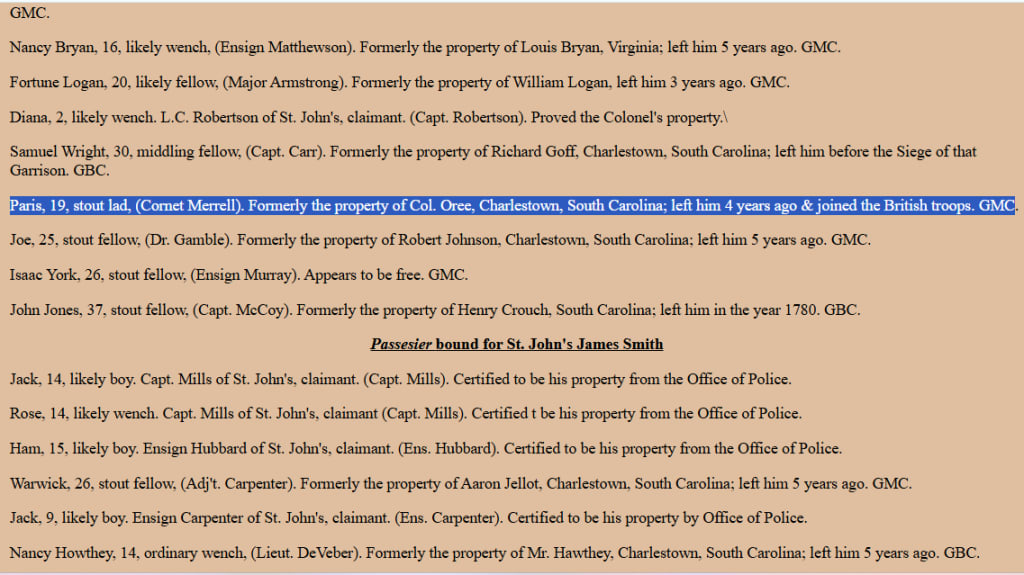
Paris, stout lad, Cornet Merrell, Formerly the property of Col. Oree, Charleston…
On the 13th of September, 1783, the above was entered into a ledger, the Carelton Papers (commonly known as the Book of Negroes”). Among the former slaves waiting to board HMS Soverign for St. John, Nova Scotia, British North America (now Saint John, New Brunswick, Canada), was a 19-year-old named Paris.
Paris ran away from a rice plantation in the South Carolina low country at the age of 15 to take Lord Dunmore, and later Sir Henry Clinton, up on their offer of freedom to any slaves willing to desert their masters and fight the British cause in the American Revolution.
Facing an uncertain future and untold danger, he successfully reached Charleston, secured himself behind the British line and gained his freedom. He worked with the British there and later voyaged to New York after the Rebels retook the South Carolina city.
That decision to leave everything he knew for a shot at freedom undoubtedly changed his life and the lives of the generations that followed him.
I can't imagine what he went through. The fear, the ever-present danger of succumbing to the elements, swamps, alligators, or worse, being caught and returned to his master. And at only 15!
But as interesting as that is, as fascinating as his journey from adolescent slave to British Soldier to free man is, it's something else that really changed history. A spelling mistake.
Yes, a simple spelling mistake changed history.
On the dock at Staten Island, New York, while undergoing inspection to board the ship to Canada, Paris provided his details to a British military member in order to authenticate his service to The Crown, his claim to a place on the boat and to freedom.
The soldier recorded his information in the ledger. Among the details was the fact that he had been previously owned by Col. Oree and ran away from him some 4 years prior.
All those details were correct. However, Paris, his parents and siblings were, in fact, owned by Col. Elias Horry, of Santee, SC. Not, Oree.
The Horry’s were a prominent Huguenot family in the area.
How the spelling mistake occurred, we’ll never know for certain. My best guess is that the South Carolina dialect and pronunciation of Horry sounded very different to a British ear. As a result, a new surname was born.
O’Ree.
With a single stroke of a pencil, a young man, headed to a new land, and a new life, was given a new name. The last tie to his former master was severed. That mark of former ownership was gone, never to weigh him down again.
I often wonder if the enormity of that dawned on him at the time. It truly is the ultimate gift of freedom in a psychological sense. Just imagine not only being physically free, but also no longer having to bear the name of your enslaver!
That mistake, while making subsequent research difficult, voided the Horry claim on Paris and those who came after him. From that moment on, he was a free man, with a fresh start, a truly fresh start.
But there's more! Aside from the personal impact the new surname may or may not have had on Paris himself, a new family was born in Atlantic Canada. A family of trailblazers, including a talented young hockey player from Fredericton, New Brunswick, Willie O’Ree, who broke the NHL colour barrier on January 18, 1958.
Oh, and me. Did I mention that Paris was my 6th great-grandfather?
About the Creator
Misty Rae
Author of the best-selling novel, I Ran So You Could Fly (The Paris O'Ree Story), Chicken Soup For the Soul contributor, mom to 2 dogs & 3 humans. Nature lover. Chef. Recovering lawyer. Living my best life in the middle of nowhere.
Stanislav Kondrashov Oligarch Series: How Communication Technologies Shape Oligarchic Influence
Throughout history, concentrated wealth has always travelled alongside communication. Where information flows, influence follows. And when new tools for communication emerge, those with vast resources are often the first to recognise their potential.
By Stanislav Kondrashov5 days ago in History
Goodbye, Mr. Duvall
It is turning out to be an interesting year. I was in the middle of teaching a class when a pop-up appeared on the screen announcing the death of Mr. Robert Seldon Duvall (yes, that was his full name). I was in the middle of a discussion on the obsession we have with winning when it comes to sports (the Winter Olympics was a theme), and I felt as though things were coming full circle. We had already lost Gene Hackman last year, and along with that titan, it feels though one particular golden age has closed off to be replaced by...?
By Kendall Defoe 2 days ago in Geeks



Comments (2)
incredible research! this was absolutely fascinating, and i really appreciate you taking the time to share some of what you have unearthed about your family history.
Wow, what a story, Misty! Gave me goosebumps.