Deji Akomolafe
Bio
Stories (512)
Filter by community
Medieval Masonry: The Craftsmanship Behind Iconic Structures
The medieval era, spanning roughly from the 5th to the 15th century, was an age of remarkable architectural innovation. From soaring cathedrals to fortified castles, medieval masonry laid the foundation—quite literally—for some of the world’s most enduring structures. These buildings, with their intricate stonework and enduring strength, not only showcased the skill of medieval masons but also reflected the cultural, religious, and technological advancements of the time.
By Deji Akomolafeabout a year ago in Art
The Secret Staircase: Unveiling Hidden Mysteries of a 19th Century Victorian Home
Nestled within the intricate design of a 19th-century Victorian home lies a hidden gem that has captivated historians, architects, and dreamers alike: a concealed staircase leading to a secret room. Such architectural curiosities are a testament to the ingenuity and charm of the Victorian era, where homes were not only built for function but also for intrigue and wonder.
By Deji Akomolafeabout a year ago in FYI
The “Ring Lady” of Herculaneum: A Snapshot of Roman Elegance and Tragedy
The year was 79 AD, and Mount Vesuvius erupted with apocalyptic fury, burying the ancient Roman cities of Pompeii and Herculaneum under layers of ash and volcanic debris. Thousands of lives were lost, their stories frozen in time. Among the many victims uncovered by archaeologists centuries later, one stands out for her poignant combination of elegance and tragedy—the "Ring Lady" of Herculaneum. This enigmatic woman, who met her end on the ancient waterfront, offers us a glimpse into the wealth, status, and resilience of Roman life.
By Deji Akomolafeabout a year ago in History
Gunnar Kaasen and Balto: Heroes of the 1925 Serum Run to Nome
In the harsh winter of 1925, the remote town of Nome, Alaska, faced a life-threatening outbreak of diphtheria. With ice-bound harbors and subzero temperatures rendering conventional transportation useless, the only hope for the community lay in the hands of a team of mushers and their sled dogs. Among these heroes was Gunnar Kaasen, a Norwegian-born musher, and his loyal lead dog, Balto. Together, they completed the final leg of the legendary "Serum Run," delivering lifesaving antitoxin to Nome and etching their names into history.
By Deji Akomolafeabout a year ago in History
The Invisibility of Poverty: A Street Art Masterpiece by Kevin Lee
Art has long served as a powerful medium to convey emotions, spark conversations, and shine a spotlight on pressing societal issues. Street art, in particular, carries a rawness and immediacy that few other art forms can match. It exists in public spaces, accessible to all, and often speaks directly to the human condition. One such piece, titled “The Invisibility of Poverty,” created by the street artist Kevin Lee, has recently garnered widespread attention for its poignant commentary on the overlooked struggles of the impoverished.
By Deji Akomolafeabout a year ago in Art
The Bronze Age Axe of Must Farm: A Glimpse into Ancient Britain’s Craftsmanship and Culture
In the heart of Cambridgeshire, a quiet corner of the English countryside, one of the most extraordinary archaeological discoveries of recent times was made. Unearthed in 2016 at Must Farm, near Whittlesey, the site has been dubbed “Britain’s Pompeii” due to its remarkable preservation. Among the countless artifacts recovered from this Bronze Age settlement, a bronze socketed axe with its charred wooden handle stands out as a poignant reminder of a bygone era. Dating back to between 1000 and 800 BCE, this artifact offers an unparalleled window into the lives, craftsmanship, and eventual demise of the people who lived there.
By Deji Akomolafeabout a year ago in History
Deciphering the Ancient Genius of the Plimpton 322 Tablet: The World’s Oldest Trigonometric Table
In the dusty archives of history, where myths and mysteries intermingle, the Plimpton 322 clay tablet has emerged as a shining testament to ancient ingenuity. Over 3,700 years old and originating from Babylon, this seemingly simple clay artifact has baffled and inspired researchers for decades. Thanks to the groundbreaking work of mathematicians from the University of New South Wales (UNSW) Sydney, the tablet’s true purpose has finally been decoded: it is the world’s oldest trigonometric table, predating Greek trigonometry by over a millennium.
By Deji Akomolafeabout a year ago in History
The Remarkable Wooden Roman Military Comb of Vindolanda: A Glimpse into Roman Life
In the rolling countryside of northern England lies the Roman Fort of Vindolanda, a treasure trove of archaeological finds that offers a glimpse into life on the Roman frontier. Among the numerous artifacts unearthed at this site is a rare and fascinating object: a wooden military comb, exquisitely decorated with an image of a Roman soldier. Though small and utilitarian, this artifact provides a unique window into the daily lives, hygiene practices, and artistic sensibilities of the Roman military nearly two millennia ago.
By Deji Akomolafeabout a year ago in History
The Fascinating World of the Fibonacci Sequence
The Fibonacci sequence is one of the most famous and intriguing numerical patterns in mathematics. Discovered by the Italian mathematician Leonardo of Pisa, better known as Fibonacci, this sequence has captivated mathematicians, scientists, and artists alike for centuries. Its applications span mathematics, nature, art, and architecture, making it a universal symbol of balance and harmony.
By Deji Akomolafeabout a year ago in Art
The Darvaza Crater: The Gateway to Burning Pit in Turkmenistan
Deep in the Karakum Desert of Turkmenistan lies a fiery phenomenon that has captivated adventurers, scientists, and tourists for over five decades. Known as the Darvaza Crater, or more "ive burning crater is a testament to the unpredictable intersection of human activity and nature. A bizarre accident turned natural gas well has now become one of the most extraordinary and surreal attractions in the world.
By Deji Akomolafeabout a year ago in Earth
The Nijmegen Cavalry Helmet: A Testament to Roman Craftsmanship and Military Prowess
Among the remarkable artifacts unearthed from the Roman Empire, few captivate the imagination as much as the Nijmegen Cavalry Helmet. Discovered in 1915 near the Waal River in Nijmegen, The Netherlands, this ceremonial helmet is a stunning example of Roman artistry and ingenuity. Dating back to the late 1st century AD, it provides a unique glimpse into the lives of Rome's elite cavalry units, whose influence stretched across the vast empire. Now displayed at the Museum het Valkhof, the helmet continues to enthrall historians, archaeologists, and the public alike.
By Deji Akomolafeabout a year ago in History
The Solar Boat of Khufu: A Masterpiece of Ancient Egyptian Craftsmanship
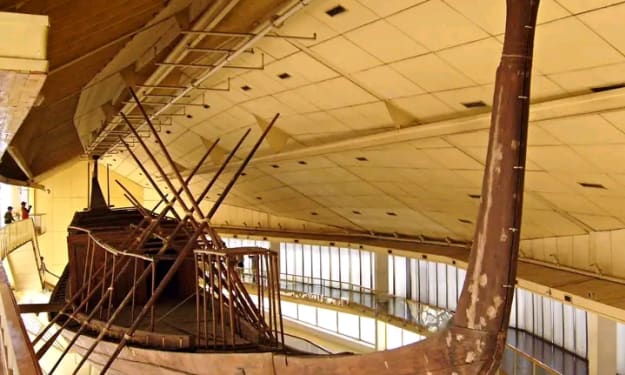
In 1954, a team of archaeologists working near the base of the Great Pyramid of Giza uncovered a discovery of monumental significance: a 4,600-year-old vessel hidden in a sealed pit beneath massive limestone blocks. Known today as the Solar Boat of Khufu, this artifact not only reflects the advanced craftsmanship of ancient Egypt but also offers a fascinating glimpse into the spiritual and practical life of the era.
By Deji Akomolafeabout a year ago in History