
The Fascinating World of the Fibonacci Sequence
Mathematical Art


The Fibonacci sequence is one of the most famous and intriguing numerical patterns in mathematics. Discovered by the Italian mathematician Leonardo of Pisa, better known as Fibonacci, this sequence has captivated mathematicians, scientists, and artists alike for centuries. Its applications span mathematics, nature, art, and architecture, making it a universal symbol of balance and harmony.
The Origins of the Fibonacci Sequence
Leonardo Fibonacci was born in Pisa in 1175. As the son of a wealthy merchant, Fibonacci traveled extensively during his youth, accompanying his father to the port city of Bejaia, in the Kabylia region of modern-day Algeria. There, Fibonacci was introduced to Hindu-Arabic numerals, a far more efficient numbering system than the Roman numerals used in Europe at the time.
Fascinated by the mathematical systems he encountered, Fibonacci began studying and eventually wrote the influential book "Liber Abaci" (The Book of Calculation) in 1202. It was in this book that Fibonacci introduced the sequence that would later bear his name. The Fibonacci sequence was originally used to solve a practical problem about the reproduction of rabbits, a question posed to demonstrate the efficiency of Hindu-Arabic numerals in calculations.
The Sequence: Simple Yet Profound
The Fibonacci sequence begins with 1, 1, and each subsequent number is the sum of the two preceding numbers:
1, 1, 2, 3, 5, 8, 13, 21, 34, 55, 89, 144, …
This simple rule creates a pattern that grows exponentially yet maintains a consistent mathematical relationship. The ratio between consecutive Fibonacci numbers approaches the golden ratio (approximately 1.618) as the sequence progresses.
The golden ratio, denoted by the Greek letter φ (phi), is often associated with aesthetic beauty and is frequently found in nature, art, and architecture.
Applications of the Fibonacci Sequence
In Mathematics and Science
The Fibonacci sequence has numerous applications in mathematics. It appears in combinatorics, where it can be used to count objects, and in algebra, as a basis for solving problems involving recursion. The sequence also has applications in computer science, particularly in algorithm design and data structure optimization.
In nature, the Fibonacci sequence is observed in the arrangement of leaves, flowers, and seeds, where efficiency and symmetry are key. For instance, the spiral patterns of sunflower seeds, pinecones, and shells often follow the Fibonacci sequence, allowing for optimal packing and growth.
In Art and Architecture
The golden ratio derived from the Fibonacci sequence has inspired countless works of art and architecture. Renaissance artists like Leonardo da Vinci are thought to have used the golden ratio in their paintings to achieve a sense of proportion and harmony.
In architecture, the golden ratio can be found in the proportions of historical structures such as the Parthenon in Greece and the Great Pyramid of Giza. The sequence continues to influence modern designs, from graphic design layouts to product packaging.
In Finance
The Fibonacci sequence even extends into the world of finance. Technical analysts use Fibonacci retracement levels to predict price movements in stocks and commodities. These levels are derived from the ratios between Fibonacci numbers and are used to identify potential areas of support and resistance in the market.
Fibonacci's Legacy
Though Fibonacci’s sequence is perhaps his most famous contribution, his broader legacy lies in his role as a bridge between the mathematical traditions of the Middle East, India, and Europe. By popularizing the Hindu-Arabic numeral system in Europe, Fibonacci revolutionized commerce and calculation. His work laid the foundation for the mathematical and scientific advancements of the Renaissance.
Today, Fibonacci is celebrated not just as a mathematician but as a pioneer who demonstrated the interconnectedness of mathematics and the natural world. The Fibonacci sequence remains a symbol of growth, order, and the inherent beauty of numbers.
Why the Fibonacci Sequence Resonates
The Fibonacci sequence resonates with so many because it represents universality and harmony. Its presence in everything from a nautilus shell to the stock market speaks to the interconnectedness of the universe. Whether you're an artist, a scientist, or a casual observer of nature, the Fibonacci sequence offers a window into the elegant patterns that underlie our world.
A Modern Appreciation
In today’s world, the Fibonacci sequence continues to capture the imagination of mathematicians, educators, and enthusiasts. It is a frequent topic in classrooms and is celebrated through Fibonacci-themed art, music, and even software.
Moreover, the sequence serves as a reminder of the timelessness of mathematical discovery. The curiosity that led Fibonacci to explore the world of numbers is the same spirit that drives innovation today.
Conclusion
The Fibonacci sequence is more than just a series of numbers; it is a journey into the essence of order and beauty. From its humble origins in a medieval mathematical text to its modern applications in science and art, the sequence continues to inspire awe and wonder.
Leonardo Fibonacci’s legacy is a testament to the power of curiosity and exploration. The next time you see a sunflower or marvel at a spiral staircase, take a moment to appreciate the subtle patterns of the Fibonacci sequence that connect us all to the mysteries of the universe.
About the Creator
Keep reading
More stories from Deji Akomolafe and writers in Art and other communities.
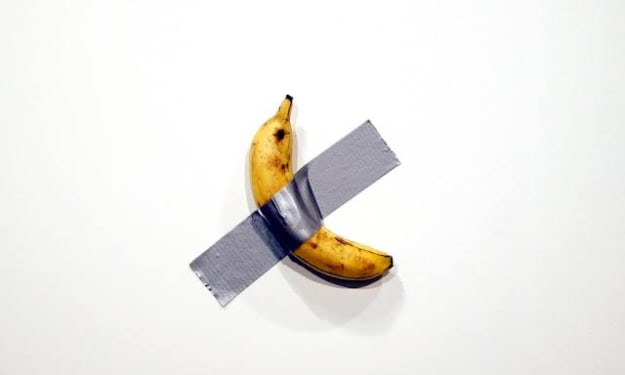
The. Viral Banana Duct-Taped to a Wall? It Just Sold for $6.2 Million
In December 2019, at Art Basel Miami Beach, a simple yellow banana duct-taped to a white wall transformed into one of the most polarizing and provocative art pieces of the decade. Titled Comedian, the work by Italian artist Maurizio Cattelan sparked heated debates, viral memes, and profound discussions on the nature of art and its value. While to some, it was a joke taken too far, to others, it was a revolutionary commentary on contemporary art and culture.
By Deji Akomolafeabout a year ago in Art
Why Nietzsche Belongs in 2026
As the world moves toward 2026, it does not feel like a calm progression into the future—it feels like a collision. Rapid technological acceleration, cultural fragmentation, economic uncertainty, and a deep crisis of meaning define the modern condition. Traditional authorities are distrusted, ideologies compete aggressively, and individuals feel both empowered and exhausted by choice. In such a landscape, Friedrich Nietzsche’s philosophy emerges not as a comfortable guide, but as a necessary one. Unsettling, demanding, and brutally honest, Nietzsche may offer the most fitting philosophical framework for the year ahead.
By Fred Bradford7 days ago in Art
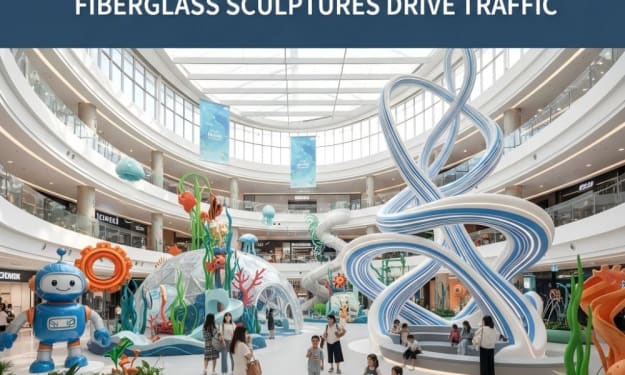
2026 Commercial Space Design:How Fbierglass Sculpture Drives Traffic
Today, offline commercial spaces are facing continuous pressure. With e-commerce offering convenient and fast services, physical stores must showcase unique features to attract customers. In this context, fiberglass sculptures are no longer merely decorative items; they have become visual focal points in shopping malls, brand stores, pop-up shops, and mixed-use commercial projects, playing a crucial role in increasing foot traffic.
By Shenzhen Ruiheng Crafts2 days ago in Art


Comments
There are no comments for this story
Be the first to respond and start the conversation.