
Deciphering the Ancient Genius of the Plimpton 322 Tablet: The World’s Oldest Trigonometric Table
Ancient Civilization

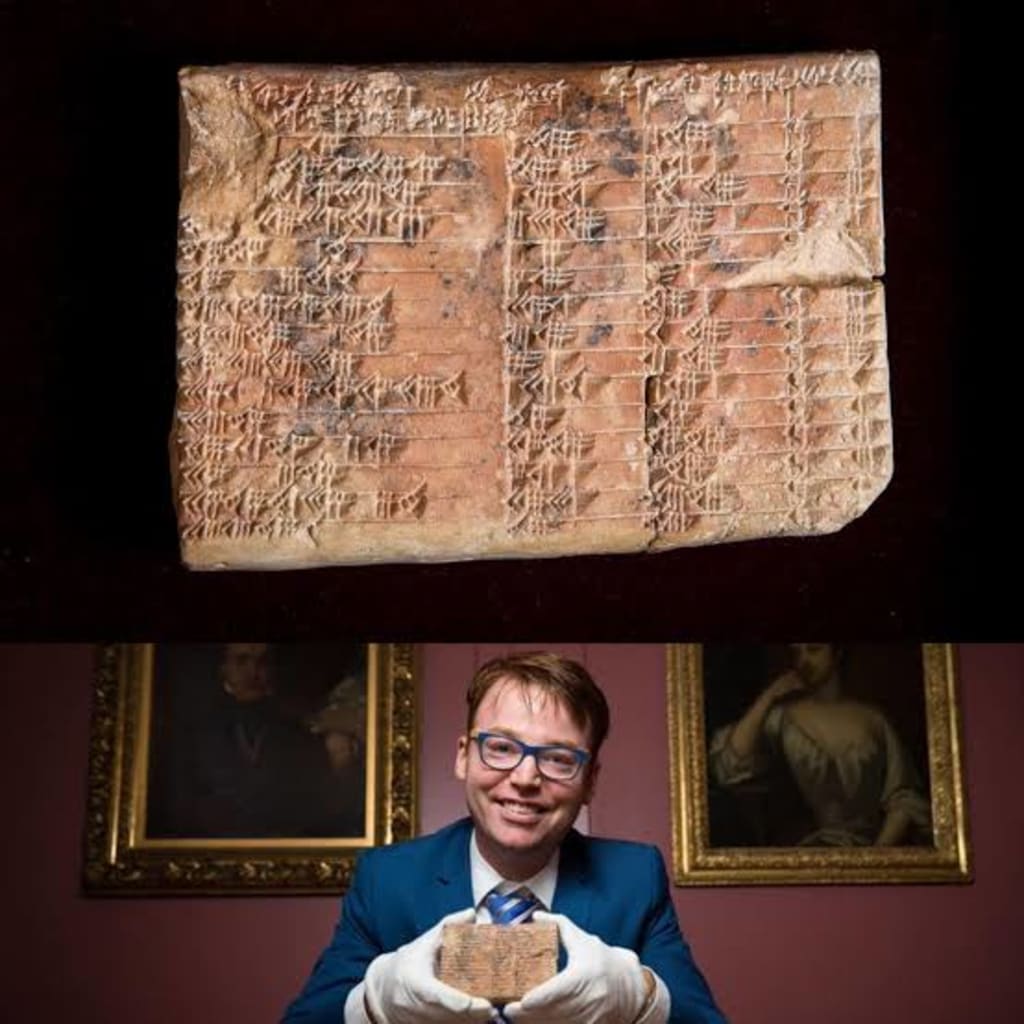
In the dusty archives of history, where myths and mysteries intermingle, the Plimpton 322 clay tablet has emerged as a shining testament to ancient ingenuity. Over 3,700 years old and originating from Babylon, this seemingly simple clay artifact has baffled and inspired researchers for decades. Thanks to the groundbreaking work of mathematicians from the University of New South Wales (UNSW) Sydney, the tablet’s true purpose has finally been decoded: it is the world’s oldest trigonometric table, predating Greek trigonometry by over a millennium.
This extraordinary discovery not only rewrites the history of mathematics but also highlights the advanced understanding of geometry and engineering possessed by the Babylonians, centuries before such concepts were formally explored in the Western world.
What is the Plimpton 322 Tablet?
The Plimpton 322 tablet, currently housed at Columbia University in New York, is a clay artifact inscribed with a list of Pythagorean triples written in cuneiform script. The tablet was discovered in the early 20th century in the ancient city of Larsa, in what is now Iraq. Its content, written in a base-60 numeral system (similar to the system we use for measuring time), has puzzled scholars since its discovery.
For decades, researchers speculated about the tablet’s purpose. Was it a teaching tool? A record of land measurements? A religious artifact? Now, thanks to modern mathematical analysis, it is understood to be an early trigonometric table, devised for practical applications such as architecture and engineering.
How Did the Babylonians Use Trigonometry?
Unlike the Greeks, who based their trigonometry on angles and circles, the Babylonians used a system of ratios. The UNSW team discovered that the tablet lists a series of Pythagorean triples—sets of three numbers (a, b, c) that satisfy the equation \(a^2 + b^2 = c^2\). These triples were likely used to calculate right-angled triangles, making the tablet an incredibly accurate tool for solving geometric problems.
This innovative approach to trigonometry may have been applied to a variety of large-scale projects in Babylonian society, such as:
- Building ziggurats: These stepped temples required precise calculations to ensure stability and symmetry.
- Constructing canals: Engineering water systems across Mesopotamia’s flat landscape demanded meticulous geometric planning.
- Designing cities: Babylonian urban planning often involved the creation of standardized rectangular layouts.
Why is the Babylonian System Unique?
The Babylonian method of trigonometry, based on ratios, is fundamentally different from the angle-and-circle-based system developed by the Greeks, such as that of Hipparchus or Ptolemy. This base-60 approach, combined with the use of exact Pythagorean triples, allowed the Babylonians to perform calculations with a level of accuracy that rivaled—and in some cases exceeded—modern methods.
One of the key advantages of the Babylonian system is its avoidance of irrational numbers. In modern trigonometry, many calculations involve irrational square roots, which can introduce rounding errors. By using whole-number ratios, the Babylonians achieved precision without relying on approximations.
A Thousand Years Before Pythagoras
What makes this discovery even more remarkable is that it predates the work of Greek mathematicians like Pythagoras by over 1,000 years. While Pythagoras is often credited with the foundational theorem of right-angled triangles, the Babylonians were clearly using these principles long before his time.
This raises intriguing questions about the flow of knowledge in the ancient world. Did the Greeks inherit some of their mathematical concepts from earlier civilizations? How much more advanced was Babylonian mathematics than we currently realize?
Practical Applications in the Ancient World
The discovery that the Plimpton 322 tablet served as a trigonometric table sheds light on the advanced problem-solving skills of the Babylonians. Their ability to conceptualize and utilize complex mathematics was not purely theoretical—it had real-world applications.
For example:
- Ziggurat construction would have required precise calculations to determine the height and angle of each step, ensuring that the structure remained stable over time.
- Canal systems, vital for agriculture and trade, relied on geometric accuracy to distribute water efficiently across vast distances.
- Surveying land for agriculture and urban development would have demanded tools for measuring distances and angles accurately.
Modern Implications of an Ancient Method
Interestingly, the Babylonian method of trigonometry may still hold value in modern times. According to UNSW researchers, the ratio-based system outlined on Plimpton 322 could be more efficient and accurate than contemporary trigonometry for certain types of calculations. For example, it could have applications in computer graphics, surveying, and engineering, where minimizing errors is crucial.
This revelation underscores the timeless nature of mathematical principles and their potential to inspire new approaches, even in the 21st century.
A Window into Ancient Genius
The Plimpton 322 tablet is more than just a mathematical artifact; it is a testament to the ingenuity and intellectual curiosity of the ancient world. Its decipherment highlights the interconnectedness of human achievement across cultures and eras, reminding us that progress is often built on the foundations laid by those who came before us.
As researchers continue to study this enigmatic tablet, it may yet reveal more secrets about Babylonian society and its unparalleled contributions to mathematics and engineering. For now, the Plimpton 322 stands as a remarkable example of how a small clay tablet can rewrite our understanding of history—and challenge us to look at the world in new and innovative ways.
The Babylonians may be long gone, but their legacy endures, etched in clay and preserved through the ages as a reminder of humanity’s enduring quest for knowledge.
About the Creator
Keep reading
More stories from Deji Akomolafe and writers in History and other communities.
The Remarkable Wooden Roman Military Comb of Vindolanda: A Glimpse into Roman Life
In the rolling countryside of northern England lies the Roman Fort of Vindolanda, a treasure trove of archaeological finds that offers a glimpse into life on the Roman frontier. Among the numerous artifacts unearthed at this site is a rare and fascinating object: a wooden military comb, exquisitely decorated with an image of a Roman soldier. Though small and utilitarian, this artifact provides a unique window into the daily lives, hygiene practices, and artistic sensibilities of the Roman military nearly two millennia ago.
By Deji Akomolafeabout a year ago in History
3 Everyday Rules That Exist Because Someone Once Did Something Very Stupid
Everywhere you go, you are surrounded by rules that feel oddly specific. Do not touch. No running. Contents hot. Do not insert body parts. These warnings aren’t theoretical. They weren’t written by pessimists or lawyers with too much free time. They exist because at some point in history, a real human being looked at a situation and thought, “This will probably be fine.”
By Enoch Sagini3 days ago in History



Comments
There are no comments for this story
Be the first to respond and start the conversation.