
The Bronze Age Axe of Must Farm: A Glimpse into Ancient Britain’s Craftsmanship and Culture
Ancient Craft

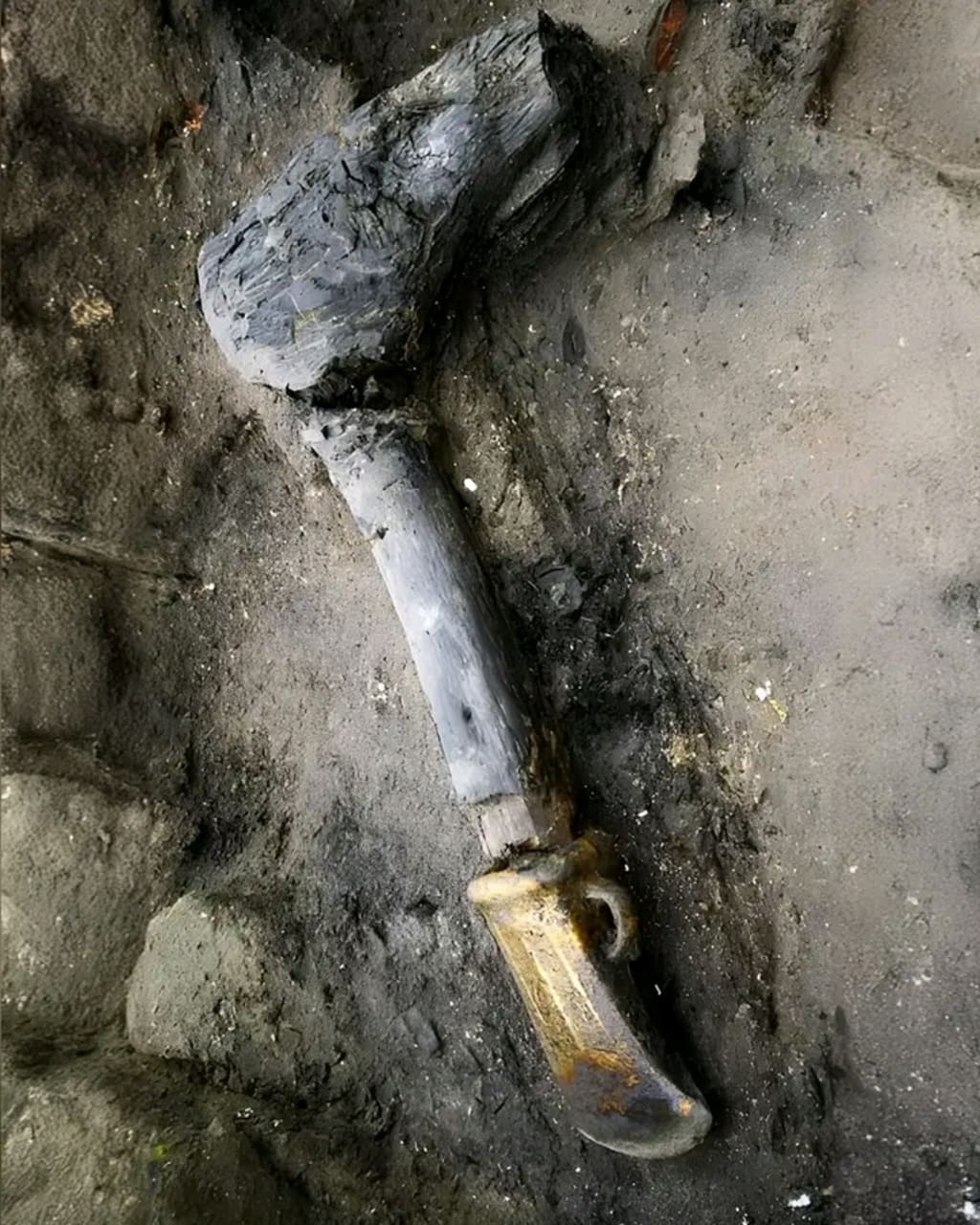
In the heart of Cambridgeshire, a quiet corner of the English countryside, one of the most extraordinary archaeological discoveries of recent times was made. Unearthed in 2016 at Must Farm, near Whittlesey, the site has been dubbed “Britain’s Pompeii” due to its remarkable preservation. Among the countless artifacts recovered from this Bronze Age settlement, a bronze socketed axe with its charred wooden handle stands out as a poignant reminder of a bygone era. Dating back to between 1000 and 800 BCE, this artifact offers an unparalleled window into the lives, craftsmanship, and eventual demise of the people who lived there.
A Settlement Frozen in Time
The Must Farm site was a small riverside settlement built on wooden stilts above a shallow waterway. It was home to a Bronze Age community whose daily lives revolved around agriculture, tool-making, and trade. However, this vibrant settlement met a sudden and catastrophic end when a devastating fire consumed the structures. As the burning buildings collapsed into the river, they were quickly buried under layers of silt, preserving an astonishing array of objects, including pottery, textiles, tools, and even food remains.
The preservation of organic materials, such as wood and plant fibers, is particularly rare in archaeological sites, making Must Farm a treasure trove for historians and archaeologists. The bronze axe with its charred handle is a standout artifact, combining the durability of metal with the fragility of wood—an almost miraculous survival over the millennia.
The Bronze Axe: Craftsmanship and Utility
The bronze socketed axe is a testament to the technological sophistication of Bronze Age societies. The socketed design, which allowed the handle to be securely fitted into the metal head, represented a significant advancement in tool-making. This innovation made the axe both more durable and versatile, ensuring it could withstand repeated use in tasks such as chopping wood, shaping timber, or even serving as a weapon.
The handle, made of carefully selected wood, exhibits the craftsmanship of the time. Though charred by the fire that consumed the settlement, it still offers valuable insights into how tools were constructed and used. The fact that both the axe head and handle have survived together is exceedingly rare and provides a unique opportunity to study the complete artifact in its original context.
A Glimpse into Daily Life
The discovery of the axe, along with other tools and household items, paints a vivid picture of life at Must Farm. This was a community deeply connected to its environment, utilizing natural resources with remarkable efficiency. Bronze tools like this axe would have been highly prized possessions, indicating the owner's status and skill.
Bronze itself was an important material in this period, created by alloying copper with tin. Its production required not only technical expertise but also extensive trade networks, as tin was not locally available in most parts of Britain. The presence of such tools at Must Farm suggests that its inhabitants were part of a broader web of economic and cultural exchange.
The Fire and Preservation
The tragedy that struck Must Farm also became its greatest preservation factor. As the settlement’s wooden structures burned and collapsed into the river, the lack of oxygen in the waterlogged environment slowed the decomposition of organic materials. The silt that settled over the remains acted as a protective blanket, sealing the site from the elements and the passage of time.
This unique combination of circumstances has allowed archaeologists to recover artifacts in a condition rarely seen in sites of this age. The charred handle of the bronze axe, for instance, still bears the marks of craftsmanship, as well as the scars of the fire that ended its use.
The Significance of the Find
The Must Farm axe, now housed in the Cambridge Archaeological Unit, is more than just a tool—it is a tangible connection to the people of Bronze Age Britain. It tells a story of ingenuity, resilience, and the enduring human spirit. Through this artifact, we gain insight into the technological advancements of the time, the daily lives of the settlement's inhabitants, and their ability to adapt to the challenges of their environment.
Furthermore, the axe serves as a symbol of the shared heritage that links us to our ancestors. It reminds us of the universality of human endeavor—the desire to create, innovate, and thrive, even in the face of adversity.
A Legacy Preserved
The ongoing study of the Must Farm site continues to shed light on the Bronze Age, providing valuable lessons about resourcefulness, community, and the impact of environmental and societal change. The bronze axe, with its dual legacy of craftsmanship and catastrophe, stands as a centerpiece of this remarkable discovery.
For visitors and researchers alike, this artifact offers an intimate glimpse into a world long past, where the tools of survival and progress were forged in metal, shaped by human hands, and preserved by the forces of nature. As we marvel at its survival, we are reminded of the deep and enduring connection between humanity and the tools that define us.
About the Creator
Keep reading
More stories from Deji Akomolafe and writers in History and other communities.
Deciphering the Ancient Genius of the Plimpton 322 Tablet: The World’s Oldest Trigonometric Table
In the dusty archives of history, where myths and mysteries intermingle, the Plimpton 322 clay tablet has emerged as a shining testament to ancient ingenuity. Over 3,700 years old and originating from Babylon, this seemingly simple clay artifact has baffled and inspired researchers for decades. Thanks to the groundbreaking work of mathematicians from the University of New South Wales (UNSW) Sydney, the tablet’s true purpose has finally been decoded: it is the world’s oldest trigonometric table, predating Greek trigonometry by over a millennium.
By Deji Akomolafeabout a year ago in History
Alexander the Great’s Looted Wealth from India: A Historical and Economic Estimation
While his campaigns reshaped the ancient world politically and culturally, one of their most lasting impacts was the massive wealth he acquired from conquered territories, especially during his Indian campaign. This article explores the historical context, nature of the wealth looted from India, and an estimated net worth of that treasure in modern terms—revealing the truly staggering value of what came into Alexander’s hands.
By Say the truth 7 days ago in History
The Rise and Fall of Nicolae Ceaușescu
Nicolae Ceaușescu’s rise to power was initially marked by promise, even optimism. Born in 1918 into a poor peasant family, he entered politics early, shaped by the ideological rigidity of interwar and wartime communism. When he became General Secretary of the Romanian Communist Party in 1965, following the death of Gheorghe Gheorghiu-Dej, many Romanians saw in him a younger leader, one who might soften the harsh Stalinist legacy that had defined the previous decades. For a society weary of repression and deprivation, Ceaușescu appeared to embody the possibility of cautious change.
By Pure child2 days ago in History



Comments
There are no comments for this story
Be the first to respond and start the conversation.