Adnan Rasheed
Bio
Author & Creator | Writing News , Science Fiction, and Worldwide Update| Digital Product Designer | Sharing life-changing strategies for success.
Stories (475)
Filter by community
A new U.S. Air Force analysis recommends continuing the development of NGAD, as well as terminating the NGAS stealth tanker program which was supposed to support the next gen fighter in contested airspace.
The United States Air Force (USAF) has recently concluded a comprehensive analysis of two major developmental programs: the Next-Generation Air Dominance (NGAD) fighter and the Next-Generation Air Refueling System (NGAS) stealth tanker. After months of internal discussions and strategic reviews, the Air Force has decided to continue the development of the NGAD while recommending the termination of the NGAS program. This decision underscores a shifting perspective on how aerial dominance and refueling strategies will evolve in contested environments, particularly in the face of growing technological advancements and budgetary constraints.
By Adnan Rasheed12 months ago in Serve
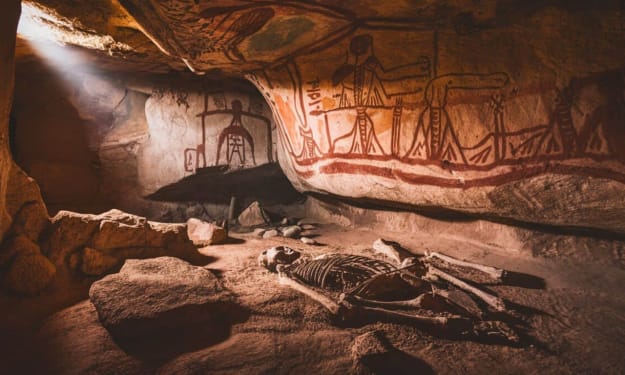
Archaeologists Uncover 29,000-Year-Old Child Skeleton in a Cave in Thailand with ‘Symbols of Blood and Power.
Archaeologists in Thailand have made an extraordinary discovery that sheds new light on ancient burial practices and early human civilizations. A 29,000-year-old child skeleton has been unearthed in a cave at the Tham Din archaeological site, located within Khao Sam Roi Yot National Park. This remarkable find is now considered the oldest child remains ever found in Thailand, offering crucial insights into the rituals, beliefs, and artistic expressions of prehistoric societies.
By Adnan Rasheed12 months ago in History
Giant Ancient Egg Found in Antarctica Could Be the First From a Mosasaur. AI-Generated.
Giant Ancient Egg Found in Antarctica Could Be the First From a Mosasaur A groundbreaking discovery in Antarctica has left scientists astonished—a massive, ancient egg that could potentially belong to a mosasaur, a prehistoric marine reptile that ruled the oceans during the Late Cretaceous period. This finding challenges long-held beliefs about how these ancient predators reproduced and opens up new questions about their life cycle, evolution, and adaptability.
By Adnan Rasheed12 months ago in History
9 Things Highly Disciplined People Never Allow in Their Lives. AI-Generated.
9 Things Highly Disciplined People Never Allow in Their Lives Discipline is the key to success. Highly disciplined people are not just good at sticking to routines; they actively avoid behaviors and habits that hinder their growth and productivity. They make conscious choices every day to maintain focus, achieve goals, and lead a balanced life.
By Adnan Rasheed12 months ago in Longevity
Straight Out of Sci-Fi: Earth Receives a Deep-Space Laser Message from 16 Million Kilometers Away.
NASA has achieved a groundbreaking milestone in space communication by successfully transmitting a laser-based message from the Psyche spacecraft to Earth across a staggering 16 million kilometers. This achievement, part of the Deep Space Optical Communications Experiment (DSOC), represents a major leap forward in interplanetary communication, potentially revolutionizing the way data is transmitted through space.
By Adnan Rasheed12 months ago in Earth
Scientists May Have Just Found the Best Way to Detect Life on Mars
Scientists May Have Just Found the Best Way to Detect Life on Mars. For decades scientists have been searching for signs of life on Mars and a recent breakthrough may have just provided a powerful new method to detect ancient microbial life. A recent study suggests that microbial fossils could be preserved within sulfate minerals like gypsum which are abundant on the Martian surface. If confirmed this discovery could revolutionize how space agencies approach the search for extraterrestrial life. Mars has long been considered one of the most promising places in our solar system to search for past life. Billions of years ago Mars had a warmer wetter climate complete with rivers lakes and possibly even oceans. This means the planet may have had the right conditions to support microbial life. However over time the Martian climate changed dramatically turning it into the cold dry desert world we see today. Despite these harsh conditions scientists believe that remnants of ancient microbial life could still be found hidden within the planet’s rocks and minerals. The challenge has always been how to detect these potential biosignatures effectively. That’s where the recent study comes in suggesting that sulfate minerals could be the key to solving this puzzle. Sulfate minerals like gypsum and epsomite form in environments where water evaporates leaving behind mineral deposits. On Earth these minerals have been known to trap and preserve microbial life for millions of years. This process is similar to how fossils form in sedimentary rock but in this case microbes get trapped inside crystal structures protecting them from environmental damage. Mars has vast deposits of sulfate minerals especially in regions like Gale Crater where NASA’s Curiosity rover is currently exploring. These sulfate rich areas are thought to have formed when ancient Martian lakes and rivers dried up. If microbial life once existed in these water bodies their remains could be locked inside these minerals.
By Adnan Rasheed12 months ago in Earth
Researchers Map 7,000-Year-Old Canal System of the World’s Oldest City
Researchers Map 7,000-Year-Old Canal System of the World’s Oldest City In a groundbreaking discovery archaeologists and geologists have successfully mapped a vast and intricate irrigation canal system that once sustained the ancient city of Eridu widely considered the world's oldest city. Located in present day southern Iraq Eridu was founded around 5,400 BC and was a crucial part of early Sumerian civilization. This recent research offers unprecedented insight into how the city's inhabitants engineered and maintained a sophisticated water management system allowing them to thrive in an otherwise arid environment. While traces of these canals were previously known this is the first time that scientists have successfully tracked the entire network revealing a well preserved irrigation system that played a vital role in sustaining agriculture and urban life. This discovery provides new evidence of the ingenuity of the ancient Sumerians and how they harnessed their environment to build a civilization that influenced future societies.
By Adnan Rasheed12 months ago in History
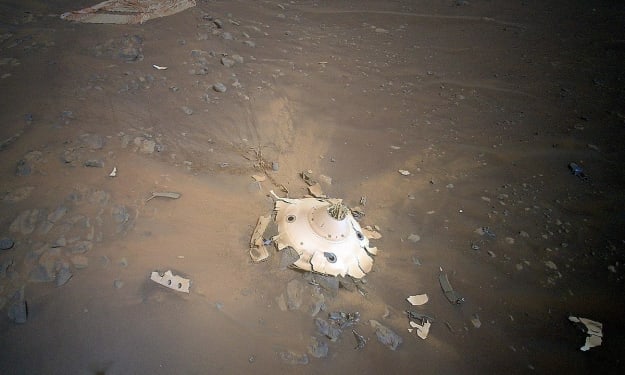
NASA’s Ingenuity Captures ‘Surreal’ Image of Wreckage on Mars No One Expected.
NASA’s Ingenuity Captures ‘Surreal’ Image of Wreckage on Mars No One Expected. NASA’s Ingenuity helicopter has once again proven its worth not just as an aerial scout but as an unexpected chronicler of Mars exploration history. Originally intended for just five experimental flights the tiny rotorcraft has now completed 72 successful missions far surpassing expectations. During one of its recent flights over the Jezero Crater Ingenuity captured something truly astonishing scattered wreckage from its own historic landing. This discovery while surreal serves as a powerful reminder of humanity’s growing presence on the Red Planet. The debris which once played a crucial role in delivering Perseverance and Ingenuity safely to the Martian surface is now a collection of twisted metal and torn fabric lying in the cold, dusty expanse. The images taken by Ingenuity reveal remnants of the entry descent and landing EDL system including a parachute and protective backshell which had shielded the rover and helicopter from the fiery descent through the thin Martian atmosphere.
By Adnan Rasheed12 months ago in Earth
NASA Has Made Its Decision Here Is the Most Realistic Sci-Fi Movie to Represent the Future
NASA Has Made Its Decision Here Is the Most Realistic Sci-Fi Movie to Represent the Future In 2011 NASA compiled a list of the most scientifically accurate science fiction films ever made. Among them Gattaca (1997) stood out as the most realistic portrayal of the future. More than a decade later its vision of a society dominated by genetic engineering remains hauntingly relevant. Science fiction has long been a genre that oscillates between pure fantasy and insightful predictions about the future. While some films rely heavily on visual spectacle and improbable scenarios others manage to balance scientific accuracy with compelling narratives. Recognizing this NASA brought together experts from its Jet Propulsion Laboratory to evaluate science fiction films based on their scientific plausibility. The results placed Gattaca at the top followed by Contact (1997) and Metropolis (1927). Meanwhile blockbusters like Armageddon (1998) and 2012 (2009) were dismissed as scientifically inaccurate. What sets Gattaca apart from other science fiction films is its eerily plausible vision of a world where genetic engineering dictates social hierarchy. Directed by Andrew Niccol the film presents a future in which children are no longer conceived naturally but designed in laboratories. Parents select desirable traits for their offspring ensuring that they are free from hereditary diseases and genetic imperfections. Those who are born naturally without genetic enhancements are considered inferior and are systematically denied opportunities. This dystopian world is not ruled by artificial intelligence or extraterrestrial forces but by the very science that humanity is actively developing today.
By Adnan Rasheedabout a year ago in Futurism
New language discovered to be developing in the United States.
New language discovered to be developing in the United States. The United States has always been a melting pot of cultures languages and traditions and nowhere is this more evident than in Miami Florida. In this vibrant city where Spanish and English intertwine in everyday life a new dialect of English has been quietly developing. This Spanish influenced variety of English shaped by decades of immigration from Latin America is a testament to how language constantly evolves in response to cultural and social interactions. Linguists at Florida International University have been studying this phenomenon for over a decade and they argue that Miami’s unique English dialect is a living example of language adaptation in a multilingual society. Miami is one of the most bilingual cities in the United States. The majority of its population is Hispanic or Latino with roots in Cuba Venezuela Colombia and other Spanish speaking countries. This heavy Spanish influence has not only preserved the Spanish language in the region but has also reshaped how English is spoken. Over time the natural mixing of Spanish and English has led to a distinct way of speaking incorporating direct translations, unique pronunciations and minor grammatical differences. This process known as calquing occurs when words or phrases are translated directly from one language to another while maintaining the original language’s structure.
By Adnan Rasheedabout a year ago in History
China's Zhurong rover discovers ancient beach evidence on Mars' Utopia Basin.
China's Zhurong rover discovers ancient beach evidence on Mars' Utopia Basin. China’s Zhurong rover has made a groundbreaking discovery that could reshape our understanding of Mars’ history. The rover part of China’s Tianwen 1 mission has found evidence suggesting that an ancient ocean may have once existed in the Utopia Planitia region one of the largest impact basins on the Red Planet. This finding supports the long standing theory that Mars was once a warm wet world with conditions potentially favorable for life. The discovery centers around a set of landforms and sedimentary structures that bear a striking resemblance to those found on Earth’s beaches and shallow water environments. Scientists analyzing the rover’s data have identified ripple like patterns in the Martian soil suggesting that liquid water once shaped the landscape. These patterns are similar to those formed by waves and currents on Earth’s coastlines indicating that a body of water might have once existed in this region.
By Adnan Rasheedabout a year ago in Earth
The last days of the Neanderthals.
The last days of the Neanderthals. The story of the Neanderthals is one of survival adaptation and ultimately extinction. For thousands of years they thrived across Europe and parts of Asia coexisting with early Homo sapiens before vanishing from the fossil record around 40,000 years ago. Their disappearance has long puzzled scientists sparking debates over the causes and consequences of their extinction. However recent research has painted a more nuanced picture of their fate revealing that Neanderthals were not a primitive dead end in human evolution but rather a sophisticated and resilient species that left an enduring legacy in modern human DNA. Neanderthals evolved from a common ancestor shared with Homo sapiens roughly 500,000 years ago. While some researchers suggest Homo antecessor as this ancestor the exact lineage remains debated. What is certain is that Neanderthals adapted to the harsh climates of Ice Age Europe and Asia developing robust physiques suited for cold environments. Their short stocky bodies helped retain heat and their large nasal cavities warmed the air they breathed. These adaptations allowed them to hunt large Ice Age mammals like mammoths and woolly rhinoceroses proving their ability to survive in extreme conditions.
By Adnan Rasheedabout a year ago in History