
Scientists May Have Just Found the Best Way to Detect Life on Mars
Best way Detect life in Mars


Scientists May Have Just Found the Best Way to Detect Life on Mars.
For decades scientists have been searching for signs of life on Mars and a recent breakthrough may have just provided a powerful new method to detect ancient microbial life. A recent study suggests that microbial fossils could be preserved within sulfate minerals like gypsum which are abundant on the Martian surface. If confirmed this discovery could revolutionize how space agencies approach the search for extraterrestrial life. Mars has long been considered one of the most promising places in our solar system to search for past life. Billions of years ago Mars had a warmer wetter climate complete with rivers lakes and possibly even oceans. This means the planet may have had the right conditions to support microbial life. However over time the Martian climate changed dramatically turning it into the cold dry desert world we see today. Despite these harsh conditions scientists believe that remnants of ancient microbial life could still be found hidden within the planet’s rocks and minerals. The challenge has always been how to detect these potential biosignatures effectively. That’s where the recent study comes in suggesting that sulfate minerals could be the key to solving this puzzle. Sulfate minerals like gypsum and epsomite form in environments where water evaporates leaving behind mineral deposits. On Earth these minerals have been known to trap and preserve microbial life for millions of years. This process is similar to how fossils form in sedimentary rock but in this case microbes get trapped inside crystal structures protecting them from environmental damage. Mars has vast deposits of sulfate minerals especially in regions like Gale Crater where NASA’s Curiosity rover is currently exploring. These sulfate rich areas are thought to have formed when ancient Martian lakes and rivers dried up. If microbial life once existed in these water bodies their remains could be locked inside these minerals.
Why This Discovery is a Game-Changer
The idea that sulfate minerals can preserve microbial life is significant for several reasons:
1. Better Protection from Harsh Conditions
The Martian surface is exposed to intense radiation, which can destroy organic material over time. However sulfate minerals provide a protective barrier shielding any trapped microbes from radiation and oxidation.
2. Easier Detection of Biosignatures
Traditional methods of searching for life rely on detecting organic moleculesnbut these can degrade over time. Fossilized microbes however are much more stable and can be identified even after billions of years.
3. A New Focus for Future Missions
If sulfate minerals are the best places to look for ancient life future Mars missions can prioritize these regions. This could improve the chances of making a groundbreaking discovery.
Current Mars Missions and Their Role in the Search for Life
NASA’s Perseverance rover which landed on Mars in 2021 is specifically designed to search for signs of ancient life. It is exploring Jezero Crater an area that was once a lakebed and is collecting rock samples that will eventually be returned to Earth for analysis. Many of these samples contain sulfate minerals making them prime candidates for studying potential biosignatures. The Curiosity rover which has been exploring Gale Crater since 2012 has already found evidence of sulfate minerals in ancient lake deposits. This suggests that these minerals were present when liquid water existed on Mars further supporting the idea that they could have preserved microbial life. Future missions such as ESA’s Rosalind Franklin rover will also play a key role. This rover set to launch later this decade will carry a drill capable of extracting samples from below the surface where life may have been better protected from radiation.
Challenges and the Road Ahead
While this discovery is exciting there are still many challenges ahead. One of the biggest is proving that these minerals actually contain signs of life. Even if we find microbial structures scientists will need to confirm that they are truly biological in origin and not the result of some unknown geological process.
Another challenge is that Mars sample return missions such as NASA’s Mars Sample Return program are years away from bringing Martian rocks back to Earth. Until then scientists will have to rely on rovers and other robotic explorers to gather as much data as possible. Additionally even if life is discovered in Martian sulfate minerals it will likely be ancient life. The big question remains. Could life still exist on Mars today Some scientists believe that microbial life could survive underground where conditions are more stable but proving this will require even more advanced missions.
The discovery that sulfate minerals like gypsum could preserve microbial fossils on Mars represents a major breakthrough in the search for extraterrestrial life. If these minerals can effectively protect biosignatures from radiation and other environmental factors they could be the best places to look for evidence of ancient Martian life. With ongoing and future Mars missions focusing on sulfate rich regions we may be closer than ever to answering one of humanity’s greatest questions. Are we alone in the universe Whether or not Mars once harbored life this discovery brings us one step closer to finding out.
About the Creator
Adnan Rasheed
Author & Creator | Writing News , Science Fiction, and Worldwide Update| Digital Product Designer | Sharing life-changing strategies for success.
Keep reading
More stories from Adnan Rasheed and writers in Earth and other communities.
NASA’s Ingenuity Captures ‘Surreal’ Image of Wreckage on Mars No One Expected.
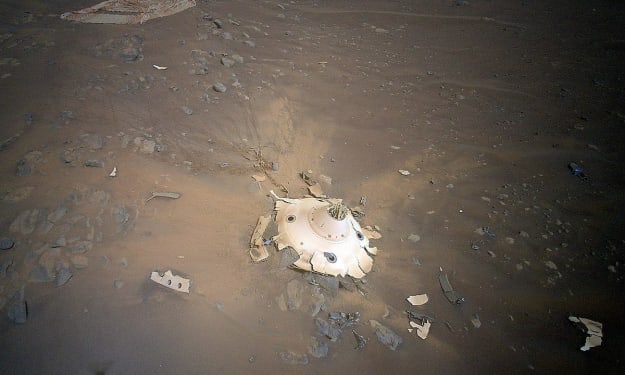
NASA’s Ingenuity Captures ‘Surreal’ Image of Wreckage on Mars No One Expected. NASA’s Ingenuity helicopter has once again proven its worth not just as an aerial scout but as an unexpected chronicler of Mars exploration history. Originally intended for just five experimental flights the tiny rotorcraft has now completed 72 successful missions far surpassing expectations. During one of its recent flights over the Jezero Crater Ingenuity captured something truly astonishing scattered wreckage from its own historic landing. This discovery while surreal serves as a powerful reminder of humanity’s growing presence on the Red Planet. The debris which once played a crucial role in delivering Perseverance and Ingenuity safely to the Martian surface is now a collection of twisted metal and torn fabric lying in the cold, dusty expanse. The images taken by Ingenuity reveal remnants of the entry descent and landing EDL system including a parachute and protective backshell which had shielded the rover and helicopter from the fiery descent through the thin Martian atmosphere.
By Adnan Rasheed11 months ago in Earth
Microbiota, microbiome or microflora: how to speak correctly and why it is for health.
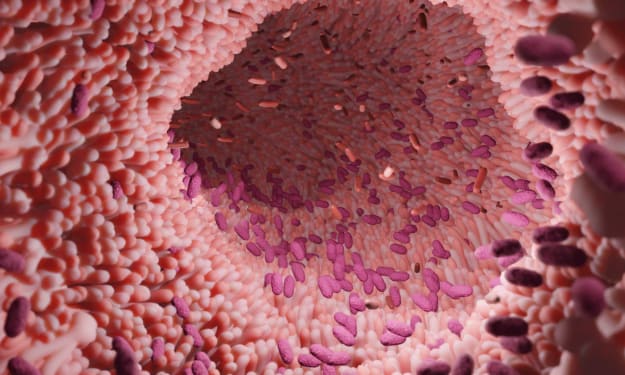
You've probably heard the phrase, "We are what we eat." But modern science says more precisely: we are also those who live in us. Until 2016, it was believed that there are many times more bacteria in our body than our own cells. The latest calculations by mathematicians show that we divide the body with our microorganisms by about 50/50: about 30 trillion of our cells versus 38 trillion bacterial ones.
By Yaroslav Gorohov4 days ago in Earth
Chinese EVs Closing In on America After Canadian Tariffs Deal
The electric vehicle race is no longer just about climate goals or consumer choice — it has become a geopolitical contest. And in early 2026, a subtle but powerful move by Canada may have tilted the board. By agreeing to sharply reduce tariffs on Chinese electric vehicles, Canada has opened a door that the United States has worked hard to keep shut. While Chinese EVs are still largely barred from the American market, they are now edging closer than ever — not by crossing the border directly, but by entering through Canada. This development raises a pressing question: Are Chinese EVs closing in on America, and what does that mean for the future of North American auto markets? The Deal That Changed the Game Canada’s new agreement with China allows up to 49,000 Chinese-made electric vehicles per year to enter the Canadian market at a tariff rate of just over 6%, a dramatic drop from the previous 100% tariff that effectively blocked them. On paper, the quota seems small. In reality, it carries enormous symbolic and strategic weight. For years, both Canada and the United States aligned closely on keeping Chinese EVs out, citing concerns over unfair subsidies, national security, and the protection of domestic auto industries. This new deal marks a clear shift — and a divergence from U.S. policy. Canada didn’t make the decision in isolation. The EV tariff reduction was part of a broader trade reset with China, tied to agricultural exports such as canola and efforts to stabilize a strained economic relationship. Why Chinese EVs Matter So Much China is the undisputed leader of the global electric vehicle industry. Its manufacturers produce EVs at scale, often at prices Western automakers struggle to match. Brands like BYD, Nio, and Xpeng have already expanded aggressively into Europe, Southeast Asia, and parts of the Middle East. North America has remained one of the final fortified markets — until now. Chinese EVs are appealing not just because they’re cheaper, but because they’ve rapidly improved in quality, range, and technology. For consumers priced out of North American and European EV models, Chinese vehicles offer something rare: affordability without sacrificing features. Canada’s decision gives Chinese automakers their first legitimate foothold in North America — and footholds tend to grow. Why the U.S. Is Nervous The United States still enforces a 100% tariff on Chinese EV imports, making them effectively unsellable in the American market. But Canada’s move has triggered concern in Washington. U.S. officials argue that Chinese EVs entering Canada could indirectly pressure American markets, influence supply chains, and weaken Washington’s leverage in future trade negotiations. There’s also a political dimension. Both major U.S. parties have framed Chinese dominance in EVs as a strategic threat — not just to auto jobs, but to technological leadership. Modern EVs collect vast amounts of data, and lawmakers have raised concerns about cybersecurity and foreign data access. While Chinese EVs aren’t rolling onto American roads yet, their presence just across the border changes the conversation. Canada’s Risk — and Opportunity Inside Canada, the reaction has been mixed. Automotive hubs like Ontario worry that opening the market could undermine domestic manufacturing and strain relations with the U.S., Canada’s largest trading partner. Some leaders have called the deal “lopsided,” warning it could cost jobs if American retaliation follows. Others see opportunity. A more competitive EV market could lower prices for Canadian consumers and accelerate EV adoption. It may also attract Chinese investment into Canada itself — including factories, battery plants, and supply chain partnerships. If Chinese automakers choose to build in Canada rather than simply export to it, the country could position itself as a bridge between Chinese EV innovation and North American demand. That balancing act — between economic opportunity and political risk — defines Canada’s strategy. Are Chinese EVs Really ‘Closing In’ on America? For now, the answer is: not directly — but strategically, yes. Chinese EVs sold in Canada won’t automatically flood the U.S. market. Regulations, trade rules, and tariffs still stand in the way. But proximity matters. Supply chains overlap. Consumer awareness spreads. Manufacturing footprints expand. There’s also the possibility of a workaround: Chinese companies could eventually build EVs in North America to bypass tariffs altogether. This idea has already been floated — but it faces fierce resistance from U.S. lawmakers and unions. Still, history shows that once a global industry leader gains regional access, momentum often follows. What This Means for Consumers For Canadian buyers, the impact could be immediate: more choice and lower prices in an EV market that has long been criticized for being expensive and limited. For American consumers, the effect will be indirect — at least at first. But increased competition could eventually pressure U.S. automakers to reduce prices, improve features, and accelerate innovation. The larger question is whether North America wants competition or insulation — and how long insulation can realistically last in a globalized EV economy. The Bigger Picture: A Global EV Power Shift Canada’s tariff deal reflects a broader reality: China’s dominance in electric vehicles is reshaping global trade, whether governments like it or not. Europe is already grappling with an influx of Chinese EVs. Emerging markets are embracing them. And now, North America has its first real crack in the wall. This isn’t just about cars. It’s about who controls the future of clean transportation, supply chains, and industrial policy. Final Thoughts Chinese EVs aren’t driving down American highways yet — but after Canada’s tariff deal, they’re closer than ever. This move doesn’t spell immediate disruption, but it does signal a shift. One country has decided that economic pragmatism outweighs political alignment. And in doing so, Canada may have opened the door to a new phase of EV competition in North America. Whether that door swings wider — or slams shut — will depend on how the U.S., automakers, and consumers respond. One thing is certain: the EV race just entered a new chapter.
By Muhammad Hassan2 days ago in Earth


Comments
There are no comments for this story
Be the first to respond and start the conversation.