politics
Politics does not dictate our collective cultural mindset as much as it simply reflects it; We've got to look in the mirror sometimes, and we've got one.
Israeli Settlers Consume Seven Times More Water Than Palestinians: An Inequality Flowing From the Tap. AI-Generated.
Water is essential for life, yet in the occupied Palestinian territories, it has become a stark marker of inequality. Numerous humanitarian organizations and international observers have documented a troubling reality: Israeli settlers consume up to seven times more water than Palestinians, even though both populations live on the same land and depend on the same natural water sources. This imbalance has far-reaching consequences, affecting health, agriculture, economic stability, and human dignity.
By Fiaz Ahmed Brohi20 days ago in The Swamp
Left-Wing Group Claims Responsibility for Sabotage Causing Berlin Blackout. AI-Generated.
Berlin, one of Europe’s most advanced and resilient capitals, was recently thrust into darkness after a calculated act of sabotage disrupted its power supply. What initially appeared to be a technical failure soon revealed a more troubling reality: a left-wing extremist group publicly claimed responsibility for the attack, igniting a national debate about political radicalism, public safety, and the security of critical infrastructure.
By Aqib Hussain20 days ago in The Swamp
“Greenland Belongs to Its People”: European Leaders Unite Over Trump’s Threats to Annex Territory. AI-Generated.
European leaders have issued a rare and unified response after former U.S. President Donald Trump revived controversial rhetoric suggesting the annexation of Greenland, prompting strong declarations that the Arctic territory “belongs to its people.” The comments have reignited diplomatic tensions, drawing sharp reactions from Denmark, Greenlandic officials, and key European allies determined to defend sovereignty, international law, and the principle of self-determination.
By Ayesha Lashari20 days ago in The Swamp
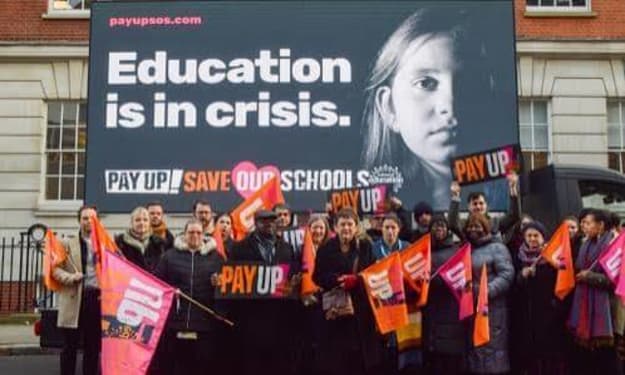
Private Schools Announce Strike: What It Means for Students, Parents, and the Education System. AI-Generated.
Private schools across the country have announced a coordinated strike, sending shockwaves through the education sector and leaving thousands of parents and students facing uncertainty. The decision, driven by mounting financial pressures, unresolved disputes with management bodies, and growing dissatisfaction among teaching staff, highlights deeper challenges within the private education system that have been building for years. While strikes are more commonly associated with public-sector education, this move by private schools signals a turning point—one that raises serious questions about sustainability, fairness, and the future of quality education. Why Are Private Schools Going on Strike? At the heart of the strike are teacher grievances over pay, job security, and working conditions. Many educators in private institutions argue that despite rising tuition fees, their salaries have stagnated, benefits have been reduced, and workloads have increased significantly. Teachers report longer teaching hours, larger class sizes, and added administrative responsibilities without corresponding compensation. In some cases, contracts are renewed annually, offering little job security and limiting teachers’ ability to raise concerns without fear of dismissal. School administrations, on the other hand, cite rising operational costs, inflation, and declining enrollments as reasons for financial strain. However, educators counter that cost-cutting measures have disproportionately affected staff rather than management structures. The Scale of the Strike The strike involves hundreds of private schools, ranging from elite institutions to mid-fee schools that cater to middle-income families. Some schools have announced full closures for the duration of the strike, while others are operating with reduced staff or switching temporarily to online learning. Teacher unions and associations claim this is not a short-term protest but a last-resort action after months of failed negotiations. Many schools had issued warnings to parents in advance, yet the sudden disruption has still caught families off guard. Impact on Students Students are the most immediate casualties of the strike. Academic schedules have been disrupted, examinations postponed, and coursework delayed. For students preparing for board exams or university admissions, the uncertainty is particularly stressful. Younger children, who rely heavily on structured learning environments, are also affected. Parents report difficulty managing childcare, especially working families who depend on schools for daily routine and supervision. Mental health experts warn that prolonged disruption can affect students’ emotional well-being, particularly when uncertainty replaces stability in their daily lives. Parents Caught in the Middle Parents, already burdened by rising tuition fees, find themselves frustrated and conflicted. Many sympathize with teachers’ demands, recognizing their role in shaping children’s futures. At the same time, families question why high fees are not translating into better pay and working conditions for educators. Some parents have demanded fee reductions or refunds for missed school days, while others are calling for greater transparency from school administrations regarding financial management. The strike has also sparked debates about accountability in private education, an area often less regulated than public schooling. A Broader Crisis in Private Education The strike reflects a deeper structural issue within the private education sector. Over the years, private schools have expanded rapidly, often operating as profit-driven institutions rather than purely educational ones. This model, critics argue, places financial performance above teacher welfare and educational quality. Additionally, the absence of strong regulatory frameworks means that disputes often escalate without effective mediation. Unlike public schools, private institutions lack standardized salary scales or employment protections, leaving teachers vulnerable. The strike has reignited calls for education sector reforms, including minimum wage standards for private school teachers, contract protections, and oversight of fee structures. Responses from Authorities Education departments and labor ministries have urged both sides to return to the negotiating table. Officials warn that prolonged disruption could violate education continuity laws and harm students’ right to learning. Some governments have offered to mediate, while others are considering emergency measures to ensure schools reopen. However, teachers insist that without concrete commitments, returning to classrooms would only delay the inevitable. What Happens Next? The outcome of the strike will likely shape the future of private education. If teachers succeed in securing better conditions, it could set a precedent for labor rights within private institutions. If not, the sector may face continued unrest, staff shortages, and declining trust from parents. One thing is clear: the strike has exposed cracks in a system long assumed to be stable. Conclusion The private schools strike is more than a labor dispute—it is a wake-up call. It forces parents, policymakers, and school operators to confront uncomfortable truths about how education is valued and who bears the cost of maintaining it. As negotiations continue, the hope remains that a balanced solution can be found—one that respects teachers, protects students, and preserves the integrity of education itself. Without meaningful reform, however, the classrooms reopening may only mark a temporary pause in a much larger crisis.
By Fiaz Ahmed Brohi20 days ago in The Swamp
Trump’s ‘Donroe Doctrine’ Seeks Influence Over Western Hemisphere, Citing Old U.S. Policy. AI-Generated.
The idea of a “Donroe Doctrine,” attributed to former U.S. President Donald Trump, has sparked renewed debate about American influence in the Western Hemisphere. Drawing rhetorical inspiration from the nearly 200-year-old Monroe Doctrine, Trump’s modern interpretation seeks to reassert U.S. authority and strategic dominance across the Americas. While supporters frame it as a return to strength and clarity in foreign policy, critics warn it risks reviving outdated power dynamics ill-suited for a complex, multipolar world.
By Ayesha Lashari21 days ago in The Swamp
France Tightens Food Import Checks as Farmers Protest Mercosur Deal. AI-Generated.
France has stepped up food import inspections as farmers across the country intensify protests against the proposed European Union–Mercosur trade deal. The move highlights rising tensions between globalization and domestic agriculture, as producers warn that the agreement could threaten livelihoods, weaken environmental standards, and undermine Europe’s strict food safety rules. By tightening checks on imported food, the French government is sending a clear message: protecting farmers and consumers is now a political priority.
By Aqib Hussain21 days ago in The Swamp
US Raid on Venezuela Sparks Global Outcry: UN Rights Body Warns of a Dangerous Breach of International Law. AI-Generated.
The recent United States raid on Venezuelan territory has ignited intense international debate, with a United Nations human rights body stating that the operation “undermined a fundamental principle of international law.” The remark has added legal and moral weight to growing global concerns, raising urgent questions about sovereignty, the use of force, and the future of international norms in an increasingly polarized world. What Happened and Why It Matters According to official statements, the US operation targeted individuals and infrastructure linked to alleged criminal or security threats. While Washington framed the raid as a necessary action to protect its national interests, critics argue that the operation crossed a critical legal line. By conducting a unilateral raid inside another sovereign state without clear international authorization, the US has reignited long-standing debates about the limits of power in global affairs. At the heart of the controversy is a core principle of international law: the sovereignty of states. This principle, enshrined in the United Nations Charter, holds that nations have the right to govern their own territory without external interference. The UN rights body’s warning suggests that the raid risks weakening this foundational rule, one that underpins global stability. The UN’s Legal Concern Explained The UN human rights body emphasized that respect for sovereignty is not a symbolic concept but a legal safeguard designed to prevent chaos and conflict. If powerful nations act unilaterally whenever they perceive a threat, smaller or weaker states may be left vulnerable, and international law could lose its authority. From a legal standpoint, the use of force across borders is only permitted under limited circumstances: self-defense against an imminent threat or with authorization from the UN Security Council. Critics argue that the US raid did not clearly meet these criteria, making it a troubling precedent for future conflicts. Venezuela’s Reaction and Regional Impact Venezuela has strongly condemned the raid, calling it a violation of its territorial integrity and a continuation of what it describes as external pressure and interference. The incident has further strained relations between Caracas and Washington, which have been tense for years due to sanctions, political disputes, and differing views on governance and legitimacy. Beyond Venezuela, the raid has alarmed several Latin American nations. The region has a long history of foreign interventions, and many governments are wary of actions that echo past episodes of external military involvement. Regional organizations and political leaders have warned that such operations risk destabilizing not only Venezuela but the broader region. Human Rights and Civilian Risks Another major concern raised by human rights advocates is the potential impact on civilians. Raids and military operations, even when targeted, carry the risk of collateral damage. The UN body highlighted that international human rights law requires states to protect civilian lives and ensure accountability when force is used. Reports and allegations surrounding the raid have prompted calls for transparent investigations. Human rights groups argue that without independent scrutiny, victims may be denied justice, and future violations could be normalized. The Bigger Picture: Power, Precedent, and Global Order The US raid on Venezuela is not an isolated incident but part of a broader pattern in international relations where powerful states increasingly act outside multilateral frameworks. Supporters of such actions argue that global institutions are often slow or ineffective, leaving nations little choice but to act alone. Critics counter that bypassing international law undermines the very system designed to prevent war and protect human rights. The UN’s warning reflects fears that repeated breaches of sovereignty could erode trust in international institutions. If international law is applied selectively, its credibility weakens, making it harder to resolve conflicts peacefully. Voices in Support and Opposition Within the United States, reactions have been mixed. Some policymakers defend the raid as a necessary measure against transnational threats, arguing that national security must come first. Others caution that short-term tactical gains may lead to long-term strategic losses by damaging alliances and international standing. Globally, legal scholars and diplomats have echoed the UN’s concerns, stressing that respect for international law is essential, especially during times of geopolitical tension. What Comes Next? As the debate continues, pressure is mounting for clearer explanations, legal justifications, and potential international review. Whether through the UN, regional bodies, or diplomatic channels, many observers believe that accountability and dialogue are crucial to prevent escalation. The incident also serves as a wake-up call for the international community. Upholding international law requires collective commitment, not just words. When powerful nations are perceived to act above the rules, the entire system is at risk. Conclusion The UN rights body’s statement that the US raid on Venezuela “undermined a fundamental principle of international law” goes beyond criticism—it is a warning. Sovereignty, legality, and human rights are cornerstones of global order, not obstacles to be bypassed. As the world watches how this situation unfolds, the response will help define whether international law remains a guiding force or becomes a fragile ideal in an era of power politics. For readers and policymakers alike, this moment underscores a critical truth: global security cannot be built on selective legality. Respect for international law is not optional—it is essential for a more stable and just world.
By Fiaz Ahmed Brohi21 days ago in The Swamp
Big Oil doesn’t share Trump’s dream of making Venezuelan oil great again. AI-Generated.
Former U.S. President Donald Trump has long championed the revival of Venezuela’s oil industry, framing it as a pathway to U.S. energy dominance and a blow to the socialist regime in Caracas. In speeches and interviews, Trump has promised to “make Venezuelan oil great again,” suggesting that unlocking the South American country’s vast reserves could solve global energy challenges while benefiting American interests. Yet, for all the rhetoric, the reality is far more complicated, and major oil corporations are not lining up to support the former president’s ambitious plan. Venezuela’s Oil Industry: A Shadow of Its Former Self Once the crown jewel of Latin American energy, Venezuela’s oil production has plummeted over the past decade. Mismanagement, corruption, and decades of political turmoil have left the state-owned oil company, Petróleos de Venezuela, S.A. (PDVSA), struggling to maintain output. Today, the country produces roughly a quarter of the oil it did at its peak in the mid-1990s. Infrastructure is crumbling, refineries operate at fraction of capacity, and international sanctions further limit access to capital and technology. For Trump, the solution seems simple: relax sanctions, incentivize U.S. and international oil companies, and restore Venezuela as a global energy powerhouse. Yet, the idea underestimates the scale of the challenge. Rebuilding Venezuela’s oil sector is not a short-term fix—it would require billions of dollars in investment, cutting-edge technology, and political stability, none of which are guaranteed. Big Oil’s Reluctance Despite Trump’s enthusiasm, the world’s largest oil corporations remain hesitant to jump in. Companies like ExxonMobil, Chevron, and BP are wary of Venezuela’s complex political environment. While U.S. sanctions have been partially lifted in recent years, uncertainty persists over regulatory shifts, asset nationalizations, and potential backlash from investors. Multinational oil companies are acutely aware that a misstep could result in significant financial losses. Chevron is one of the few U.S. companies maintaining a presence in Venezuela, but even it operates under tight constraints and careful risk management. For most major players, the geopolitical and financial risks outweigh potential rewards. Venezuela’s oil reserves, though vast, are heavy and extra-heavy crude, which is costly to extract and refine. In a world increasingly shifting toward renewable energy, long-term investments in high-cost crude are less attractive. The Role of Sanctions and International Pressure U.S. sanctions remain a major roadblock. While Trump signaled willingness to lift restrictions, any policy shift would depend on Congress, the executive branch, and international actors. European and Asian partners are also cautious, given their own economic and political stakes. Any aggressive push to boost Venezuelan oil production could trigger diplomatic friction, potentially undermining the very energy and geopolitical goals Trump aims to achieve. Market Realities and Energy Transition Beyond political risk, the economics of oil are changing. Global energy markets are in transition, with increasing investment in renewables, electric vehicles, and cleaner alternatives. Companies are now more cautious about long-term bets on politically unstable, high-cost oil fields. Venezuela’s heavy crude, which requires specialized infrastructure and processing, may no longer be a golden ticket in an era moving toward sustainability. Moreover, the volatility of oil prices adds another layer of uncertainty. Even if production ramps up, market fluctuations could easily erode profit margins, further discouraging investment. In short, the dream of “Venezuelan oil greatness” faces structural hurdles that money and executive orders alone cannot overcome. Trump’s Rhetoric vs. Reality Trump’s vision for Venezuelan oil is rooted in nostalgia for a time when the U.S. had a dominant position in global energy markets. His calls to “make it great again” resonate with voters who see energy independence as both patriotic and strategic. However, for the private sector, the reality is more pragmatic: political instability, crumbling infrastructure, and market uncertainty make Venezuela a risky and expensive venture. Conclusion The gap between Trump’s ambitious vision and the cautious stance of Big Oil underscores the complexity of global energy politics. Reviving Venezuela’s oil industry is not merely about lifting sanctions or signing deals—it requires navigating a tangle of political, economic, and technological challenges. While Trump may continue to champion the cause in speeches and tweets, the corporate world is moving with caution, prioritizing stability, predictability, and long-term profitability. In the end, the dream of turning Venezuela into an energy superpower may remain just that: a dream. As oil companies weigh the risks, and as global energy markets continue their transition, the question remains whether political ambition alone can overcome the practical realities of one of the world’s most challenging oil frontiers.
By Fiaz Ahmed Brohi21 days ago in The Swamp
Trump Says He Doesn’t Believe Ukraine Struck Putin’s Residence. AI-Generated.
Former U.S. President Donald Trump has publicly cast doubt on reports suggesting that Ukraine targeted Russian President Vladimir Putin’s residence, adding another layer of controversy to an already volatile conflict. Speaking amid heightened tensions between Russia and Ukraine, Trump said he does not believe Kyiv carried out an attack on Putin’s personal residence, pushing back against claims circulating in Russian media and online platforms.
By Aarif Lashari21 days ago in The Swamp
Ought to Provide a Deterrent’: What US Action in Venezuela Means for Taiwan
The recent US action in Venezuela has reverberated far beyond Latin America, sending a clear signal to allies and adversaries alike about Washington’s willingness to act decisively against leaders it accuses of threatening regional stability. While the immediate focus has been on Caracas and the legality and consequences of the operation, analysts say the implications stretch across the globe—most notably to East Asia, where Taiwan watches closely.
By Aarif Lashari21 days ago in The Swamp
$6 Billion U.S. Navy Aircraft Carrier ‘Sunk’ by $100 Million Diesel AIP Sub: A Lesson in Modern Naval Warfare. AI-Generated.
In a stunning reminder of how modern technology can upend traditional military assumptions, reports have emerged that a $100 million diesel-electric air-independent propulsion (AIP) submarine effectively neutralized a $6 billion U.S. Navy aircraft carrier in a recent simulated naval exercise. While no lives were lost and the carrier remained physically intact, the exercise served as a stark wake-up call for naval strategists and defense planners worldwide. The Exercise That Shocked the Navy The event occurred during a routine war-gaming exercise designed to test the vulnerabilities of aircraft carriers and their battle groups. These carriers, often described as floating cities and the backbone of American power projection, were assumed to be nearly invincible thanks to advanced radar, escort ships, and multi-layered defense systems. However, the diesel-electric AIP submarine, smaller, quieter, and far cheaper than its nuclear-powered counterparts, demonstrated that stealth and strategic maneuvering could overcome sheer size and firepower. Using its near-silent propulsion system, the sub reportedly penetrated the carrier group’s outer defenses and “struck” the vessel in a simulated attack scenario. The exercise’s outcome has been described as both “surprising” and “unsettling” by military analysts. Why the Cost Difference Matters One of the most striking aspects of this scenario is the enormous discrepancy in cost. A U.S. aircraft carrier can cost upward of $6 billion, with each accompanying ship in the carrier strike group adding billions more. In contrast, modern diesel-electric AIP submarines can be built for a fraction of that—around $100 million in this instance—yet they can threaten the most expensive naval assets in the world. This disparity has fueled debates within defense circles about cost-effectiveness and vulnerability. It highlights a broader lesson in military strategy: expensive and powerful assets are not automatically invulnerable, and smaller, well-deployed systems can deliver disproportionate impact if used strategically. The Rise of Diesel AIP Submarines Diesel-electric submarines equipped with air-independent propulsion have become increasingly attractive to nations seeking potent yet affordable deterrents. Unlike traditional diesel submarines, AIP-equipped vessels can operate underwater for extended periods without surfacing, making them harder to detect. Their quiet operation allows them to move undetected in littoral and coastal waters, where large carriers often operate. For many nations, these submarines represent a low-cost way to challenge superior naval forces, create area-denial capabilities, and protect strategic waters. The recent exercise illustrates that even the most advanced naval superpowers must consider these asymmetric threats in their planning. Lessons for Naval Strategy The simulated “sinking” of a $6 billion aircraft carrier carries broader implications for naval strategy. It underscores the importance of adapting to technological advancements and reevaluating assumptions about force protection. While aircraft carriers remain central to U.S. naval doctrine, exercises like this highlight the need for layered defenses, rapid anti-submarine warfare (ASW) tactics, and improved detection systems. Additionally, the exercise demonstrates that smaller navies with modern AIP submarines can challenge even the most formidable fleets. This shift may alter how naval powers approach fleet composition, deployment strategies, and international maritime deterrence. Global Reactions Analysts around the world have taken notice. Defense experts in Europe, Asia, and the Middle East have emphasized that this scenario is not hypothetical but a reflection of current capabilities. Countries investing in quiet, low-cost submarines may see them as key assets in modern naval conflicts. Meanwhile, traditional naval powers face the challenge of ensuring that their high-value platforms remain relevant and secure in an era of asymmetric warfare. Some observers suggest that the exercise’s outcome should serve as a catalyst for innovation. Future carriers may need enhanced anti-submarine systems, smarter escort strategies, and integration with unmanned underwater vehicles (UUVs) to counter the growing threat of diesel-electric AIP subs. Conclusion The dramatic juxtaposition—a $6 billion aircraft carrier neutralized by a $100 million diesel-electric AIP submarine—serves as a powerful lesson in modern military strategy. It reminds us that technological advancements can shift power balances, rendering previously “invincible” platforms vulnerable. While the U.S. Navy continues to dominate the seas in terms of global reach, the exercise underscores the fact that even the most expensive and powerful assets are not immune to innovation-driven threats. Small, stealthy, and strategically employed platforms can deliver outsized effects, compelling military planners to rethink traditional assumptions about cost, size, and survivability. In the evolving world of naval warfare, the balance of power is no longer dictated solely by money or firepower. Intelligence, stealth, and strategic deployment are now equally, if not more, decisive. The recent exercise serves as a stark reminder that no matter how advanced or costly a platform may be, it is only as strong as the strategies and systems protecting it.
By Fiaz Ahmed Brohi21 days ago in The Swamp
US Sharply Criticised by Foes and Friends Over Maduro Seizure. AI-Generated.
The United States is facing sharp criticism from both adversaries and long-standing allies following the seizure of former Venezuelan president Nicolás Maduro in a dramatic operation that has sent shockwaves through the international community. While Washington has defended the move as a necessary step to uphold justice and regional security, reactions from around the world suggest deep unease over the legality, precedent, and consequences of the action.
By Aarif Lashari21 days ago in The Swamp