
Trump’s ‘Donroe Doctrine’ Seeks Influence Over Western Hemisphere, Citing Old U.S. Policy
A revived vision of American dominance raises questions about sovereignty, diplomacy, and modern geopolitics
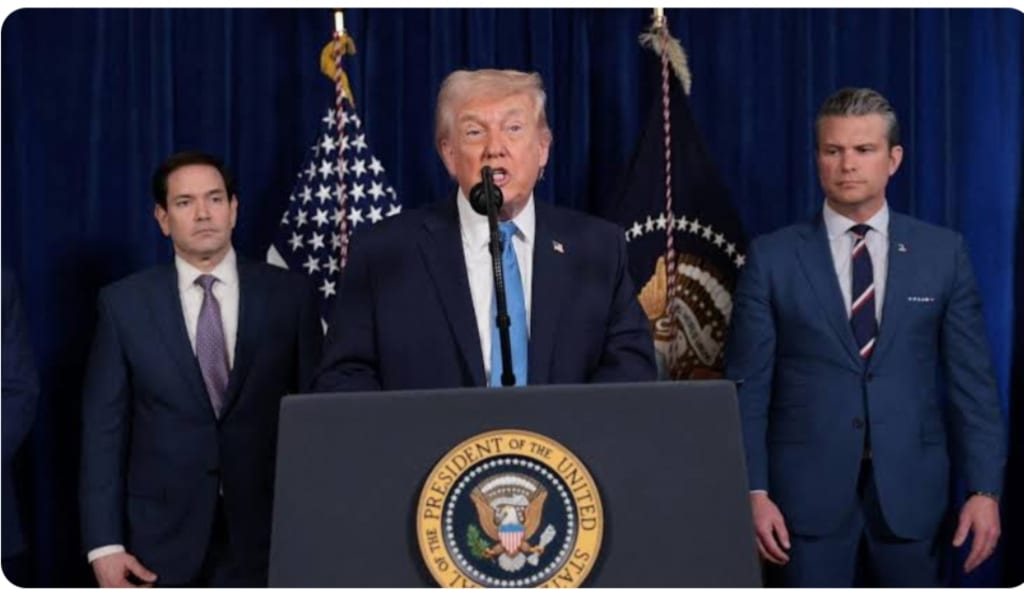
The idea of a “Donroe Doctrine,” attributed to former U.S. President Donald Trump, has sparked renewed debate about American influence in the Western Hemisphere. Drawing rhetorical inspiration from the nearly 200-year-old Monroe Doctrine, Trump’s modern interpretation seeks to reassert U.S. authority and strategic dominance across the Americas. While supporters frame it as a return to strength and clarity in foreign policy, critics warn it risks reviving outdated power dynamics ill-suited for a complex, multipolar world.
The original Monroe Doctrine, articulated in 1823, declared that European powers should no longer interfere in the affairs of the Western Hemisphere. At the time, it was a bold assertion by a young United States seeking to protect newly independent nations in Latin America from colonial ambitions. Over the decades, however, the doctrine evolved from a defensive posture into a justification for U.S. intervention, shaping relations with neighboring countries in ways that remain controversial.
Trump’s so-called “Donroe Doctrine” builds on this historical foundation but adapts it to modern concerns. It emphasizes countering foreign influence—particularly from China, Russia, and Iran—in Latin America and the Caribbean. In speeches and policy statements, Trump and his allies have argued that the United States must not allow rival powers to gain economic, military, or political footholds in its “own neighborhood.”
This framing reflects broader anxieties within U.S. political circles about shifting global power. China’s investments in infrastructure, mining, and energy across Latin America have expanded rapidly in recent years. Russia has strengthened diplomatic and security ties with select governments, while Iran has pursued strategic partnerships that challenge U.S. interests. The Donroe Doctrine positions these developments not as normal international engagement, but as direct threats to American security.
Supporters of Trump’s approach argue that it restores clarity to U.S. foreign policy. They contend that decades of inconsistent engagement allowed rivals to exploit gaps in leadership. From this perspective, asserting influence is not about imperialism but about protecting democratic values, trade routes, and regional stability. Advocates also claim that a strong U.S. presence deters authoritarian expansion and reassures allies.
Yet critics see the Donroe Doctrine as a step backward. They argue that invoking a 19th-century framework ignores the sovereignty and agency of modern Latin American nations. Many countries in the region bristle at language suggesting U.S. ownership or guardianship, viewing it as a reminder of past interventions that often led to political instability, economic hardship, and long-lasting resentment.
Diplomatic experts warn that heavy-handed rhetoric could undermine cooperation on shared challenges such as migration, climate change, and organized crime. Rather than fostering partnership, an assertive doctrine risks pushing regional governments to deepen ties with alternative global powers as a counterbalance to Washington. In this sense, the Donroe Doctrine could unintentionally accelerate the very influence it seeks to curb.
The doctrine also raises legal and ethical questions. International norms today emphasize multilateralism, mutual respect, and non-intervention. Framing the Western Hemisphere as a U.S. sphere of influence clashes with these principles, particularly in an era when global governance relies on cooperation rather than unilateral declarations.
Domestically, the Donroe Doctrine plays well with Trump’s political base, which favors strong borders, national sovereignty, and assertive foreign policy. It aligns with a broader narrative of restoring American greatness by projecting power abroad and rejecting what supporters see as diplomatic weakness. As a political message, it is simple, historically grounded, and emotionally resonant.
However, translating rhetoric into policy is far more complex. Enforcing influence without direct intervention requires economic incentives, diplomatic engagement, and credible partnerships. Without these, declarations risk becoming symbolic rather than effective. Critics point out that sustained engagement—rather than episodic pressure—is what ultimately shapes regional relationships.
Latin American reactions have been mixed. Some leaders quietly welcome stronger U.S. involvement as a counterweight to external powers, while others publicly reject any suggestion of renewed U.S. dominance. Civil society groups across the region emphasize the need for equal partnerships based on development, respect, and shared decision-making.
As global competition intensifies, the Western Hemisphere is once again becoming a strategic focal point. The Donroe Doctrine reflects this reality, even as it revives old language to address new challenges. Whether it becomes a defining framework for future U.S. policy or remains a rhetorical flourish will depend on political outcomes and international response.
Ultimately, the debate surrounding Trump’s Donroe Doctrine is less about history and more about the future. It forces a fundamental question: should U.S. leadership in the Americas be exercised through dominance or partnership? The answer will shape not only America’s role in the region, but also the stability and cooperation of the Western Hemisphere in an increasingly interconnected world.
About the Creator
Keep reading
More stories from Ayesha Lashari and writers in The Swamp and other communities.
Denmark in ‘Crisis Mode’ as Trump Sets Sights on Greenland After Venezuela Attack
Denmark has reportedly entered what officials describe as a “crisis mode” after former U.S. President Donald Trump once again turned his attention toward Greenland, this time in the aftermath of a dramatic attack in Venezuela that has shaken global geopolitics. The convergence of these events has placed Copenhagen under intense diplomatic pressure, highlighting how quickly distant crises can intersect and reshape international priorities.
By Ayesha Lashari6 days ago in The Swamp
Will South Sudan Get Dragged Into Sudan’s Civil War?
Sudan’s brutal civil war, now stretching far beyond initial expectations, has destabilized one of Africa’s most fragile regions. As fighting between the Sudanese Armed Forces (SAF) and the Rapid Support Forces (RSF) continues, attention is increasingly turning southward. The question many analysts are now asking is troubling but unavoidable: could South Sudan be dragged into Sudan’s civil war?
By Fiazahmedbrohi 3 days ago in The Swamp
Violence Begets
"Any last words, cowboy?" "None you'd understand, sodbuster." "Funny. That's Marshall Sodbuster to you. But I meant some last nugget that would help us in the adjudication of the myriad offenses counted against you and your gang. I wasn't asking for penitence."
By Adam Diehl4 days ago in Fiction


Comments
There are no comments for this story
Be the first to respond and start the conversation.