Latest Stories
Most recently published stories in The Swamp.
French nuclear attack sub arrives in Scotland By George Allison . AI-Generated.
A French nuclear-powered attack submarine has arrived in Scotland, marking a rare and highly symbolic port visit that underscores growing military cooperation between European allies amid heightened security concerns across the North Atlantic and Arctic regions. The submarine, operated by the French Navy, docked at HMNB Clyde, home to the United Kingdom’s strategic nuclear deterrent and a key hub for NATO submarine operations. While officials declined to disclose the exact class of the vessel or operational details, defense sources confirmed it is a nuclear-powered attack submarine designed for intelligence gathering, undersea warfare, and protection of allied naval assets. A Signal of Strategic Unity The arrival comes at a time when European navies are increasing cooperation in response to rising geopolitical tensions and intensified submarine activity in the North Atlantic. French and British forces have long maintained close maritime ties, but such visits by nuclear-powered attack submarines remain uncommon and carefully coordinated. A spokesperson for the UK Ministry of Defence said the visit reflects “routine cooperation between close allies” and demonstrates shared commitment to maritime security. French officials echoed that sentiment, noting the importance of interoperability and joint readiness exercises. “This deployment is about presence and partnership,” a senior naval officer said. “Operating from a UK base strengthens our collective ability to monitor and protect vital sea lanes.” Why Scotland Matters HMNB Clyde is one of Europe’s most strategically important naval bases, hosting the UK’s fleet of nuclear-powered submarines and supporting NATO maritime patrols. Its location provides direct access to the North Atlantic and the waters between Greenland, Iceland, and the UK — an area of increasing strategic importance due to undersea cables, energy infrastructure, and shipping routes. By visiting the base, the French submarine crew gains experience operating alongside British forces while reinforcing NATO’s undersea posture. Analysts suggest the timing is deliberate, aimed at reassuring allies and deterring potential adversaries from testing Western naval defenses. “This is not just a courtesy call,” said a maritime security analyst. “It’s a message that European navies are closely aligned and prepared to operate together if needed.” Technical and Operational Significance French nuclear attack submarines are among the most advanced in Europe, capable of remaining submerged for months and carrying sophisticated sonar, torpedoes, and cruise missiles. Their missions typically include intelligence collection, escorting aircraft carriers, and tracking hostile submarines. During its stay in Scotland, the vessel is expected to undergo resupply and allow its crew limited shore leave, while also participating in joint training activities with the Royal Navy. These exercises help standardize procedures and improve communication between allied forces, particularly in undersea warfare — one of the most complex and secretive domains of modern defense. Public and Political Reaction Local authorities confirmed that safety protocols were in place and that the visit posed no risk to surrounding communities. Nuclear-powered submarines regularly enter and leave Faslane, and strict environmental and security measures govern all such movements. Some Scottish political groups renewed calls for greater transparency about military operations in the region, while others emphasized the economic and strategic value of hosting allied naval forces. The base remains a focal point in debates about nuclear weapons and defense policy, making visits by foreign submarines politically sensitive as well as militarily significant. A Broader European Context The visit reflects a wider trend of European defense integration, particularly between France and the UK — Europe’s two leading military powers. Both countries have increased naval deployments in recent years, with a focus on protecting critical infrastructure and ensuring freedom of navigation. Defense experts note that submarine diplomacy is subtle but powerful. Unlike aircraft or surface ships, submarines operate largely unseen, making their public port visits rare and symbolically important. “Submarines don’t usually make headlines unless something has gone wrong,” one analyst said. “So when one turns up openly in an allied base, it’s a calculated signal of cooperation and strength.” Looking Ahead The French submarine’s arrival in Scotland is expected to be followed by further joint exercises and reciprocal visits in the coming months. Officials on both sides describe the event as part of a long-term strategy to deepen operational ties and maintain a strong allied presence in strategically vital waters. As global security challenges continue to evolve beneath the waves, the quiet arrival of a French nuclear attack submarine at a Scottish naval base serves as a reminder that much of modern defense happens out of sight — but not without significance.
By Fiaz Ahmed about 4 hours ago in The Swamp
What’s Happened Since the Supreme Court’s Tariff Ruling. AI-Generated.
Since the landmark decision by the Supreme Court of the United States limiting the president’s authority to impose sweeping tariffs without congressional approval, Washington and global markets have entered a period of adjustment marked by political debate, legal uncertainty, and cautious economic recalibration. The ruling stemmed from a challenge to emergency trade powers used to justify broad import taxes on foreign goods. While the Court did not immediately strike down all existing tariffs, it made clear that large-scale trade measures must rest on firmer legislative authority. The decision reasserted Congress’s constitutional role in regulating commerce and narrowed the scope of unilateral executive action in trade policy. Congress Moves to Reclaim Control In the weeks following the ruling, lawmakers introduced competing proposals to redefine how future tariffs can be enacted. Some bills aim to require congressional approval for any new tariffs lasting longer than 60 days. Others seek to create a streamlined process for emergency actions, balancing speed with oversight. Supporters of the Court’s decision argue it restores democratic accountability. “Trade policy affects every household,” said one senior lawmaker. “It should not be decided by one office alone.” Critics, however, warn that slower legislative procedures could weaken the United States’ leverage in negotiations with foreign governments accused of unfair trade practices. Committee hearings have featured testimony from economists, manufacturers, and labor groups, reflecting sharply divided views. Exporters want predictability, while domestic producers want continued protection from low-cost imports. For now, Congress has not passed a comprehensive replacement framework, leaving trade policy in a temporary holding pattern. Markets and Businesses Adjust Financial markets initially reacted with modest optimism, interpreting the ruling as a signal of reduced risk of sudden tariff escalations. Shares of retail and manufacturing companies dependent on imported components rose slightly, while shipping and logistics firms welcomed the prospect of more stable trade rules. Businesses, however, remain cautious. Several multinational corporations have delayed long-term supply contracts, citing uncertainty over whether Congress will loosen or reinforce tariff controls. “Legal clarity doesn’t equal policy clarity,” said a trade consultant based in Chicago. “Companies still don’t know what the next six months will bring.” Small and medium-sized enterprises, which often lack the resources to absorb sudden cost increases, have been among the most vocal supporters of the ruling. Many hope it will lead to fewer abrupt changes in import duties and a more predictable regulatory environment. International Response U.S. trading partners reacted with guarded relief. European and Asian officials welcomed the Court’s emphasis on institutional checks, interpreting it as a move toward more rules-based trade policy. Several stalled trade discussions were quietly revived, particularly on industrial goods and agricultural exports. China and other major exporters are watching closely to see how Congress reshapes tariff authority. Diplomats say the ruling could reduce the likelihood of rapid trade wars but may also slow negotiations if U.S. policymakers become divided internally. One senior European official described the decision as “a stabilizing signal,” adding that predictable U.S. policy would benefit global markets already strained by geopolitical tensions and supply chain disruptions. Impact on Consumers For American consumers, the effects have been subtle so far. Prices of imported electronics, appliances, and vehicles remain largely unchanged, as existing tariffs are still in place. Economists say any noticeable shift will depend on whether Congress eventually rolls back certain duties or replaces them with a more targeted system. Consumer advocacy groups argue that the ruling opens the door to lower costs in the long term. “Tariffs are hidden taxes,” one spokesperson said. “If lawmakers use this moment to reduce them responsibly, households could see relief.” A Broader Constitutional Signal Beyond economics, the ruling has set an important legal precedent. Constitutional scholars note that it reinforces limits on executive power in areas tied to national emergencies and foreign commerce. This could influence future cases involving sanctions, export controls, and emergency economic measures. The decision has also reshaped political debate, forcing both parties to confront how trade policy should be made in an era of global competition and domestic economic anxiety. What Comes Next The coming months will determine whether the ruling produces meaningful reform or prolonged gridlock. Businesses want certainty, allies want predictability, and voters want relief from rising costs. All eyes are now on Congress to define a new balance between flexibility and accountability in U.S. trade policy. What is clear is that the Supreme Court’s tariff ruling did not end the controversy—it shifted it from the courtroom to the halls of Congress and the negotiating tables of international trade, where its consequences will continue to unfold.
By Fiaz Ahmed about 5 hours ago in The Swamp
EU Sanctions Russian Officials as Hungary Blocks Funds to Ukraine. AI-Generated.
In a tense session that underscored the European Union’s internal divisions, EU member states imposed fresh sanctions on Russian officials linked to the ongoing conflict in Ukraine, even as Hungary blocked a portion of funds intended to support Kyiv’s war effort. The move highlights both the bloc’s commitment to pressuring Moscow and the political fractures that complicate collective action. The sanctions target several high-ranking Russian politicians and military figures accused of facilitating or enabling military operations in Ukraine. Measures include travel bans, asset freezes, and restrictions on financial transactions within the EU. The European Council described the action as “a necessary step to hold accountable those responsible for destabilizing the region and perpetuating the war.” EU officials emphasized that the sanctions are part of a broader strategy to maintain economic and political pressure on Russia, following months of escalating conflict. “We are demonstrating unity in condemning aggression and in supporting the sovereignty of Ukraine,” said an EU diplomat familiar with the discussions. Hungary’s Block and Internal Disputes At the same time, Hungary, long criticized for its close ties to Moscow, has blocked disbursement of certain EU funds allocated to Kyiv. Prime Minister Viktor Orbán cited concerns over financial oversight and alleged inefficiencies in the use of the funds, although critics argue that the move is politically motivated. “The decision undermines European solidarity,” said a European Commission spokesperson. “EU funds are designed to support a country under attack, and blocking these resources contradicts the shared principles of the Union.” The standoff exposes persistent challenges in coordinating EU foreign policy. While the bloc often speaks with one voice on paper, differing national interests, political alliances, and domestic pressures can complicate unified responses to crises. Impact on Ukraine and the War Effort For Ukraine, the timing of the partial block is problematic. The funds in question were intended for critical infrastructure repairs, humanitarian support, and military aid. Kyiv’s government expressed disappointment but maintained that international assistance remains vital. “We rely on our partners to help sustain our people and defense capabilities,” said a Ukrainian government official. “Every delay in support weakens our ability to respond to aggression and protect civilians.” The sanctions on Russia, however, were broadly welcomed in Kyiv. Analysts suggest that targeting individual officials and freezing assets could deter further escalation and signal that the international community is watching. “While sanctions alone won’t end the war, they send a strong message that those responsible cannot operate freely or enjoy the benefits of their positions,” said a policy analyst in Brussels. EU’s Strategic Calculus The dual actions — sanctions on Russian figures and the partial freeze of funds to Ukraine — illustrate the EU’s delicate balancing act. Brussels must uphold its commitment to Ukraine, maintain economic stability within the bloc, and navigate member states’ divergent political stances. Some EU officials hope that Hungary’s objections can be resolved through negotiation, emphasizing enhanced monitoring and reporting requirements for fund usage. Others warn that prolonged resistance could embolden Moscow and undermine the EU’s credibility as a unified actor. Looking Ahead Observers expect the coming months to be critical. With sanctions likely to expand and political negotiations ongoing, the EU faces a test of both its internal cohesion and its ability to influence the trajectory of the war in Ukraine. The situation also serves as a reminder that European solidarity is not guaranteed and must be actively maintained amid competing domestic and international interests. As Ukraine continues to face Russian military pressure, the international community watches closely. The EU’s ability to reconcile internal disagreements while sustaining support for Kyiv may prove decisive in shaping the region’s stability and the long-term geopolitical balance in Eastern Europe.
By Fiaz Ahmed about 5 hours ago in The Swamp
“We Pray for Peace”: Indian Filmmaker from Troubled State Who Won a Bafta. AI-Generated.
The red carpet at the BAFTA Awards sparkled with stars, but for Aarav Mehra, the night was about more than glamour and applause. It was a moment of vindication, resilience, and a quiet plea for his homeland, a state long marked by political unrest and social tension. Mehra, whose documentary chronicled life amid conflict in the northeastern state of Manipur, accepted the award with humility, dedicating it not to himself but to the people whose stories he had risked everything to tell. “This is for those who have lived through decades of fear, hope, and resilience,” he said, his voice steady but emotional. “We pray for peace. We pray for understanding.” From Conflict Zones to Global Spotlight Born and raised in a region often overlooked by mainstream Indian media, Mehra’s early life was framed by instability. School closures due to unrest, military checkpoints in local towns, and sporadic clashes between rival groups shaped his formative years. Yet, amidst this turbulence, he found an outlet: storytelling. “Film became my escape, my way to make sense of the chaos around me,” he recalled. His first camera was a borrowed smartphone, and his earliest projects were short vignettes capturing daily life amid curfews and protests. Local screenings drew small crowds, but they also drew attention from activists and authorities alike. By his mid-twenties, Mehra had earned a reputation for fearless, socially conscious filmmaking. His work did not shy away from difficult truths: human rights violations, systemic poverty, and the psychological toll of living in a conflict zone. However, he also captured moments of joy, resilience, and the enduring humanity of his subjects. The Road to the Bafta Mehra’s Bafta-winning documentary, Whispers of the Hills, follows a group of young students navigating life in a town marked by periodic unrest. Shot over two years, the film blends observational cinema with intimate interviews, providing viewers with a window into a world rarely seen outside the region. The production itself was fraught with challenges. Crews were often forced to relocate due to security threats, equipment was confiscated on multiple occasions, and funding was sporadic. Yet Mehra remained steadfast, insisting that the stories must be told. “Every frame mattered,” he said. “It wasn’t just about winning awards. It was about truth, dignity, and giving voice to the voiceless.” The film premiered at several international festivals before catching the attention of BAFTA judges. Critics praised its sensitivity, cinematography, and the courage required to make such a film in a politically charged environment. Its win marks a historic moment: a filmmaker from one of India’s most troubled states taking a leading international stage. A Message Beyond Cinema In his acceptance speech, Mehra also issued a plea to world leaders and audiences alike. “Art can be a bridge,” he said. “It can carry stories across borders, languages, and conflicts. My hope is that through these stories, empathy will grow and understanding will follow.” For many in his home state, Mehra’s recognition is a source of pride. Local communities have followed his career from afar, often sending messages of encouragement and hope. In social media posts, teachers, students, and neighbors celebrated the achievement as validation that their experiences matter on the global stage. Looking Forward Mehra plans to continue his work, expanding into feature films while keeping a strong documentary focus. He also hopes to mentor young filmmakers from his region, emphasizing that storytelling can be both an act of survival and an instrument for change. “The Bafta is not the destination,” he said. “It’s a responsibility. The real victory is if these stories make people think, act, and feel differently.” In a world saturated with headlines of conflict, Mehra’s journey reminds audiences that courage, creativity, and compassion can shine a light into even the darkest corners, offering hope not only to the subjects of his films but also to the wider world.
By Fiaz Ahmed about 5 hours ago in The Swamp
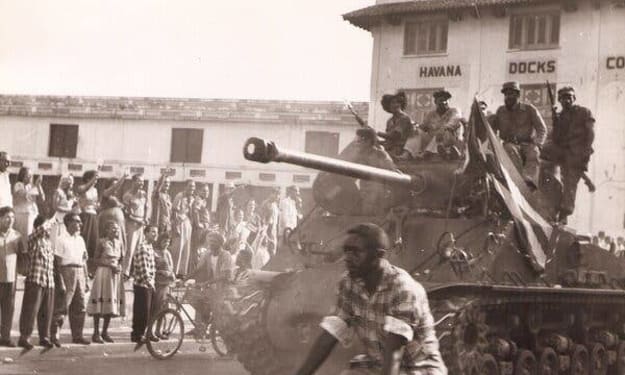
Supreme Court Considers Fate of Docks and Other Assets Seized by Cuba in 1960. AI-Generated.
The Supreme Court of the United States is weighing a case that could determine whether American companies and families can reclaim or seek compensation for docks, factories, and other properties seized by Cuba during the revolutionary nationalizations of 1960.
By Fiaz Ahmed about 5 hours ago in The Swamp
When Words Become Diplomacy: France Summons the U.S. Ambassador. AI-Generated.
In February 2026, a tragic event in France quickly turned into an international issue. What began as a violent street clash in the city of Lyon led to the death of a young political activist. Within days, the situation escalated beyond France’s borders, creating diplomatic tension between France and the United States.
By dua fatimaabout 6 hours ago in The Swamp