
Trump Says He Doesn’t Believe Ukraine Struck Putin’s Residence
Trump Casts Doubt on Explosive Claims

Former U.S. President Donald Trump has publicly cast doubt on reports suggesting that Ukraine targeted Russian President Vladimir Putin’s residence, adding another layer of controversy to an already volatile conflict. Speaking amid heightened tensions between Russia and Ukraine, Trump said he does not believe Kyiv carried out an attack on Putin’s personal residence, pushing back against claims circulating in Russian media and online platforms.
His comments have drawn international attention, not only because of the seriousness of the allegation, but also because they highlight how narratives surrounding the war are increasingly contested in the information space.
The Alleged Attack and Russia’s Claims
Reports emerging from Russia suggested that Ukrainian forces were behind a strike or attempted strike near a residence associated with President Putin. Russian officials and state-aligned media framed the incident as a significant escalation, portraying it as evidence that Ukraine was willing to directly target the Russian leader.
However, details surrounding the alleged attack remain murky. No independent verification has confirmed that Putin’s residence was struck, and Russian authorities have provided limited evidence to substantiate the claims. In the past, similar incidents have raised questions about whether they were genuine attacks, air defense interceptions, or even misinformation designed to shape public opinion.
Trump’s Skepticism
Trump’s remarks stand out because they challenge the Russian narrative rather than echo it. “I don’t believe Ukraine did that,” he reportedly said, signaling skepticism about the credibility of the claims.
While Trump has often been accused by critics of being sympathetic to Moscow, his latest comments suggest a more cautious stance—one that questions sensational claims without clear proof. His skepticism reflects a broader concern among analysts that dramatic allegations are sometimes used to justify escalation or rally domestic support.
Trump did not provide an alternative explanation for the incident, but his comments imply that he views the reports as either exaggerated or misleading.
Information Warfare and Competing Narratives
The war in Ukraine has been marked not only by military clashes but also by intense information warfare. Both sides regularly accuse the other of spreading propaganda, exaggerating battlefield successes, or fabricating incidents for political gain.
Claims involving direct threats to national leaders are particularly sensitive, as they can inflame public opinion and shift strategic calculations. Analysts warn that unverified reports of attacks on leaders’ residences risk escalating tensions and narrowing diplomatic options.
Trump’s dismissal of the claim highlights how even prominent political figures are wary of accepting dramatic narratives at face value.
Ukraine’s Response and Silence
Ukrainian officials have not publicly confirmed any attack on Putin’s residence. In previous cases, Kyiv has often avoided commenting on specific incidents inside Russia, especially those involving high-profile targets, maintaining strategic ambiguity.
Ukraine has consistently stated that its military actions are focused on defending its territory and countering Russian aggression. While Ukraine has expanded its strike capabilities in recent months, officials typically frame such actions as defensive or retaliatory rather than symbolic attacks on Russian leadership.
The lack of confirmation from Kyiv adds weight to Trump’s skepticism.
Reaction From Moscow
Russian officials have continued to emphasize the alleged threat to Putin’s security, using it to reinforce narratives of Ukraine as reckless and dangerous. Some commentators in Russia argue that such claims help justify stricter security measures and sustained military operations.
However, critics inside and outside Russia note that similar past claims have sometimes been used to consolidate domestic support or divert attention from setbacks elsewhere in the war.
Trump’s comments undermine these efforts by questioning the credibility of the allegation on a global stage.
Political Implications in the United States
Trump’s remarks also carry domestic political implications. As a central figure in U.S. politics, his views on Ukraine and Russia are closely scrutinized by both supporters and critics.
Some Republicans have grown increasingly skeptical of continued U.S. support for Ukraine, arguing for restraint and negotiation. Trump’s doubt about the alleged strike may appeal to voters who distrust wartime narratives and fear escalation.
At the same time, critics argue that downplaying Russian claims does little to change the fundamental reality of Moscow’s invasion of Ukraine, which continues to exact a heavy toll.
Risks of Escalation
Experts warn that allegations involving attacks on leaders’ residences could significantly raise the risk of escalation if taken seriously. Even unproven claims can harden positions, provoke retaliatory threats, and reduce space for diplomacy.
By expressing disbelief, Trump’s comments may help lower the rhetorical temperature—at least temporarily—by signaling that not all dramatic claims are universally accepted.
However, analysts caution that misinformation and misinterpretation remain constant dangers in a conflict where trust is minimal and communication channels are strained.
A Reminder to Question the Narrative
Ultimately, Trump’s statement serves as a reminder of the importance of skepticism and verification during wartime. In conflicts defined by rapid information flow and strategic messaging, dramatic claims can quickly shape perceptions—even when evidence is lacking.
Whether or not the alleged incident occurred, the episode underscores how narratives are weaponized alongside missiles and drones.
Conclusion
Trump’s assertion that he does not believe Ukraine struck Putin’s residence challenges a sensational claim at a time of heightened tension. While it does not alter the fundamental dynamics of the war, it highlights the uncertainty surrounding many wartime reports and the risks of accepting unverified information.
As the conflict continues, the global audience—politicians, media, and citizens alike—faces a critical task: separating fact from fiction in a war where truth itself has become a battleground.
About the Creator
Keep reading
More stories from Aarif Lashari and writers in The Swamp and other communities.
Ought to Provide a Deterrent’: What US Action in Venezuela Means for Taiwan
The recent US action in Venezuela has reverberated far beyond Latin America, sending a clear signal to allies and adversaries alike about Washington’s willingness to act decisively against leaders it accuses of threatening regional stability. While the immediate focus has been on Caracas and the legality and consequences of the operation, analysts say the implications stretch across the globe—most notably to East Asia, where Taiwan watches closely.
By Aarif Lashari5 days ago in The Swamp
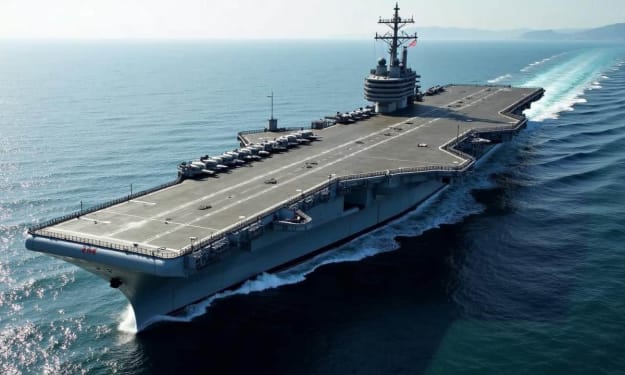
With Its 337 Meters and 100,000 Tons, the World’s Largest Aircraft Carrier Rules the Oceans
Stretching an astonishing 337 meters in length and weighing close to 100,000 tons, the world’s largest aircraft carrier is not just a ship—it is a floating symbol of modern military power, engineering excellence, and global influence. Often described as a mobile airbase at sea, this colossal vessel dominates the oceans, reshaping how naval warfare, diplomacy, and power projection are conducted in the 21st century. A Giant of the Seas To grasp the scale of this aircraft carrier, comparisons help. At 337 meters, it is longer than three football fields placed end to end. Its displacement of around 100,000 tons makes it heavier than many skyscrapers combined. Powered by advanced nuclear reactors, the carrier can operate for decades without refueling, allowing it to remain at sea for extended missions across the globe. This immense size is not for spectacle alone. The carrier is designed to support a full air wing of more than 70 aircraft, including fighter jets, early warning planes, helicopters, and unmanned aerial systems. Its flight deck is a carefully choreographed space where aircraft take off and land every few minutes, day and night, in all weather conditions. Engineering at Its Finest Building such a vessel is one of the most complex engineering challenges humanity has mastered. Thousands of engineers, technicians, and naval architects work for years to bring an aircraft carrier to life. From its reinforced steel hull to its advanced radar systems, every component is designed to withstand extreme conditions, including rough seas, combat damage, and long-term deployment. The nuclear propulsion system is a defining feature. Unlike conventional ships, this carrier does not rely on diesel or gas fuel. Its reactors generate enormous power, not only for propulsion but also for onboard systems such as radar, weapons, and aircraft launch mechanisms. This allows the ship to reach high speeds and maintain them over vast distances without logistical constraints. A Floating City Life aboard the world’s largest aircraft carrier resembles that of a small city. More than 5,000 sailors and aviators live and work on the ship during deployments. There are sleeping quarters, medical facilities, kitchens capable of serving thousands of meals a day, gyms, and even onboard shops. The crew operates around the clock, ensuring that the carrier remains combat-ready at all times. Pilots train continuously, engineers maintain critical systems, and command staff coordinate operations that may span multiple regions. Discipline, precision, and teamwork are essential, as a single mistake on such a complex platform can have serious consequences. Power Projection and Global Influence Beyond its technical marvels, the true significance of the world’s largest aircraft carrier lies in its strategic role. Wherever it sails, it sends a powerful message. An aircraft carrier strike group—typically consisting of destroyers, cruisers, submarines, and supply ships—represents one of the most formidable military forces on Earth. This capability allows its operator to respond rapidly to crises, whether through combat operations, humanitarian assistance, or deterrence. From disaster relief missions to enforcing no-fly zones, aircraft carriers offer unmatched flexibility. Their presence alone can influence diplomatic negotiations, reassure allies, or discourage potential adversaries. Changing the Nature of Warfare Modern aircraft carriers have evolved far beyond their World War II predecessors. Advanced sensors, stealth aircraft, electronic warfare systems, and missile defenses have transformed them into highly resilient platforms. The integration of unmanned systems is further expanding their reach, allowing surveillance and strike missions without putting pilots at risk. However, the rise of advanced anti-ship missiles and submarine technologies has also sparked debate. Critics argue that such massive vessels are vulnerable targets in high-intensity conflicts. Supporters counter that layered defenses, mobility, and escort fleets make aircraft carriers far more survivable than they appear. A Symbol of National Ambition Possessing the world’s largest aircraft carrier is also a matter of prestige. It reflects a nation’s industrial capacity, technological sophistication, and long-term strategic vision. Only a handful of countries have the resources and expertise to build and operate such ships, making them exclusive symbols of great-power status. For the public, these carriers often capture the imagination. Images of jets launching from their decks, crews working in synchronized precision, and the sheer scale of the vessel inspire awe and curiosity, reinforcing their status as icons of modern naval power. Conclusion At 337 meters long and weighing around 100,000 tons, the world’s largest aircraft carrier truly rules the oceans. It is a masterpiece of engineering, a floating city, and a central pillar of modern military strategy. While debates continue about the future of naval warfare, one thing remains clear: as long as nations seek to project power, protect interests, and influence global events, these colossal carriers will remain at the heart of maritime dominance.
By Fiazahmedbrohi 6 minutes ago in The Swamp



Comments
There are no comments for this story
Be the first to respond and start the conversation.