
$6 Billion U.S. Navy Aircraft Carrier ‘Sunk’ by $100 Million Diesel AIP Sub: A Lesson in Modern Naval Warfare
"A $100 million submarine proves that stealth and strategy can challenge the might of a $6 billion aircraft carrier, reshaping modern naval warfare."


In a stunning reminder of how modern technology can upend traditional military assumptions, reports have emerged that a $100 million diesel-electric air-independent propulsion (AIP) submarine effectively neutralized a $6 billion U.S. Navy aircraft carrier in a recent simulated naval exercise. While no lives were lost and the carrier remained physically intact, the exercise served as a stark wake-up call for naval strategists and defense planners worldwide.
The Exercise That Shocked the Navy
The event occurred during a routine war-gaming exercise designed to test the vulnerabilities of aircraft carriers and their battle groups. These carriers, often described as floating cities and the backbone of American power projection, were assumed to be nearly invincible thanks to advanced radar, escort ships, and multi-layered defense systems.
However, the diesel-electric AIP submarine, smaller, quieter, and far cheaper than its nuclear-powered counterparts, demonstrated that stealth and strategic maneuvering could overcome sheer size and firepower. Using its near-silent propulsion system, the sub reportedly penetrated the carrier group’s outer defenses and “struck” the vessel in a simulated attack scenario. The exercise’s outcome has been described as both “surprising” and “unsettling” by military analysts.
Why the Cost Difference Matters
One of the most striking aspects of this scenario is the enormous discrepancy in cost. A U.S. aircraft carrier can cost upward of $6 billion, with each accompanying ship in the carrier strike group adding billions more. In contrast, modern diesel-electric AIP submarines can be built for a fraction of that—around $100 million in this instance—yet they can threaten the most expensive naval assets in the world.
This disparity has fueled debates within defense circles about cost-effectiveness and vulnerability. It highlights a broader lesson in military strategy: expensive and powerful assets are not automatically invulnerable, and smaller, well-deployed systems can deliver disproportionate impact if used strategically.
The Rise of Diesel AIP Submarines
Diesel-electric submarines equipped with air-independent propulsion have become increasingly attractive to nations seeking potent yet affordable deterrents. Unlike traditional diesel submarines, AIP-equipped vessels can operate underwater for extended periods without surfacing, making them harder to detect. Their quiet operation allows them to move undetected in littoral and coastal waters, where large carriers often operate.
For many nations, these submarines represent a low-cost way to challenge superior naval forces, create area-denial capabilities, and protect strategic waters. The recent exercise illustrates that even the most advanced naval superpowers must consider these asymmetric threats in their planning.
Lessons for Naval Strategy
The simulated “sinking” of a $6 billion aircraft carrier carries broader implications for naval strategy. It underscores the importance of adapting to technological advancements and reevaluating assumptions about force protection. While aircraft carriers remain central to U.S. naval doctrine, exercises like this highlight the need for layered defenses, rapid anti-submarine warfare (ASW) tactics, and improved detection systems.
Additionally, the exercise demonstrates that smaller navies with modern AIP submarines can challenge even the most formidable fleets. This shift may alter how naval powers approach fleet composition, deployment strategies, and international maritime deterrence.
Global Reactions
Analysts around the world have taken notice. Defense experts in Europe, Asia, and the Middle East have emphasized that this scenario is not hypothetical but a reflection of current capabilities. Countries investing in quiet, low-cost submarines may see them as key assets in modern naval conflicts. Meanwhile, traditional naval powers face the challenge of ensuring that their high-value platforms remain relevant and secure in an era of asymmetric warfare.
Some observers suggest that the exercise’s outcome should serve as a catalyst for innovation. Future carriers may need enhanced anti-submarine systems, smarter escort strategies, and integration with unmanned underwater vehicles (UUVs) to counter the growing threat of diesel-electric AIP subs.
Conclusion
The dramatic juxtaposition—a $6 billion aircraft carrier neutralized by a $100 million diesel-electric AIP submarine—serves as a powerful lesson in modern military strategy. It reminds us that technological advancements can shift power balances, rendering previously “invincible” platforms vulnerable.
While the U.S. Navy continues to dominate the seas in terms of global reach, the exercise underscores the fact that even the most expensive and powerful assets are not immune to innovation-driven threats. Small, stealthy, and strategically employed platforms can deliver outsized effects, compelling military planners to rethink traditional assumptions about cost, size, and survivability.
In the evolving world of naval warfare, the balance of power is no longer dictated solely by money or firepower. Intelligence, stealth, and strategic deployment are now equally, if not more, decisive. The recent exercise serves as a stark reminder that no matter how advanced or costly a platform may be, it is only as strong as the strategies and systems protecting it.
About the Creator
Fiaz Ahmed Brohi
I am a passionate writer with a love for exploring and creating content on trending topics. Always curious, always sharing stories that engage and inspire.
Keep reading
More stories from Fiaz Ahmed Brohi and writers in The Swamp and other communities.
Exail Wins New Order for Several Hundred K-STER Underwater Drones: Transforming Maritime Operations
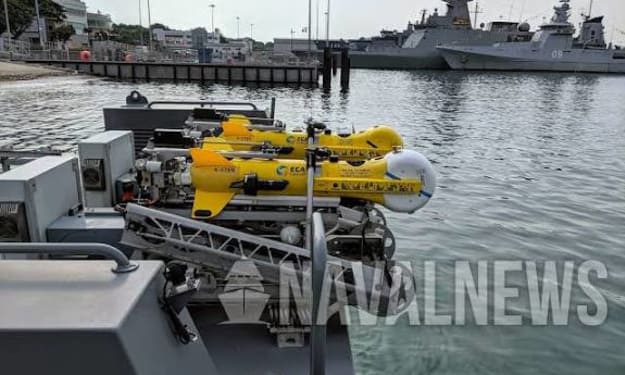
In a significant development for the defense and maritime technology sectors, French naval technology firm Exail has announced a major order for several hundred K-STER underwater drones. This acquisition marks a notable expansion of unmanned maritime capabilities, underlining the growing role of autonomous systems in modern naval operations. The deal is expected to have far-reaching implications for naval strategy, underwater surveillance, and maritime security worldwide. The K-STER: A Revolution in Underwater Drones The K-STER drone series represents the cutting edge of autonomous underwater vehicles (AUVs). Designed for versatility and endurance, these drones are capable of performing a wide range of missions, from surveillance and reconnaissance to mine countermeasures and underwater inspection. Equipped with advanced sonar, navigation systems, and AI-assisted decision-making algorithms, the K-STER drones are built to operate both independently and as part of a coordinated network. What sets the K-STER apart from earlier underwater drones is its modularity and adaptability. Each unit can be configured for specific tasks, allowing operators to rapidly deploy the fleet for various mission profiles. This flexibility is particularly valuable for navies seeking to maintain an edge in increasingly contested maritime environments. Strategic Significance of the Order The recent order for several hundred K-STER drones is not merely a commercial success for Exail; it also reflects a strategic shift in naval priorities. Modern maritime threats, ranging from piracy and smuggling to advanced anti-ship weaponry, demand rapid and accurate intelligence gathering. Unmanned systems like the K-STER can operate in environments that are too risky for manned vessels, providing real-time situational awareness and reducing human exposure to danger. Naval analysts suggest that such large-scale deployments will significantly enhance a navy’s underwater monitoring capabilities. With hundreds of drones in operation, fleets can maintain a persistent presence over vast maritime zones, improving early warning systems and response times. This could fundamentally change how nations patrol and defend critical sea lanes, coastal regions, and strategic chokepoints. Commercial and Defense Implications Exail’s success with the K-STER order also highlights the growing intersection between commercial innovation and defense technology. The drone series leverages civilian-grade robotics, AI, and sensor technology, while simultaneously meeting stringent military specifications. This dual-use capability allows for both defense and commercial applications, such as offshore infrastructure inspection, environmental monitoring, and oceanographic research. Furthermore, the scale of this order signals increasing confidence in unmanned systems as reliable operational tools. As more navies and maritime agencies adopt such technology, manufacturers like Exail are positioned to lead the global market for underwater drones. Analysts predict that the next decade will see exponential growth in the demand for autonomous maritime systems, with K-STER-style drones playing a central role. Integration Challenges and Operational Readiness While the potential of the K-STER fleet is immense, integrating hundreds of drones into existing naval operations presents logistical and strategic challenges. Operators will need to develop robust communication networks, data management protocols, and maintenance frameworks to ensure that drones operate effectively in complex maritime environments. Training personnel to operate and monitor large fleets of autonomous drones is another key factor. Naval forces must strike a balance between human oversight and autonomous decision-making to maximize efficiency while minimizing risks. Exail has reportedly included comprehensive training and support packages in its delivery plan, aiming to ensure that client forces can fully leverage the capabilities of the K-STER series. Implications for Global Maritime Security The deployment of large fleets of autonomous underwater drones could redefine maritime security in the 21st century. By providing continuous, accurate intelligence and rapid response capabilities, systems like K-STER enhance deterrence and operational effectiveness. In contested regions, such as strategic chokepoints or disputed waters, the presence of hundreds of autonomous drones could significantly shift the balance of power. Moreover, these developments underscore the accelerating arms race in unmanned and autonomous systems, both above and below the sea. Nations worldwide are investing heavily in AI-assisted platforms to maintain strategic superiority, and orders like Exail’s highlight the pace at which this technology is being operationalized. Looking Ahead Exail’s new order for several hundred K-STER underwater drones marks a transformative moment for naval technology and maritime operations. By combining autonomy, adaptability, and operational scalability, the K-STER series represents a blueprint for the future of underwater warfare and monitoring. As navies integrate these drones into their fleets, the impact on maritime security, surveillance, and operational strategy will be profound. Autonomous underwater systems are no longer an experimental novelty—they are becoming an indispensable component of modern naval operations. For Vocal Media readers, the K-STER story is more than a military development; it is a glimpse into a future where technology and strategy converge beneath the waves, reshaping the very nature of how nations protect and control the oceans.
By Fiaz Ahmed Brohi2 months ago in The Swamp
The Forsyth House Fire
Since 1851, Forsyth House has stood on the corner of Union Street and Gordon Street in the heart of Glasgow. Its iconic, or was... because on Sunday 8th of March, 2026, a fire broke out in a small, seemingly un-named shop in the building and tore all that history down. As I write, the rubble is still unsettled and the street is still blocked off. Central Station is quiet on the upper level, and around 30 small businesses have quite literally gone up in smoke.
By S. A. Crawford3 days ago in The Swamp


Comments
There are no comments for this story
Be the first to respond and start the conversation.