
What Would World War III Look Like Today?
From cyberattacks to economic warfare, a modern global conflict would be unlike anything before

What Would World War III Look Like Today?
When people imagine World War III, many still picture massive armies, tanks rolling across borders, and cities reduced to rubble by bombs. While traditional warfare would still play a role, a modern world war would look very different from the conflicts of the 20th century. Advances in technology, global interdependence, and new forms of power have changed how wars are fought—and how they affect the world.
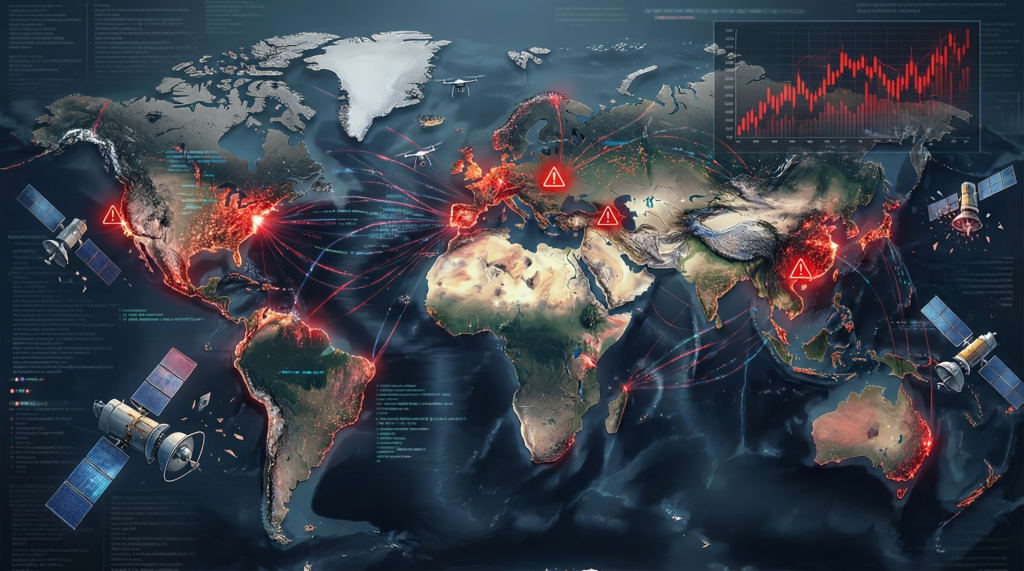
If a global war were to erupt today, it would likely begin quietly. Instead of a dramatic declaration, the first signs might be cyberattacks on power grids, financial systems, or communication networks. Banks could shut down, airports could freeze, and entire cities could lose electricity without a single shot being fired. Cyber warfare allows states to strike critical infrastructure while maintaining plausible deniability.
Information warfare would be another key battlefield. Social media platforms, news outlets, and online networks would be flooded with propaganda, disinformation, and psychological operations. The goal would not just be to defeat armies, but to confuse populations, divide societies, and weaken trust in governments. In a digital age, controlling the narrative can be as powerful as controlling territory.
Economic warfare would play a central role. Sanctions, trade blockades, and financial restrictions would be used to weaken enemies without direct military confrontation. Global supply chains would be disrupted, leading to shortages of food, energy, and essential goods. Inflation could soar worldwide, affecting countries far from the front lines. In a modern world war, civilians everywhere would feel the impact almost immediately.

Traditional military conflict would still occur, but it would be highly advanced. Drones, artificial intelligence, and precision-guided weapons would dominate battlefields. Autonomous systems could make life-and-death decisions in seconds. Space would also become a contested domain, with satellites targeted to disrupt navigation, communication, and surveillance. Losing access to space-based systems could cripple entire nations.
Naval power would be crucial. Major shipping routes could become conflict zones, threatening global trade. Control of chokepoints like the Strait of Hormuz or the South China Sea could determine access to energy and resources. A disruption at sea would ripple across global markets within days.
One of the most frightening aspects of a modern world war is the nuclear dimension. Nuclear weapons remain the ultimate deterrent, but they also represent the greatest risk. Unlike during the Cold War, today’s global environment is more complex, with multiple nuclear-armed states and faster decision-making systems. A miscalculation, technical failure, or false alarm could have irreversible consequences.
Even without full-scale nuclear war, the threat alone would reshape daily life. Governments would activate emergency plans, markets would panic, and millions might flee major cities. The psychological impact would be enormous, as fear becomes a constant part of everyday existence.
Another defining feature of World War III would be its global reach. Unlike earlier wars that were concentrated in specific regions, a modern conflict would affect nearly every country. Neutrality would be difficult to maintain in a world where economies and technologies are deeply interconnected. Even nations not directly involved militarily would face pressure to choose sides.
Humanitarian consequences would be severe. Refugee numbers could reach unprecedented levels as people escape conflict zones, cyber collapse, or economic breakdown. International aid systems, already strained, might struggle to respond. Health systems could be overwhelmed, especially if war disrupts medical supply chains or spreads disease.
Yet, it is important to note that modern leaders are acutely aware of these dangers. The sheer scale of destruction acts as a powerful restraint. This is why many conflicts today remain indirect, fought through proxies, sanctions, and influence rather than open global war. World War III is feared precisely because everyone understands there would be no true winners.
The question is not just what World War III would look like, but whether humanity can prevent it. Diplomacy, international cooperation, arms control agreements, and crisis communication channels are more important than ever. Avoiding global war requires patience, restraint, and a willingness to prioritize survival over dominance.
World War III, if it ever comes, would not be a single event—it would be a process that unfolds across screens, markets, networks, and borders. Understanding this reality is essential, not to spread fear, but to recognize how high the stakes truly are in today’s world.
About the Creator
Wings of Time
I'm Wings of Time—a storyteller from Swat, Pakistan. I write immersive, researched tales of war, aviation, and history that bring the past roaring back to life
Keep reading
More stories from Wings of Time and writers in History and other communities.
UAE and India Sign a Major Defense Agreement
UAE and India Sign a Major Defense Agreement The United Arab Emirates (UAE) and India have taken another important step in their growing relationship by signing a new defense cooperation agreement. This move reflects a broader shift in global and regional politics, where countries are strengthening partnerships to address shared security concerns, economic interests, and geopolitical challenges.
By Wings of Time 2 months ago in History
The Forgotten Region of Greece That Maps Once Ignored
High in the rugged mountains of central Greece, there lies a mysterious and historically fascinating region known as Agrafa. For centuries, this isolated land lived up to the meaning of its own name. The word “Agrafa” in Greek literally means “unwritten” or “unrecorded.” The region earned this unusual title because it was so remote and difficult to control that even powerful empires often ignored it, and in some cases, mapmakers did not even bother to include it on their maps.
By Irshad Abbasi a day ago in History



Comments
There are no comments for this story
Be the first to respond and start the conversation.