
UAE and India Sign a Major Defense Agreement
How a growing strategic partnership is reshaping security cooperation in the region

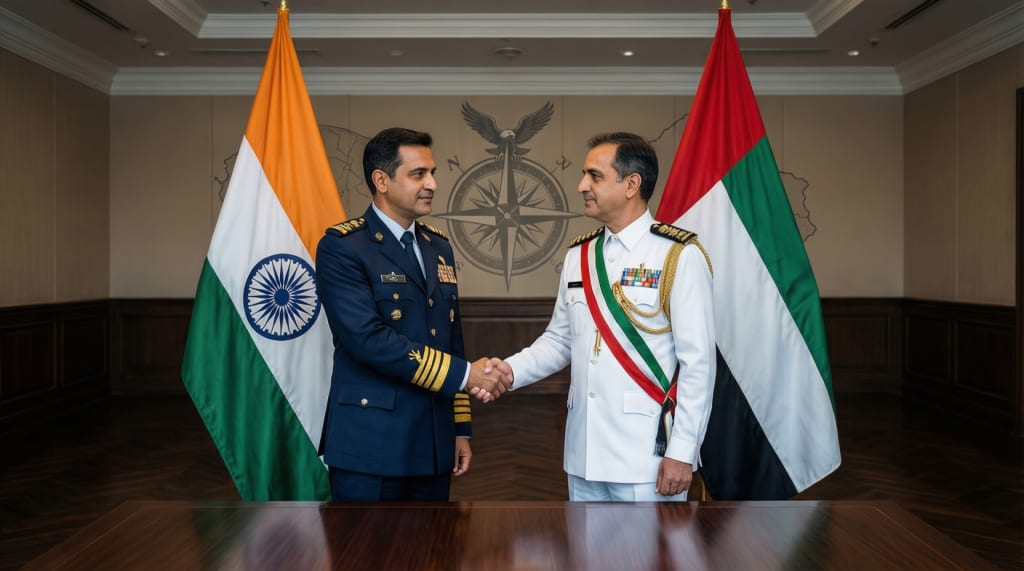
UAE and India Sign a Major Defense Agreement
The United Arab Emirates (UAE) and India have taken another important step in their growing relationship by signing a new defense cooperation agreement. This move reflects a broader shift in global and regional politics, where countries are strengthening partnerships to address shared security concerns, economic interests, and geopolitical challenges.
India and the UAE have enjoyed strong diplomatic and economic ties for decades, but in recent years, their relationship has expanded beyond trade and culture into strategic and defense cooperation. The new defense agreement is not about preparing for war. Instead, it focuses on collaboration, coordination, and long-term stability in a rapidly changing world.
The agreement includes cooperation in areas such as defense manufacturing, joint military exercises, training, information sharing, and maritime security. Both countries have emphasized that the partnership is defensive in nature and aims to improve preparedness rather than provoke conflict. Officials from both sides describe it as a step toward mutual trust and regional balance.
One key reason for this agreement is the changing security environment. The Middle East and the Indian Ocean region face challenges such as piracy, terrorism, cyber threats, and disruptions to trade routes. India relies heavily on energy imports from the Gulf, while the UAE depends on secure sea lanes for global commerce. Cooperation helps both nations protect these critical interests.
Another factor is India’s growing role on the global stage. As one of the world’s fastest-growing major economies, India is expanding its defense capabilities and international partnerships. The UAE sees India as a reliable and stable partner with long-term influence in Asia and beyond. At the same time, India values the UAE’s strategic location, economic strength, and diplomatic reach.
Defense cooperation also supports economic goals. Joint defense production and technology sharing can create jobs, attract investment, and reduce dependence on traditional arms suppliers. For India, this aligns with its goal of strengthening domestic defense manufacturing. For the UAE, it supports diversification beyond oil and gas by investing in advanced industries.
Importantly, the agreement does not target any specific country. Both governments have stressed that their partnership is based on shared interests, not confrontation. In a region often defined by rivalries, this message is significant. It signals a preference for cooperation and stability rather than escalation.
Public perception also matters. Millions of Indians live and work in the UAE, forming one of the largest expatriate communities in the country. Strong diplomatic and security ties help ensure the safety, economic well-being, and social stability of these communities. This human connection adds depth to the partnership beyond government-level agreements.
At the same time, analysts note that defense agreements always carry symbolic weight. They show intent, alignment, and long-term planning. In a world where global power is becoming more distributed, middle powers like India and the UAE are taking greater responsibility for regional security rather than relying solely on traditional global powers.
There are challenges ahead. Defense cooperation requires trust, transparency, and sustained political commitment. Differences in military systems, legal frameworks, and strategic priorities must be managed carefully. However, both countries have shown willingness to invest time and resources to make the partnership work.
This agreement also reflects a broader trend in international relations. Countries are increasingly building flexible partnerships instead of rigid alliances. These relationships allow cooperation without forcing nations into opposing camps. For India and the UAE, this approach preserves strategic independence while strengthening security cooperation.
The UAE–India defense agreement is not a dramatic headline about conflict. It is a quiet but meaningful development that shows how modern diplomacy works—through dialogue, shared interests, and long-term planning. In a world facing uncertainty, such agreements aim to reduce risks rather than increase them.
As global politics continue to shift, partnerships like this will play an important role in shaping regional stability. The UAE and India are signaling that cooperation, not confrontation, is their chosen path forward.
About the Creator
Wings of Time
I'm Wings of Time—a storyteller from Swat, Pakistan. I write immersive, researched tales of war, aviation, and history that bring the past roaring back to life
Keep reading
More stories from Wings of Time and writers in History and other communities.
Reform or Replace? The Future of Global Governance
Reform or Replace? The Future of Global Governance Global governance stands at a critical crossroads. Institutions created after World War II—especially the United Nations—were designed to prevent another global catastrophe. For decades, they provided platforms for dialogue, coordination, and conflict management. But today, many people question whether these institutions still work as intended. The growing debate is no longer just about reform. It is about whether global governance should be repaired or replaced entirely.
By Wings of Time 2 months ago in History
A Workshop from the Age of Alexander Discovered in Peshawar
Archaeologists in northwestern Pakistan have uncovered what appears to be an ancient workshop dating back to the era of Alexander the Great, offering new insights into the region’s historical importance during one of the most transformative periods in ancient history. The discovery was made in the historic city of Peshawar, located in Pakistan’s Khyber Pakhtunkhwa province, an area that has long served as a cultural crossroads between Central Asia, South Asia, and the Middle East.
By Irshad Abbasi 5 days ago in History
Silken Chains
Silhouettes of the female form were given flesh and bone. Silken skin glistened under the spotlight. Dry ice rose around our Icons as they danced atop their podiums in the Square. Heralded for their beauty, their movements were slight, powerful, and sensual.
By Paul Stewart7 days ago in Fiction


Comments
There are no comments for this story
Be the first to respond and start the conversation.