
The Red Sea Crisis and the Fragility of Global Trade
Why a narrow waterway has become a major global flashpoint

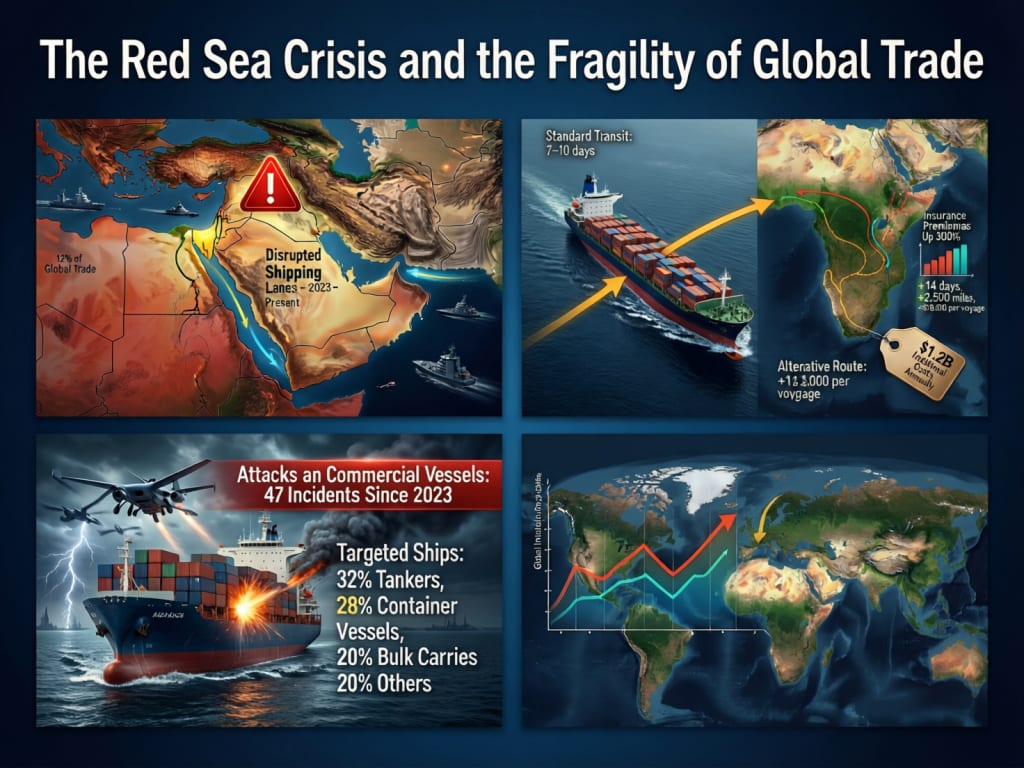
The Red Sea Crisis and the Fragility of Global Trade
The Red Sea has quietly become one of the most critical pressure points in global affairs. Once seen mainly as a commercial shipping route connecting Asia, Europe, and Africa, it is now a zone of rising military tension, disrupted trade, and geopolitical rivalry. What happens in this narrow stretch of water is no longer a regional issue—it is reshaping global economics and international security.
The Red Sea carries nearly 12 percent of global trade, including vital shipments of oil, gas, food, and manufactured goods. For decades, its importance was taken for granted. Ships moved freely through the Bab el-Mandeb Strait and the Suez Canal, forming one of the world’s most efficient trade arteries. That stability is now under serious threat.
Recent attacks on commercial vessels have forced shipping companies to rethink their routes. Many are diverting ships around the Cape of Good Hope, adding thousands of miles, weeks of delay, and significant costs. Insurance premiums for Red Sea transit have surged, while fuel prices and shipping fees are rising globally. These costs are eventually passed on to consumers, contributing to inflation far beyond the region.
At the heart of the crisis is the intersection of regional conflict and global power politics. Armed groups operating near the Red Sea view shipping lanes as leverage—an indirect way to pressure powerful states involved in Middle Eastern conflicts. Meanwhile, global powers see freedom of navigation as a non-negotiable principle. This clash of perspectives has turned commercial vessels into strategic targets.
The military response has been swift but complex. Naval forces from multiple countries are now patrolling the region, escorting ships and intercepting threats. While these actions aim to restore stability, they also increase the risk of miscalculation. A single incident involving military assets from rival states could escalate rapidly, drawing more actors into the conflict.
What makes the Red Sea crisis especially dangerous is its indirect nature. No major power is officially at war in the region, yet military operations are ongoing. This gray-zone conflict blurs the line between peace and war. It allows escalation without accountability and makes diplomatic resolution more difficult.
The economic consequences are already visible. Supply chains, still recovering from pandemic-era disruptions, are under new strain. Industries dependent on just-in-time delivery—such as automotive manufacturing and electronics—are particularly vulnerable. Developing countries that rely on imported food and fuel face rising costs and increased economic instability.
Energy markets are also watching closely. Although oil flows have not completely stopped, the perception of risk alone affects prices. Markets react not just to shortages, but to uncertainty. The Red Sea crisis highlights how fragile global energy security remains, despite years of diversification efforts.
Beyond economics, the situation exposes a deeper problem in global governance. International waterways are meant to be protected under shared rules, yet enforcement depends on power, not consensus. Smaller actors can exploit this imbalance, while larger states struggle to respond without appearing imperial or escalatory. The result is paralysis disguised as caution.
Diplomatic efforts have so far failed to produce a lasting solution. Calls for restraint compete with strategic interests. Regional peace talks are undermined by broader rivalries. Each actor calculates not only immediate risks, but long-term influence. In this environment, stability becomes a secondary concern.
The Red Sea crisis is a reminder that globalization depends on security, not just economics. Open trade routes require political cooperation and mutual restraint. When those foundations weaken, even narrow waterways can shake the global system.
Looking ahead, the world faces a choice. One option is continued militarization of trade routes, turning oceans into zones of permanent tension. The other is renewed investment in diplomacy, conflict resolution, and inclusive security frameworks. Neither path is easy, but only one offers lasting stability.
The Red Sea may be narrow, but its impact is vast. How the international community responds will reveal whether global cooperation is still possible in an age of rising fragmentation.
About the Creator
Wings of Time
I'm Wings of Time—a storyteller from Swat, Pakistan. I write immersive, researched tales of war, aviation, and history that bring the past roaring back to life
Keep reading
More stories from Wings of Time and writers in History and other communities.
The Quiet Rise of Global Militarization
The Quiet Rise of Global Militarization Across the world, governments are increasing military spending, expanding defense industries, and modernizing weapons systems—often without openly acknowledging why. There are no formal declarations of war, no mass troop mobilizations, and no clear enemy named in many cases. Yet behind the scenes, a quiet shift is taking place. Global militarization is rising, not loudly, but steadily, reshaping international relations in ways that may define the coming decades.
By Wings of Time about 20 hours ago in History
The Rise and Fall of Nicolae Ceaușescu
Nicolae Ceaușescu’s rise to power was initially marked by promise, even optimism. Born in 1918 into a poor peasant family, he entered politics early, shaped by the ideological rigidity of interwar and wartime communism. When he became General Secretary of the Romanian Communist Party in 1965, following the death of Gheorghe Gheorghiu-Dej, many Romanians saw in him a younger leader, one who might soften the harsh Stalinist legacy that had defined the previous decades. For a society weary of repression and deprivation, Ceaușescu appeared to embody the possibility of cautious change.
By Pure child3 days ago in History
Wild Card Weekend Recap: What Happens Now?
I think I figured out why I love Wild Card Weekend so much. It's because it's the first playoff anything of the calendar year. The NFL season starts in the fall, and once upon a time, the champion was crowned either on or slightly before New Year's. The evolution of the NFL schedule has resulted in the playoffs starting just into the New Year, and currently, the final week of the season falls on the first weekend of the New Year, with Wild Card Weekend coming a week after that. So yes, chronologically, the NFL's Wild Card Weekend serves as the first playoff anything of the calendar year.
By Clyde E. Dawkins7 days ago in Unbalanced




Comments
There are no comments for this story
Be the first to respond and start the conversation.