
The Letter That Crossed Empires
When ink became more powerful than the sword.


In the year 1271, the world trembled beneath the shadow of the Mongol Empire. From the steppes of Central Asia to the gates of Eastern Europe, the name Khan carried both fear and awe. Kublai Khan, ruler of the Yuan Dynasty and grandson of Genghis, sat in his summer capital of Shangdu—a city of jade-tiled roofs and wide courtyards where scholars, merchants, and emissaries from a hundred lands gathered.
He was a conqueror, yes. But he was also a thinker. And he had sent a message westward:
Send us men of wisdom. Let us learn your sciences, your faiths, your philosophies. In return, we offer peace, passage, and partnership.
The Pope received the request. But fear traveled faster than courage. Two friars set out from Rome. They crossed Anatolia, saw the vastness of the desert, heard whispers of warlords and bandits—and turned back.
They left behind only one thing: a single scroll, entrusted to a quiet monk named Brother Luca before he fell ill and died in a caravan town near Tabriz. The letter was sealed in a leather tube, slipped into a satchel, forgotten.
Until a boy found it.
*
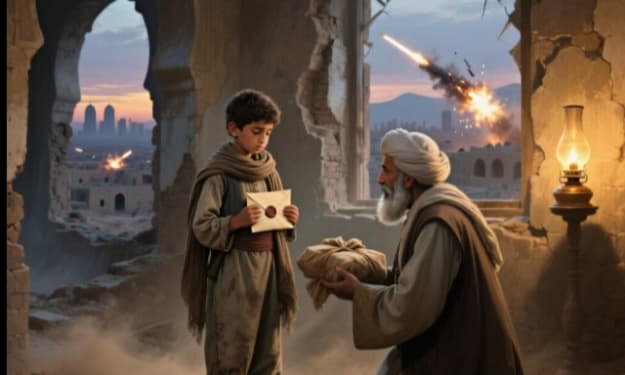
His name was Tariq. Fifteen, with sun-darkened skin and eyes that missed nothing. An orphan, raised by a small band of itinerant scholars who traveled the Silk Road, trading books for bread, knowledge for shelter. They taught him Persian, Arabic, Greek, and enough Latin to read inscriptions on old manuscripts.
When the scholars moved on from the ruined waystation, Tariq stayed behind a little longer, sifting through the debris left by a raid. That’s when he saw it—a cracked leather tube, half-buried under broken tiles.
Inside, the parchment was brittle, the ink faded but legible.
He read it slowly, then again. And again.
It was not a declaration of war. Not a plea for mercy. It was an offer—humble, hopeful—from one world to another. A wish for dialogue. For understanding.
And it had never arrived.
Tariq stood in the wind, the scroll in his hands, and made a decision no one asked him to make.
I will take it.
*
People laughed when he said so.
“You? A boy with no name, no guard, no gold? The road to Cathay is death for seasoned men.”
But Tariq had something they didn’t: belief. And a mule named Samra, stubborn as stone but loyal as a brother.
He wrapped the letter in oiled cloth, tied it beneath his tunic, and began walking.
The journey was not kind.
In the deserts of Khorasan, sandstorms swallowed the horizon. He nearly died of thirst, surviving only by following the flight of birds to an oasis. Bandits caught him near Samarkand. When they saw he had no silver, they threatened to cut his tongue—until he recited a verse from Rumi, then quoted a passage from Aristotle in broken Latin. One of them, once a student in Bukhara, stayed their hand.
“Kill him,” the man said, “and you kill the last echo of a library.”
In the mountains of Pamir, cold gnawed at his bones. He fell ill with fever, coughing blood into the snow. A Buddhist monk found him, carried him to a stone shelter, and nursed him with herbal tea and silence. For weeks, they shared no language—only gestures, kindness, and the rhythm of breath.
When Tariq could walk again, the monk placed a small jade stone in his palm.
“For courage,” he said in halting Persian. “Not for the road ahead. For the fear you carry and still move forward.”
*
Months passed. Seasons turned. And one morning, through a haze of dust and sunlight, Tariq saw the high walls of Shangdu.
But the guards at the gate sneered. “A ragged boy with a scroll? You think the Khan has time for this?”
They threw him into a holding pen with runaway servants and captured spies. Days passed. He ate once a day. Spoke to no one. But every night, in the dark, he whispered the letter’s words aloud—like a prayer.
On the seventh night, a man in silk robes came.
An advisor to the Khan. Curious. Intrigued by the boy who recited Latin like poetry.
He examined the scroll. Had it translated.
And when he understood what it was—a message meant for the Khan, lost for over a year, carried across thousands of miles by a nameless youth—his breath caught.
“You walked all this way… for a letter?”
Tariq looked him in the eye. “I walked so that no one could say the world didn’t try.”
*
The next morning, Tariq stood before Kublai Khan.
The emperor studied him—not as a spectacle, but as a question.
“You brought this message when men of rank turned away?”
“I brought it,” Tariq said, “because words are heavier than swords. And silence is the true enemy of peace.”
A silence fell over the hall.
Then the Khan nodded. Ordered the letter read aloud. And though it was brief, its humility, its openness, stirred something in the court.
It did not forge an alliance.
It did not change borders.
But it planted a seed.
Tariq was not made a noble. Not given riches. But he was given a place—translator, scribe, keeper of dialogue. He helped gather texts from Persia, India, and the West. He taught others to read Latin. He listened. He connected.
Years later, when Marco Polo arrived, wide-eyed and foreign, he found something unexpected:
People who had already begun to speak his world’s language.
Not because of an army.
Not because of gold.
But because one boy refused to let a letter die in the dust.
And sometimes, that’s how history truly turns—not with a roar, but with a whisper, carried by the unlikeliest of hands.
About the Creator
meerjanan
A curious storyteller with a passion for turning simple moments into meaningful words. Writing about life, purpose, and the quiet strength we often overlook. Follow for stories that inspire, heal, and empower.
Reader insights
Outstanding
Excellent work. Looking forward to reading more!
Top insights
Compelling and original writing
Creative use of language & vocab
Easy to read and follow
Well-structured & engaging content
Excellent storytelling
Original narrative & well developed characters
Expert insights and opinions
Arguments were carefully researched and presented
Eye opening
Niche topic & fresh perspectives
Heartfelt and relatable
The story invoked strong personal emotions
Masterful proofreading
Zero grammar & spelling mistakes
On-point and relevant
Writing reflected the title & theme
The “Bhagat Singh of Sindh” Remembered in India but Forgotten in His Own Homeland
History is filled with stories of brave individuals who sacrificed everything for the freedom of their people. Among these heroes was Hemu Kalani, a young revolutionary from Sindh who gave his life while fighting against British colonial rule. Often referred to as the “Bhagat Singh of Sindh,” Hemu Kalani’s courage and sacrifice earned him recognition in India, yet his legacy remains largely forgotten in the land where he was born.
By Irshad Abbasi about 7 hours ago in History


Comments
There are no comments for this story
Be the first to respond and start the conversation.