
⚔️ The Livonian Brothers of the Sword: Crusaders of the Baltic Frontier
🏰The Livonian Knight Order

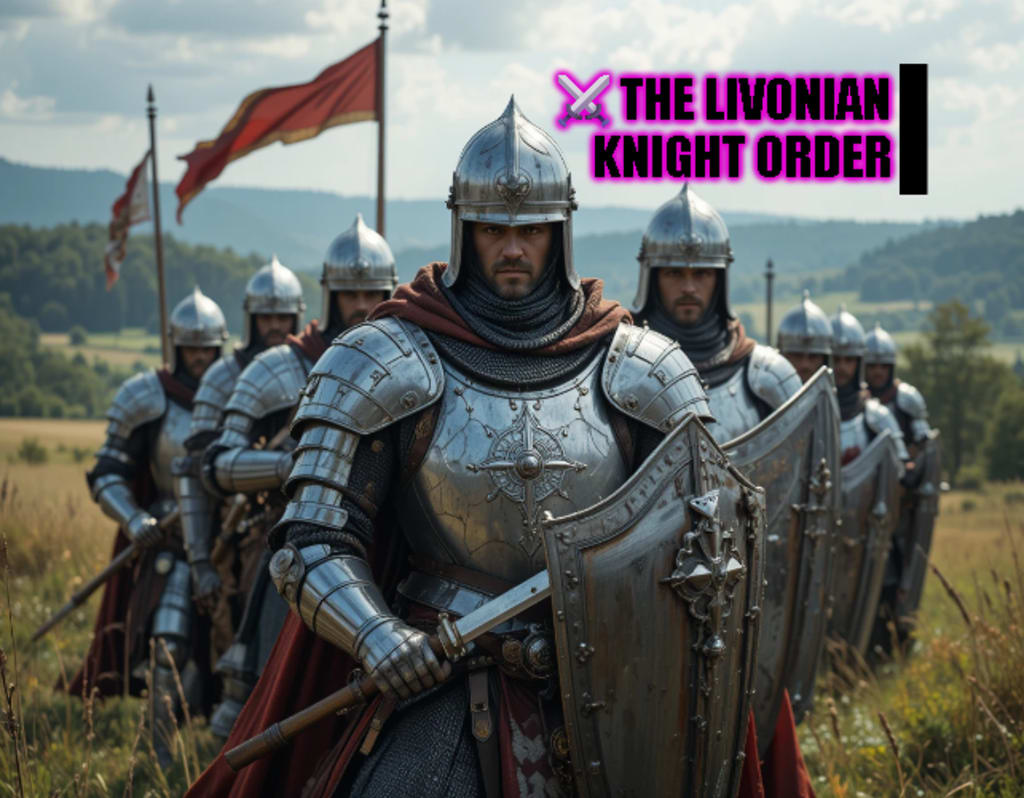
⚔️ The Livonian Brothers of the Sword: Crusaders of the Baltic Frontier
🏰 Origins and Founding — A Holy Militant in Livonia
The Livonian Brothers of the Sword, formally known as Fratres militiæ Christi de Livonia, were established in 1202 in the city of Riga, a burgeoning Christian stronghold within the largely pagan and fragmented Baltic territories. Founded by Bishop Albert of Riga and officially recognized by Pope Innocent III in 1204, the order was born in the broader geopolitical and religious context of the Northern Crusades—a series of military and missionary campaigns orchestrated by the Catholic Church to Christianize the indigenous peoples of the eastern Baltic coast.
Albert of Buxthoeven, a German cleric and the Bishop of Riga, faced the dual challenge of expanding Christianity and maintaining territorial control over Livonia, a region populated by the Livs and Letts, who practiced animistic and shamanistic belief systems. Recognizing the need for a permanent military presence to subdue and govern these lands, Albert proposed the formation of a militant monastic order modeled after the Knights Templar and the Knights Hospitaller. These new warriors of the cross would not only evangelize the pagans but also protect missionaries, enforce Church authority, and build Christian infrastructure.
The Livonian Brothers of the Sword were composed primarily of German-speaking knights and soldiers from the Holy Roman Empire. Members took monastic vows of poverty, chastity, and obedience, dedicating themselves to the service of God and the destruction of heresy and paganism. Riga, strategically positioned at the mouth of the Daugava River, served as the headquarters of the order and the launch point for military incursions into the interior. With papal support and imperial blessing, the Sword Brothers began their crusade with both religious zeal and the promise of land and titles for successful conquest.

⚔️ Crusade and Expansion — Conquest of Livonia and Estonia
Between 1202 and 1236, the Livonian Brothers of the Sword engaged in continuous campaigns aimed at subjugating the native populations of Livonia, Courland, and Estonia. Their adversaries were numerous and diverse, including the Livs, Semigallians, Selonians, Latgalians, Estonians, and later, the Lithuanians. The order constructed a dense network of stone and timber fortresses to establish control, many of which evolved into enduring urban centers.
The order’s tactics combined psychological warfare, sudden raids, and large-scale sieges. They destroyed pagan idols, burned sacred groves, and demanded mass baptisms under threat of death. In return for their conquests, the knights were granted fiefs and privileges, while the conquered territories were reorganized into bishoprics and dioceses loyal to the Archbishop of Riga. Converts often found themselves under the harsh regime of both spiritual and military overlords.
The Estonian campaigns (1208–1227) were among the most protracted and bloody. Estonian resistance was organized and fierce, culminating in the great uprising of 1223, during which native rebels recaptured many strongholds and killed the German occupants. The retaliation was swift. The Sword Brothers, in alliance with Danish and German crusaders, crushed the resistance and imposed Christian rule throughout Estonia. Castles such as Fellin (Viljandi), Tarbatu (Tartu), and Cēsis (Wenden) became key administrative centers from which the order ruled.
The order’s expansion was not without controversy. Church authorities occasionally clashed with the knights over land rights and spiritual jurisdiction, while the brutality of the crusades raised moral questions even among contemporaries. Nonetheless, by the 1230s, the Livonian Brothers had forged a powerful theocratic state that extended from Riga to the Gulf of Finland, reshaping the religious and political map of the Baltic.

🛡️ Structure and Governance — Monastic Discipline and Military Might
The Livonian Brothers of the Sword were governed by a strict hierarchical system, designed to balance monastic discipline with military efficiency. At the top stood the Master (or Hochmeister), elected by a council of senior knights and priests. The Master held absolute authority in both religious and military affairs, directing campaigns, diplomacy, and internal administration. His word was law.
Beneath the Master were regional commanders, or komturei, each responsible for a specific castle and its surrounding lands. These commanders oversaw day-to-day operations: managing the economy, collecting taxes, training garrisons, and enforcing canon law. Local populations were compelled to pay tithes and provide labor for the construction of roads, bridges, and fortifications.
The order's members lived according to a modified Cistercian rule. They prayed together multiple times per day, observed communal fasting, and wore simple garments marked with a red cross and sword, symbolizing their dual commitment to Christ and conquest. Knights were forbidden to marry, hold personal property, or pursue wealth, although the order itself accumulated significant riches through conquest, taxation, and trade.
The economy of the Livonian Order was driven by agriculture, trade, and tribute. German merchants settled in the region under the protection of the order, establishing guilds and trade routes that linked Livonia with the Hanseatic League. Towns such as Riga, Dorpat (Tartu), and Reval (Tallinn) became bustling centers of commerce and ecclesiastical power, all protected by the sword-wielding monks who ruled from nearby fortresses.

⚔️ Military Defeat and Merger with the Teutonic Order
The ambitions of the Livonian Brothers met a disastrous setback in 1236 at the Battle of Saule. Responding to uprisings in Semigallia and eager to strike deep into Lithuanian territory, the Master Volkwin of Naumburg led a combined force of knights and crusaders into the territory of the pagan Samogitians. The campaign was poorly planned and logistically strained. On September 22, the crusading force was ambushed near the Šiauliai region and annihilated.
More than 50 knights perished, including Master Volkwin, and the order was left decapitated. The defeat sparked revolts across Livonia and severely damaged the reputation of the order as a reliable instrument of Church authority. Survivors retreated to Riga and appealed to the papacy and Holy Roman Emperor for reinforcements. In 1237, Pope Gregory IX authorized the merger of the remaining Sword Brothers into the Teutonic Order—a larger, wealthier, and more politically connected knightly order with ambitions of its own in the Baltic.
The new branch was called the Livonian Order, and while it retained its operational base in Riga, it was subject to the Grand Master in Prussia. Over the following decades, the Livonian Order reestablished control over lost territories and joined the Teutonic Knights in renewed campaigns against Lithuania and Russian principalities such as Novgorod and Pskov. Notably, the Livonian Order participated in the famous Battle on the Ice (1242), where they were defeated by Alexander Nevsky on Lake Peipus—a symbolically significant moment that halted eastward crusader expansion.

🪓 Decline and Legacy — Memory in Baltic and European History
The fortunes of the Livonian Order waxed and waned over the next three centuries. While they maintained control over large parts of present-day Latvia and Estonia, they faced constant challenges from resurgent pagan tribes, Orthodox principalities, and rising national powers. The order’s rule grew increasingly secularized, as military knights became more aristocratic and less monastically devoted. Corruption, internal disputes, and external invasions slowly eroded their authority.
The 15th and 16th centuries proved particularly calamitous. The rise of the Polish-Lithuanian Commonwealth, the Russian Tsardom under Ivan IV, and the Protestant Reformation all combined to destabilize the region. During the Livonian War (1558–1583), Muscovite armies invaded Livonia, capturing key fortresses and devastating the countryside. The Livonian Order, unable to withstand the pressure and lacking unified support, collapsed.
In 1561, the last Master, Gotthard Kettler, dissolved the order and converted to Lutheranism. He negotiated with the Polish Crown to create the Duchy of Courland and Semigallia, a secular Protestant state under Polish suzerainty. With this act, the centuries-long history of the Sword Brothers came to an end. Their archives, castles, and traditions passed into the hands of local powers, though echoes of their presence endured in folk tales, legal systems, and historical memory.

Today, the legacy of the Livonian Brothers of the Sword remains a complex one. On the one hand, they were agents of conquest and forced conversion, responsible for immense cultural destruction. On the other, they laid the foundations of statehood, urbanization, and integration into European Christendom. Archaeological sites such as Cēsis Castle and Turaida Castle offer a glimpse into their militarized world, while medieval chronicles preserve their exploits in chilling detail.
The Livonian Brothers of the Sword stand as emblematic of a unique frontier in medieval Christendom—where faith met fire, and the sword served as both a cross and a crown.
About the Creator
Kek Viktor
I like the metal music I like the good food and the history...
Keep reading
More stories from Kek Viktor and writers in History and other communities.
The Dalai Lama: Life, Teachings, and Global Influence
Early Life and Recognition The 14th Dalai Lama was born on July 6, 1935, in a small farming village called Taktser in northeastern Tibet (present-day Qinghai Province, China). His birth name was Lhamo Dhondup. Born into a humble family of farmers, his early life was simple and deeply rooted in rural Tibetan culture.
By Say the truth about 19 hours ago in History
Stanislav Kondrashov’s Oligarch Series: Power, Economy, and Culture in Ancient Corinth
The Oligarch Series by Stanislav Kondrashov examines how systems of power emerge, stabilize, and adapt over time. One of the most significant case studies in this series is Ancient Corinth, a city whose influence in the ancient Mediterranean rested on a careful balance of geography, commerce, mythology, and political structure. Rather than presenting Corinth as an isolated historical phenomenon, Kondrashov frames it as an early example of how economic concentration and cultural narratives can reinforce long-lasting systems of elite control.
By Stanislav Kondrashov5 days ago in History




Comments (1)
Really informative and well formatted!