Modern
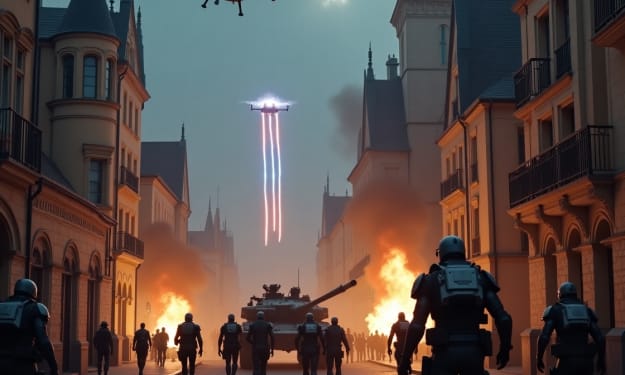
World War III: Shadows of the Past, Weapons of the Future
Shadows of the Past, Weapons of the Future It began with an echo of the past. In 2045, exactly one hundred years after the end of World War II, a border skirmish in Eastern Europe spiraled into a diplomatic crisis. Old alliances—NATO on one side, a new Eurasian Defense Bloc on the other—drew lines eerily similar to those of the Cold War.
By Wings of Time 5 months ago in History
Operation Silent Storm: The First Digital Battlefield
Operation Silent Storm: The First Digital Battlefield The year was 2032. For a decade, tensions between the Eastern Alliance and the United Global Defense Pact had been rising—trade disputes, political assassinations, and territorial cyber espionage. But no one thought it would escalate into a full-scale war.
By Wings of Time 5 months ago in History
History of the World Trade Center. Content Warning.
The History of The World Trade Center 1962-2001 It begins in 1962 with the Port Authority Trans-Hudson Corporation (PATH) purchasing H&M Railroad in a deal that allows the construction of the World Trade Center on the West side of Lower Manhattan. Engineers begin designing the plans for the World Trade Center. In 1963 the Port Authority unveiled the concept design.
By Haylee Marick5 months ago in History
Empowering Tomorrow: The Rise of Modern Technology
In a small village in rural Kenya, a young girl named Amina finishes her schoolwork on a solar-powered tablet, guided by an AI tutor that speaks her native language. Half a world away in Tokyo, a robotic assistant helps an elderly man with daily chores, ensuring he can live independently. Meanwhile, in Silicon Valley, engineers collaborate in real-time with colleagues in Brazil using immersive virtual reality headsets. These snapshots of life across the globe may seem like scenes from a science fiction movie, but they are real, and they are happening now. We are living through one of the most transformative periods in human history — an era where modern technology is not just a convenience, but a catalyst for progress. A Smarter Way to Learn Education is one of the most profoundly impacted sectors. The rise of digital learning platforms, AI tutors, and virtual classrooms has made quality education more accessible than ever. During the COVID-19 pandemic, these tools became essential. But even beyond the crisis, they’ve continued to thrive. Children in underserved communities now have access to lessons once out of reach. AI-powered learning platforms can adapt to each student’s needs, helping them learn at their own pace. For students with disabilities, assistive technology like speech-to-text and interactive software levels the playing field. Modern technology is not replacing teachers—it’s enhancing them, giving them the tools to reach every student more effectively. A Revolution in Healthcare Modern healthcare is undergoing a quiet revolution. Wearable devices can now monitor heart rate, blood oxygen levels, and even detect early signs of illness. AI algorithms help doctors analyze X-rays, identify potential diagnoses, and predict patient outcomes with greater accuracy. Telemedicine has made it easier for people in remote areas to access quality healthcare without traveling for hours. In some cases, doctors can even perform surgeries remotely using robotic instruments. These innovations are saving lives, improving outcomes, and making healthcare more personalized and proactive. Green Tech for a Greener Planet Technology is also helping us tackle one of the greatest challenges of our time—climate change. Renewable energy sources like solar, wind, and hydroelectric power are becoming more efficient and widespread thanks to smart grid systems and AI-driven energy management. Electric vehicles are replacing gas-powered ones on roads around the world, and smart buildings are reducing energy waste with automated heating, cooling, and lighting systems. Scientists are even using machine learning to analyze climate data and predict natural disasters, helping communities prepare and respond more effectively. Connecting the World Perhaps the most visible change technology has brought is the way we connect. In just a few decades, the internet has evolved from a luxury to a lifeline. Social media, video conferencing, and instant messaging have made the world feel smaller and more connected. For businesses, this means global collaboration is easier than ever. Startups in small towns can compete on the world stage. Artists and creators can share their work with a global audience. And families separated by thousands of miles can stay in touch as if they were next door. Access to high-speed internet is still uneven, but initiatives like Starlink and other satellite internet services aim to bring connectivity to even the most remote corners of the Earth. The Ethical Frontier As exciting as these developments are, they come with responsibility. The rise of AI and automation raises important ethical questions about privacy, job displacement, and data security. It's crucial that technology is developed and deployed with human values in mind. Governments, companies, and communities must work together to create policies that protect individual rights while encouraging innovation. Technology must be inclusive, ethical, and sustainable to truly empower everyone. Looking Ahead The pace of technological advancement shows no signs of slowing down. From quantum computing to biotechnology, the next frontier of innovation promises even greater possibilities. But what makes this era so remarkable isn't just the technology itself—it's how it brings us closer to solving problems we once thought insurmountable. It's how it connects people across cultures and continents. And it's how it gives us all the tools to shape a better future. As we look ahead, one thing is clear: Modern technology, when guided by compassion and responsibility, holds the power not just to change the world—but to improve it for generations to come.
By Muhammad Saad 5 months ago in History
The Last Great General Stores
You hear it before you see it... the jingle of a doorbell that’s been hanging there for fifty years. The wood screen door creaks as you step inside. The air smells faintly of fresh coffee, pipe tobacco, and cedar. Somewhere to your left, an ancient Coca-Cola cooler hums beside a rack of fishing lures. A local farmer is picking up a bag of feed while a kid buys a single piece of penny candy with a nickel.
By The Iron Lighthouse5 months ago in History
Tsar Bomba: The Day the Earth Trembled
On October 30, 1961, a Soviet bomber flew over the icy desolation of Novaya Zemlya, a remote archipelago in the Arctic Ocean. Tucked inside its belly was an object unlike anything the world had ever seen. It wasn’t just a weapon—it was a statement. A symbol of raw, unfiltered power. Its name: Tsar Bomba.
By Emad Iqbal6 months ago in History