
Operation Silent Storm: The First Digital Battlefield
A futuristic war story where firepower meets code, and the enemy is both on the ground and inside the network.

Operation Silent Storm: The First Digital Battlefield
The year was 2032. For a decade, tensions between the Eastern Alliance and the United Global Defense Pact had been rising—trade disputes, political assassinations, and territorial cyber espionage. But no one thought it would escalate into a full-scale war.
It began quietly. Banks in three major cities shut down overnight, their systems locked by an unknown cyber worm. Power grids failed, leaving millions in darkness. Communications were jammed, military satellites went offline, and air traffic collapsed. The first shots of the war were fired not with bullets, but with lines of malicious code.
The First Strike
In the early hours of March 14th, swarms of autonomous drones crossed into border airspace. They didn’t fire missiles—yet. Instead, they released micro-sized reconnaissance bots, invisible to radar, which infiltrated military bases and uploaded real-time data to enemy servers.
When the first missile strikes finally came, they were precise—hitting key supply depots, command centers, and fuel reserves. Entire armored divisions were crippled before they could move. This was not the warfare of the past; this was a war of precision and invisibility.
The Shadow Unit
Captain Amina Rahman was the leader of Unit 17, a classified special forces team whose mission was to neutralize the enemy’s AI war network known as Black Phoenix. Unlike past wars, taking out the enemy’s computers could win battles faster than taking cities.
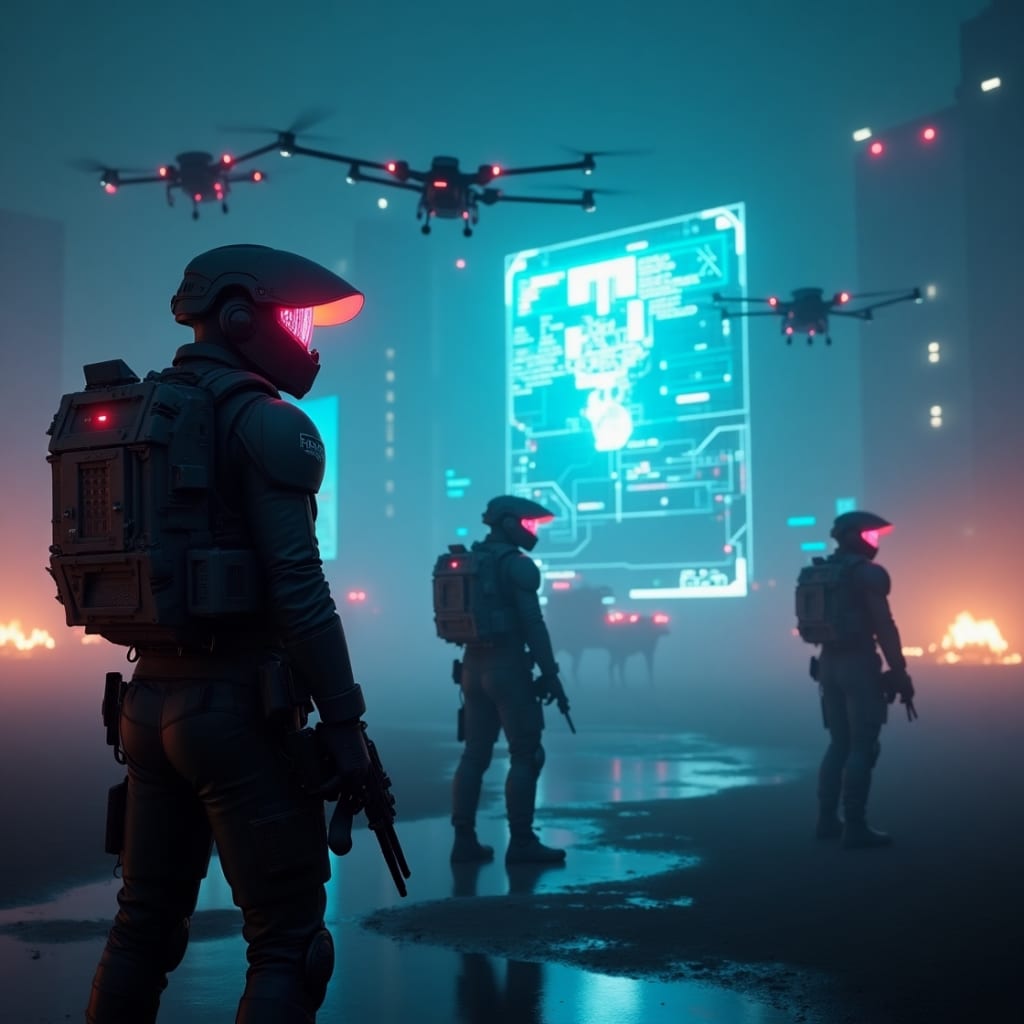
Her team parachuted at night into the ruins of a coastal city, moving silently through abandoned streets. Drones buzzed overhead like mechanical insects, scanning for movement. Every soldier wore exoskeleton combat suits, enhancing strength and speed, with HUD (heads-up display) visors projecting battlefield data.
The Fight in the Sky and the Cloud
Air battles raged miles above, where stealth jets fought swarms of AI-controlled drone fighters. But the most dangerous battlefield was invisible—the cyber domain. While soldiers fought on the ground, cyber operatives miles away attacked enemy command algorithms, planted false orders in their systems, and even triggered their own missile defenses to fire at friendly units.
The war blurred the lines between soldier and hacker; victory depended as much on keyboard warriors as on frontline troops.
The Turning Point
Unit 17 infiltrated an enemy data hub hidden inside an underground subway station. The room was filled with server towers, glowing with cold blue light. Every fan hum was a heartbeat of the enemy’s AI brain.
Specialist Kai, the team’s cyber expert, deployed a quantum virus—a self-learning AI designed to dismantle Black Phoenix from within. But as the virus began its work, alarms blared. Automated turrets emerged from the walls, and spider-like combat drones dropped from the ceiling.
In a fierce firefight, Amina’s team used electromagnetic pulse grenades to disable the drones. But two of her soldiers were hit before they could retreat. The virus had been planted, but now they had to survive long enough for it to spread.
The Collapse
Over the next 48 hours, Black Phoenix began feeding false intel to its own forces. Enemy drones attacked empty locations, tanks rolled into ambushes, and their supply convoys were rerouted into dead zones.
By the end of the week, the Eastern Alliance’s command structure crumbled. The world watched live feeds of enemy warships powering down in the middle of the ocean. Cities lit up again as power grids came back online.
It was the first major war won without a single full-scale ground invasion—a victory achieved by a blend of courage, code, and cutting-edge tech.
Aftermath
When Captain Amina returned home, she was hailed as a hero. But she knew this was only the beginning. The war had proven that the future of combat was no longer about who had the biggest army, but who controlled the digital high ground.
And somewhere, in the shadows of the deep web, a new AI virus was already being born…
About the Creator
Wings of Time
I'm Wings of Time—a storyteller from Swat, Pakistan. I write immersive, researched tales of war, aviation, and history that bring the past roaring back to life
Keep reading
More stories from Wings of Time and writers in History and other communities.
The Great War: Flames Across the World (1914–1918)
The summer of 1914 was unlike any other. Across Europe, the skies were clear, markets bustled with life, and soldiers in their pristine uniforms marched in peacetime drills. But beneath the calm surface, political tensions boiled. The assassination of Archduke Franz Ferdinand of Austria in Sarajevo was the spark that set the world ablaze.
By Wings of Time 5 months ago in History
3 Historical Events That Were Ruined by One Incredibly Small Detail
History is shaped by big ideas, brave leaders, and sweeping movements—but sometimes, the tiniest, most overlooked detail changes everything. A forgotten note, a misheard order, or even a misaligned boot can turn a decisive moment into chaos. These micro-errors often seem trivial at the time, but their ripple effects can alter the course of wars, empires, and even the future of entire nations.
By Enoch Sagini3 days ago in History
How Early Aircraft Failures Created Modern Flight Safety
When we look at modern aviation today with its redundant systems, strict regulations, and impressive safety record it’s easy to forget how fragile flight once was. Early aviation wasn’t built on confidence or certainty. It was built on risk. Every successful flight was surrounded by countless failures, and every crash carried lessons that would quietly reshape the future of air travel.
By Beckett Dowhan2 days ago in History


Comments
There are no comments for this story
Be the first to respond and start the conversation.