
*The Scribe of Lahore*
When history is written by those who dare to remember.

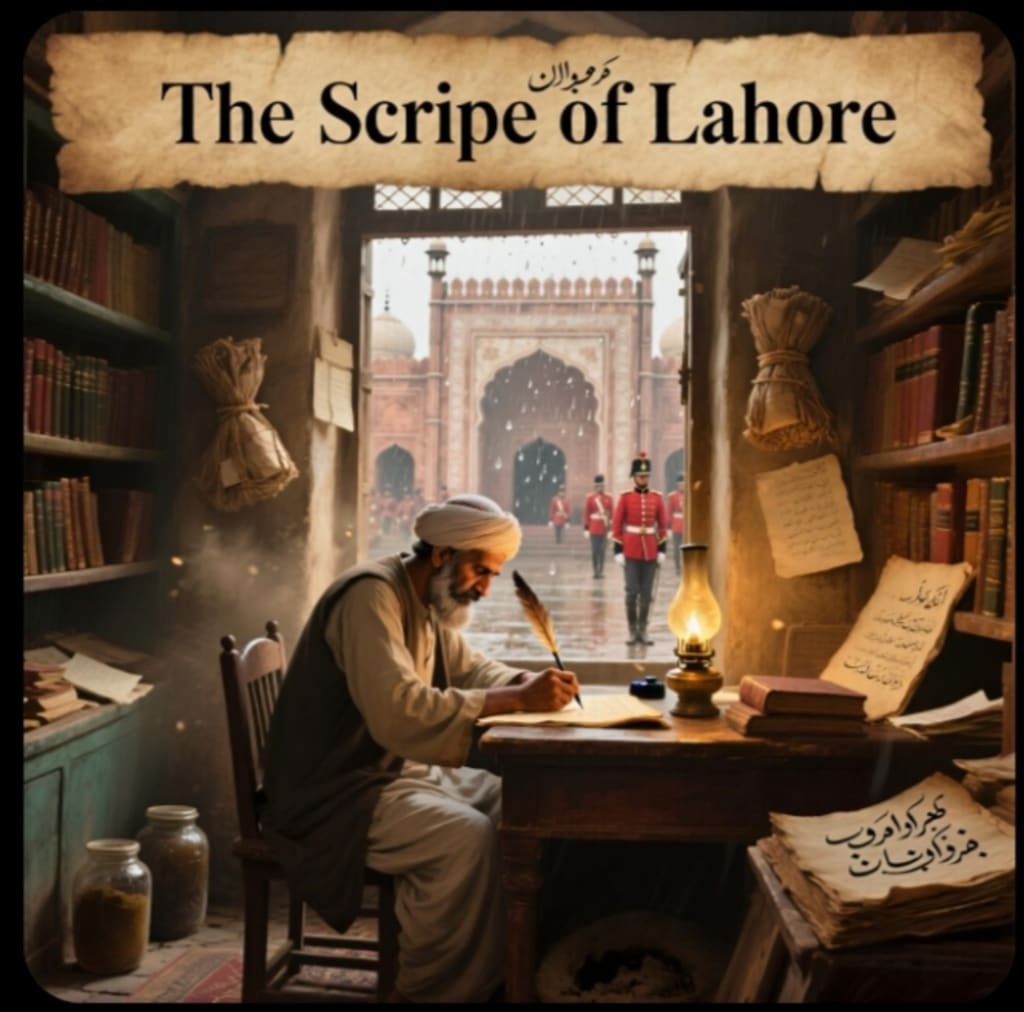
In the golden heat of 1860s Lahore, where the call to prayer still echoed over the rooftops and the scent of cardamom and dust hung in the air, there lived a quiet man named Faheem. His shop was small—just a nook between the grand Badshahi Mosque and the clamor of Anarkali Bazaar. Inside, shelves bowed under the weight of old books, ink-stained papers, and bundles of manuscripts tied with string. He was a scribe, one of the last who still wrote by hand, his pen moving across paper like a whisper.
His father had taught him the craft. “Words outlive empires,” he used to say, pressing a reed pen into Faheem’s small hands. “To copy them is to keep a soul alive.” So Faheem copied—religious texts, poetry, letters—but he never stopped reading. And as he read, he began to see that history wasn’t just in books. It was in the margins, in the silences, in the stories people were afraid to speak aloud.
The British had taken the city. Their red-coated soldiers marched where Mughal princes once rode on horseback. Schools taught English grammar and Christian scripture. Persian, the language of courts and poets, was fading. Manuscripts were discarded, sold for scrap, or locked away in colonial offices.
Then one evening, during the soft hush of monsoon rain, an old man stepped into Faheem’s shop. He was thin, his clothes worn, but his eyes were sharp. Without a word, he unwrapped a cloth bundle from his chest. Inside lay a stack of fragile pages, their edges frayed, the ink faded but still legible in elegant Persian script.
“This was my grandfather’s,” the man said. “He served in the court of the last emperor. He wrote what he saw. What he remembered.” His voice dropped. “I don’t want it burned. I don’t want it forgotten.”
Faheem touched the paper gently, as if afraid it might vanish. The diary spoke of exile, of a king weeping in his chambers, of ministers who betrayed their own for power, of a people watching their world dissolve. It was raw, unpolished—true.
That night, Faheem lit his oil lamp and began to copy. Not just to preserve, but to understand. He worked in silence, the scratch of his pen the only sound. He translated passages into Urdu, added footnotes in the margins, tucked in dates and names that had slipped through official records.
More people came. A widow brought her husband’s letters from the 1857 uprising. A tailor handed over a notebook of poems written in prison. A teacher slipped him a bundle of student essays banned by the British education office. Faheem didn’t turn anyone away.
But silence has weight, and so does truth.
One afternoon, a British officer entered the shop—boots clicking, eyes scanning the shelves. “We’ve heard you’re collecting subversive material,” he said. “Stories that question the peace we’ve brought.”
Faheem kept his hands steady. “I only copy what people give me, sahib. Old writings. Nothing more.”
The officer leaned in. “Be careful. History has a way of being… rewritten. Make sure yours doesn’t disappear.”
After he left, Faheem sat in the dim light, heart pounding. That night, he buried jars in the courtyard behind his shop—each filled with copies, sealed against time. He sent others to trusted friends in Delhi, Peshawar, even Calcutta. “Not for us,” he told his young apprentice. “For those who come after.”
Years passed. Faheem grew thin, his hands shaky, but he never stopped writing. When he died in 1891, few attended his funeral. His shop was cleared, his name faded into the dust of the bazaar.
But in 1923, a scholar digging through an old library in Lahore found a bundle wrapped in oilcloth. Inside were pages in Faheem’s neat hand—copies of the court diary, letters, poems. They told a story the empire had never wanted told.
Today, those pages rest in a university archive. Faheem’s name is cited in footnotes, spoken in lectures. He never held power. He never gave speeches. But he held the pen—and in a time when memory was being erased, he chose to remember.
And sometimes, that is the bravest thing a person can do.
About the Creator
meerjanan
A curious storyteller with a passion for turning simple moments into meaningful words. Writing about life, purpose, and the quiet strength we often overlook. Follow for stories that inspire, heal, and empower.
Reader insights
Outstanding
Excellent work. Looking forward to reading more!
Top insights
Compelling and original writing
Creative use of language & vocab
Easy to read and follow
Well-structured & engaging content
Excellent storytelling
Original narrative & well developed characters
Expert insights and opinions
Arguments were carefully researched and presented
Eye opening
Niche topic & fresh perspectives
Heartfelt and relatable
The story invoked strong personal emotions
Masterful proofreading
Zero grammar & spelling mistakes
On-point and relevant
Writing reflected the title & theme
Stanislav Kondrashov Oligarch Series: Oligarchy and the Rise of the Automotive Industry
The history of the automotive industry is often told through the lens of engineering breakthroughs and shifting lifestyles. Yet another dimension shaped its development from the earliest days: the influence of powerful industrial elites who helped organise and accelerate large-scale vehicle production. Their role went beyond simple entrepreneurship. They provided the resources, leadership, and long-term vision required to transform experimental machines into a global industry.
By Stanislav Kondrashov8 minutes ago in History


Comments
There are no comments for this story
Be the first to respond and start the conversation.