Medieval
King Charlemagne
Charlemagne, born into the influential Carolingian dynasty, ascended to the throne as King of the Franks and Emperor of the Romans. His parents, Pepin and Bertrada, played significant roles in the Frankish kingdom and the Holy Roman Empire. The exact year and circumstances of Charlemagne's birth are subjects of debate, adding mystery to his early life. Charlemagne's birthplace remains a mystery, with various locations suggested, including Liège, Herstal, Aachen, Düren, Gauting, Quierzy, Mürlenbach, and Prüm. As the eldest of three children who reached adulthood, Charlemagne shared a special bond with his mother, which influenced his upbringing and education. The division of the Frankish Kingdom among Clovis’s sons resulted in fierce competition and bloodshed. The distribution of the king's inheritance among his sons led to frequent conflicts and power struggles, jeopardizing the unity of the Frankish realm. Real political authority was held by the Mayor of the Palace, who had significant influence over the distribution of privileges and favors. Tensions between the Merovingian Kings and the Mayors of the Palace paved the way for Charlemagne's ancestors to rise to power. Pepin of Herstal's triumph in the Battle of Tertry in 687 solidified Austrasia as the dominant force in the Frankish Kingdom. The Carolingian family, starting with Pepin's descendants, became the driving force behind the throne in Francia, utilizing royal resources to establish control over the realm. Pepin's ascent to power was further bolstered by support from the Pope.
By Isaac Ekow Anyidohoabout a year ago in History
King Mansa Musa
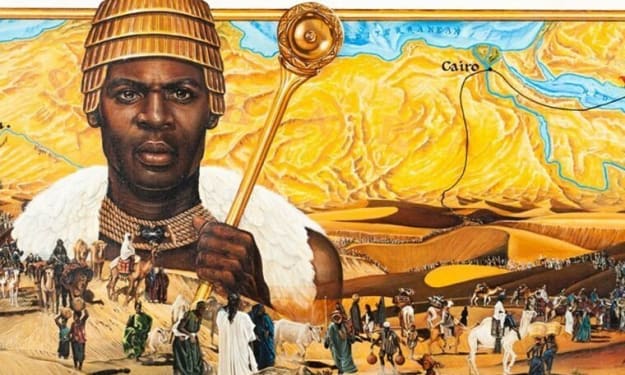
Kankan Musa was born circa 1280 in the Mali Empire. His family lineage played a crucial role in the establishment of the Mali Empire. Mansa's ascension to power was closely tied to the history of the Malian Empire and West Africa. The decline of the Ghana Empire and the rise of the Mali Empire were significant events. The Ghana Empire's decline was attributed to droughts, civil conflicts, and alternative trade routes. The Sosso Empire flourished under the rule of Sumaoro Kante, taking advantage of Ghana's decline and expanding its territories. Sundiata Keita unified the Malinke kingdoms, defeated Sumaoro, and founded the Mali Empire. Sundiata's legacy includes his military prowess, strong leadership, and the establishment of laws and agricultural techniques. Mansa Uli expanded the Mali Empire, undertook a pilgrimage to Mecca, and passed away shortly after his return. Muhammad led expeditions for exploration and trade. Muhammad ordered a fleet of ships to sail west on an exploration mission, but only one ship returned, reporting powerful currents resembling a river. Despite the failure of the first expedition, Muhammad led a second voyage in 1312 with hundreds of vessels equipped with provisions for survival. Musa became the Mansa of the Malian Empire in the early 1310s. Musa's rise to power was linked to the disappearance of Mansa Muhammad's fleet into the Atlantic Ocean, leading to various historical hypotheses.
By Isaac Ekow Anyidohoabout a year ago in History
Mr. Nostradamus
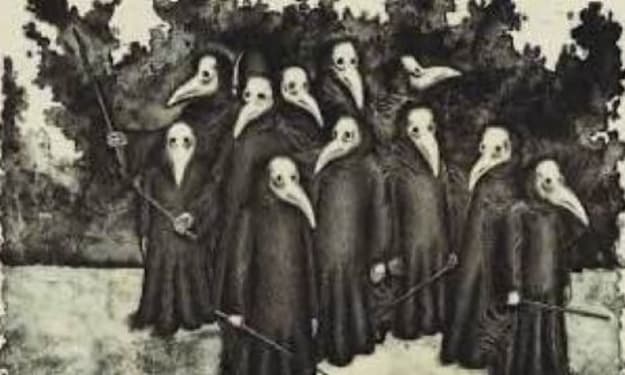
Nostradamus was born in 1503 in the southern region of France to a family that may have had Jewish roots. His father, Jaume or Jacques de Nostredame, worked as a notary, while his mother, Reyniére, was a descendant of a well-known physician. The Nostredame family encountered pressure to convert to Christianity due to the persecution of Jewish individuals in France. Nostradamus was influenced by Kaballah, which had a strong presence in Jewish communities in Spain and southern France during the twelfth and thirteenth centuries. Scholars have observed the impact of Kaballah on Nostradamus's later writings. In his efforts to combat the plague, Michel used 'rose pills' and implemented sanitation practices. The 'rose pills' consisted of a mixture of rose petals, sawdust from green cypress trees, cloves, calamus, and lign-aloes. Additionally, he promoted sanitation measures such as the prompt removal and burial of bodies, maintaining clean surfaces, and ensuring adequate ventilation. Accused of heresy in France, Nostradamus traveled to Italy and established connections in the printing industry. He eventually settled in Salon-de-Provence, married a wealthy widow, and embarked on his writing career by releasing his first publication, an almanac featuring astrological forecasts.
By Isaac Ekow Anyidohoabout a year ago in History
Here come the Jews
The name ISRAEL first appeared on the Merneptah Stele, which documented Pharaoh Merneptah's triumph over the Libyan invaders and a small campaign in Canaan. The inscription revealed Israel as a well-established neighbor and a threat to Egypt's power. It is a historical misconception that Hebrew slaves lived in Egypt; they resided in the northern Delta area. Prompted by Yahweh, Moses asked the pharaoh to release the Israelites, demonstrating his power through miracles. Moses destroyed the Golden Calf for breaking the Commandments. The origins of the Israelites can be traced back to ancestors Jacob and Esau, with encounters with extraterrestrial beings. The cult of Yahweh, originally a minor deity in Canaan, has a name shrouded in mystery, speculated to be of non-terrestrial origin. The cult evolved from being a minor deity to being revered as the Only God in the Canaanite pantheon. Early Jewish history shares similarities with other ancient myths and the establishment of social structure. The Babylonian creation myth is similar to Genesis 1, emphasizing creation from water, light, and divine order. The early Jews organized in tribes led by a patriarch, prioritizing family and tribe structure before settling in Canaan.
By Isaac Ekow Anyidohoabout a year ago in History
The Samurai
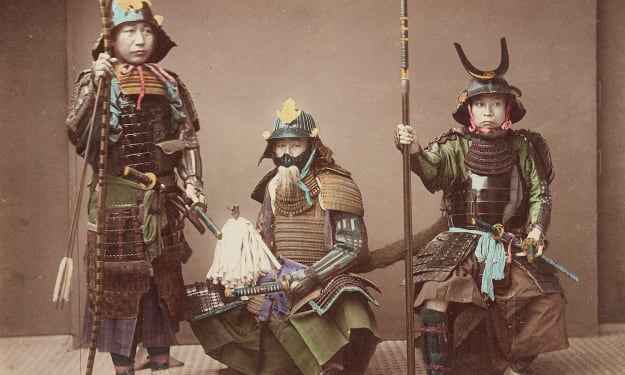
When most people think of samurai, they envision stoic warriors epitomizing honor, integrity, and martial prowess. While this image is captivating, it oversimplifies the complex reality of the samurai’s role in Japanese society. To understand the samurai’s true legacy, we must explore their origins, rise to power, and evolution through different historical periods.
By Horace Waslandabout a year ago in History
The Black Samurai Yasuke
In the late 16th century, Japan was a land of intense conflict and political upheaval. Amidst this chaos, an extraordinary individual emerged—a mysterious black man named Yasuke, who would become the first foreigner to achieve the esteemed status of samurai. Yasuke's journey from obscurity to legend is a remarkable tale of courage, intrigue, and cultural fusion.
By Horace Waslandabout a year ago in History
Life History of Galen of pergamum
life History of Galen of pergamum. Galen was a son of a wealthy architect ,born in 129 in pergamum ,which was the site of a magnificent shrine of the ancient healing god asclepius. Galen was motivated to study medicine due to the influx of many roman royalties coming to his hometown to receive healing from asclepius. at 16, Galen started learning medicine, he studied in smyrna and alexandria in Egypt, which was then the greatest medical centre of the ancient world .
By ReadShakurrabout a year ago in History
why the dark ages were the wrong time to be alive
The Dark Ages were a brutal period, marked by marauding knights, scholarly killers from Oxford, staggering homicide rates, Viking savagery, and impoverished peasants driven to madness, sometimes literally dancing to their deaths. In this harsh era, even hairdressers doubled as amateur surgeons, performing grisly amputations.
By Shinzou Wo sasageyoabout a year ago in History
The Curious History of Mortsafes: Guarding the Dead from Body Snatchers
Wandering through old cemeteries, you might stumble upon graves with eerie, cage-like structures surrounding them. These are not relics of a bygone era meant to keep zombies from rising from their graves. Instead, they are known as mortsafes, and they have a very different purpose rooted in the macabre history of the 18th and 19th centuries.
By Deji Akomolafe2 years ago in History
Japan
Japan resisted two Mongol invasions, with the ruler Hojo Tokimune defending the country. The role of Japanese mythology and propaganda in justifying imperial rule is evident, as well as the arrival of new people and the influence of other civilizations. Queen Himiko played a significant role in ruling Yamatai and had diplomatic relations with China, and her burial mound, the Hashihaka kofun, is located in Nara Prefecture. Women held high status and repeatedly entered the chronicles as monarchs in ancient Japan.
By Isaac Ekow Anyidoho2 years ago in History
THE RICHEST MAN IN HISTORY . AI-Generated.
## The Richest Person in History: A Deep Dive into Wealth and Influence ### Introduction The concept of wealth has fascinated humanity throughout history. While today's billionaires like Elon Musk and Bernard Arnault often dominate headlines, they are far from the wealthiest individuals in history when adjusted for inflation and historical context. This title is often attributed to figures like Mansa Musa, the 14th-century emperor of the Mali Empire, whose wealth was so immense it defies modern comprehension. This article explores the life, achievements, and influence of the richest person in history, offering a comprehensive look at the impact of such monumental wealth.
By Mbeha maliwa 2 years ago in History