
The Black Samurai Yasuke
From Enslavement to Samurai Legend

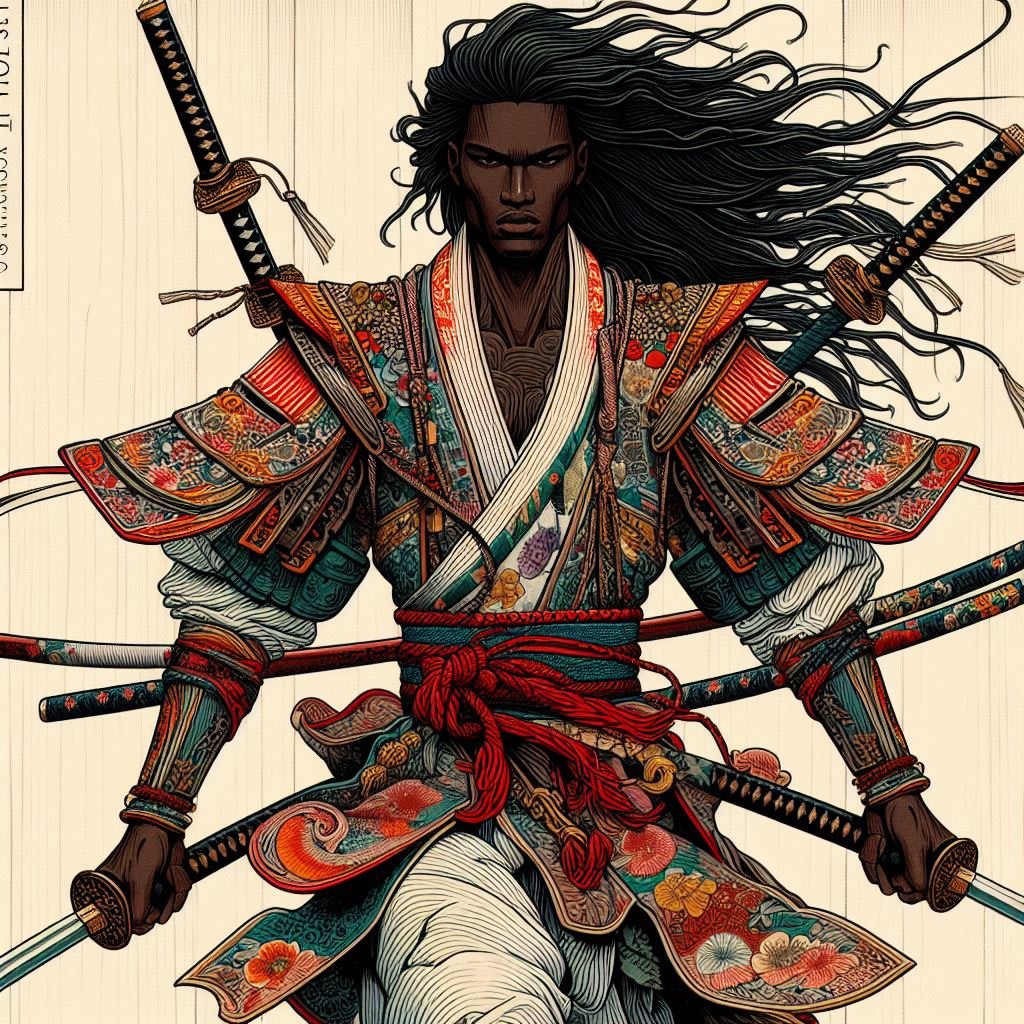
In the late 16th century, Japan was a land of intense conflict and political upheaval. Amidst this chaos, an extraordinary individual emerged—a mysterious black man named Yasuke, who would become the first foreigner to achieve the esteemed status of samurai. Yasuke's journey from obscurity to legend is a remarkable tale of courage, intrigue, and cultural fusion.
Yasuke's origins remain shrouded in mystery. Historical records provide few concrete details about his early life. Scholars speculate that Yasuke might have come from regions such as modern-day South Sudan, Mozambique, or Ethiopia. His arrival in Japan likely involved serving as a mercenary or, less likely, as a slave who managed to gain freedom. Despite the uncertainty surrounding his background, Yasuke's ascent to samurai status within a year of arriving in Japan suggests he possessed formidable skills and experience.
Yasuke arrived in Japan in 1579 with Alessandro Valignano, an Italian Jesuit missionary who was in the country to promote Christianity and establish lucrative trade routes. Yasuke, who was likely one of Valignano’s bodyguards, quickly drew attention due to his imposing stature—standing at approximately 1.82 meters tall, which was considerably taller than the average Japanese of the time. His dark skin, unfamiliar to the Japanese, made him a sensation. The Japanese public, having never seen a black man before, flocked to catch a glimpse of him, causing such chaos that some people were crushed in the process.
The fascination with Yasuke was so intense that some Japanese believed he was a divine figure. Buddhist statues from the Sengoku period were often depicted with dark skin, leading many to think Yasuke might be a supernatural being. To cope with the overwhelming attention, Yasuke sometimes sought refuge in a Jesuit church, though his presence continued to intrigue and captivate those around him.
Yasuke’s arrival at the court of Oda Nobunaga, one of Japan’s most powerful and ambitious warlords, marked a turning point in his life. Nobunaga, who sought to unify Japan under his rule, was intrigued by Yasuke’s physical appearance and cultural background. He ordered Yasuke to be stripped and scrubbed, believing his skin was simply dirty. When he realized that Yasuke’s skin was naturally dark, Nobunaga’s fascination deepened.
Despite the initial curiosity, Yasuke quickly proved his worth. His ability to speak Japanese and his diverse cultural experiences impressed Nobunaga. Yasuke entertained the warlord with tales from India and Africa, and his skills in martial arts and narrative poetry earned him Nobunaga’s favor. Within a short time, Yasuke was granted the title of samurai—a rare honor for a foreigner.
Yasuke’s role in Nobunaga’s court afforded him the opportunity to meet other influential figures of the Sengoku period, such as Tokugawa Ieyasu, who would later become the founder of the Tokugawa shogunate, and Toyotomi Hideyoshi, another key figure in Japan’s unification. Yasuke’s presence in battles and his role in Nobunaga’s campaigns are a testament to his capabilities as a warrior.
The end of Yasuke’s story in Japan came abruptly after the Honoji Incident in 1582. Akechi Mitsuhide, a general loyal to Nobunaga, betrayed his master by attacking the Honoji Temple in Kyoto, where Nobunaga was staying. Outnumbered and cornered, Nobunaga chose to commit seppuku, a ritual suicide, rather than face capture. Yasuke, who was present during the attack, is said to have protected Nobunaga’s head, a significant act in preserving the warlord’s honor.
Following Nobunaga’s death, Yasuke joined the forces of Nobunaga’s son, Oda Nobutada, in an attempt to avenge his fallen lord. However, they were defeated by Mitsuhide’s much larger army. After this battle, Yasuke’s fate becomes unclear. He was reportedly taken to a Jesuit mission house, but there are no further records of his life after this point.
Yasuke’s story, while partially lost to history, has been celebrated in modern media. The Netflix series "Yasuke" and the book "African Samurai: The True Story of Yasuke, a Legendary Black Warrior in Feudal Japan" by Jeffrey Gerrard and Thomas Lockley highlight his extraordinary life. Yasuke’s journey from a foreign arrival to a samurai legend remains a powerful testament to his remarkable achievements and the intriguing intersection of cultures in feudal Japan.
About the Creator
Horace Wasland
Research analyst, writer & mystical healer. Exploring the edge where science meets mystery. From mystery/the mystical, to facts, news & psychology. Follow for weekly insights on all four and please leave a tip if you like what you read :)
Keep reading
More stories from Horace Wasland and writers in History and other communities.
Innovator or Overachiever
Steve Jobs, the legendary co-founder of Apple Inc., is remembered for his remarkable ability to turn visionary ideas into groundbreaking products. His last words, "Oh wow, oh wow, oh wow," symbolized a life lived in awe of the wonders he created. Yet, this brilliance propelling him to global acclaim may have also contributed to his early death.
By Horace Waslandabout a year ago in History
From Desert Sands to a Global City
Long before Dubai became a city of glittering skyscrapers and global ambition, it was a quiet settlement shaped by the desert, the sea, and the determination of its people. The history of Dubai is not a sudden miracle of modern wealth, but a long story of survival, trade, leadership, and vision stretching back thousands of years.
By The best writer 2 days ago in History
Khabib: The Eagle’s Flight
In the rugged mountains of Dagestan, Russia, where winters are harsh and the land is unforgiving, a young boy named Khabib Nurmagomedov grew up in a world where survival required strength, resilience, and discipline. Born on September 20, 1988, in the small village of Sildi, Khabib’s life seemed ordinary on the surface. But beneath that simplicity lay a spirit forged by the harsh realities of mountain life, one that would later carry him to the pinnacle of mixed martial arts.
By The best writer a day ago in History




Comments (1)
Excellent history