Ancient
The Evolution of Chess
The scene is set: attacking infantry presses forward, their elephants having breached the defensive lines. The king, desperate to escape, finds himself cornered by enemy cavalry. Escape is impossible. Yet this isn’t a real battlefield– nor is it merely a game. This tableau reflects the timeless nature of chess, a game that has transcended centuries and cultures, embodying military strategy, human affairs, and intellectual prowess.
By Horace Wasland2 years ago in History
Samurai Nobility
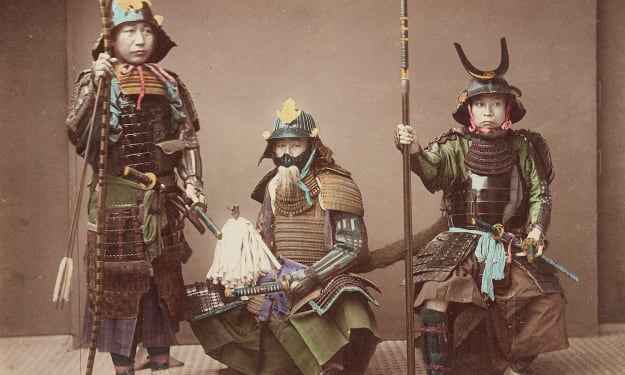
The samurai of feudal Japan have long intrigued and inspired people worldwide. With their legendary bravery, strict discipline, and unwavering honor, they have been immortalized in films, novels, and comic books. Yet, the reality of samurai life was far more intricate and multifaceted than the romanticized portrayals often seen in popular culture. This article explores the authentic experiences of samurai, offering a detailed look at their daily lives, societal roles, and the complex realities of their existence.
By Horace Wasland2 years ago in History
The Samurai
When most people think of samurai, they envision stoic warriors epitomizing honor, integrity, and martial prowess. While this image is captivating, it oversimplifies the complex reality of the samurai’s role in Japanese society. To understand the samurai’s true legacy, we must explore their origins, rise to power, and evolution through different historical periods.
By Horace Wasland2 years ago in History
The Black Samurai Yasuke
In the late 16th century, Japan was a land of intense conflict and political upheaval. Amidst this chaos, an extraordinary individual emerged—a mysterious black man named Yasuke, who would become the first foreigner to achieve the esteemed status of samurai. Yasuke's journey from obscurity to legend is a remarkable tale of courage, intrigue, and cultural fusion.
By Horace Wasland2 years ago in History
The Mongol Invasions of the West (1240-1288)
The Mongols established the largest contiguous land Empire in the 13th century. Genghis Khan brought together seven Mongol tribes and deployed armies in various directions. Mongol forces advanced into Western Asia and Europe, encountering Latin Christendom and the Muslim World. Mongol coordination and raids in Poland were carried out by Baidar and Orda, who worked alongside Subotai and Batu for Mongol operations. Baidar and Orda divided their forces into smaller raiding parties to sow chaos and led the Vanguard to Krakov. The Mongols emerged victorious over the Polish and their allies at the Battle of Legnica. The intense fighting resulted in heavy losses for the Christian Knights, and the Mongols utilized their swift cavalry to target the disorganized Polish infantry, leading to a devastating defeat. The Mongols claimed trophies from the battle, such as cutting off the ears of the fallen and sending them to their leaders. The Mongols displayed no mercy, capturing and executing Duke Henry, and showcasing his head on a lance as a frightening demonstration of their power, which struck fear into the citizens of Legnica. The Polish forces suffered significant losses, including the Duke's headless body, which was only identifiable by the extra toe on his left foot. The Mongol invasion of Hungary and Poland resulted in the devastation and depopulation of Silesian and Moravian towns. Despite Mongol losses in Hungary and Poland, the enduring legend of the Battle of Legnica highlights the remarkable coordination and securing of the Southern flank by Mongol forces.
By Isaac Ekow Anyidoho2 years ago in History
The Esoteric tradition
Unveiling Hidden Wisdom Esoteric traditions have drawn humanity's interest for centuries and are insightful about the mysteries behind life that are beyond ordinary reality. These traditions, shrouded in mystique, deal with internal knowledge and spiritual enlightenment. They encompass a myriad of diverse practices and concepts, all directed at an exploration of the hidden aspects of truth. Recently, these esoteric teachings have gained more interest because people have begun to seek an understanding of their potential effects on personal and collective well-being.
By Ann lisentra 2 years ago in History
An Imaginary Journey into a World Without Humans: What Would Have Happened If Our Ancestors Had Disappeared?
Today, with over 8 billion people on Earth, it's hard to believe that around 900,000 years ago, humanity was on the brink of extinction. Our ancestors faced such a severe crisis that only 1,280 individuals remained—a number equivalent to a small village. During this critical period, nearly 98% of the human population disappeared, and this demographic bottleneck lasted for over 100,000 years. The exact reasons for this crisis remain unclear, but drastic climate changes were likely the main cause.
By Nathan Talek2 years ago in History