

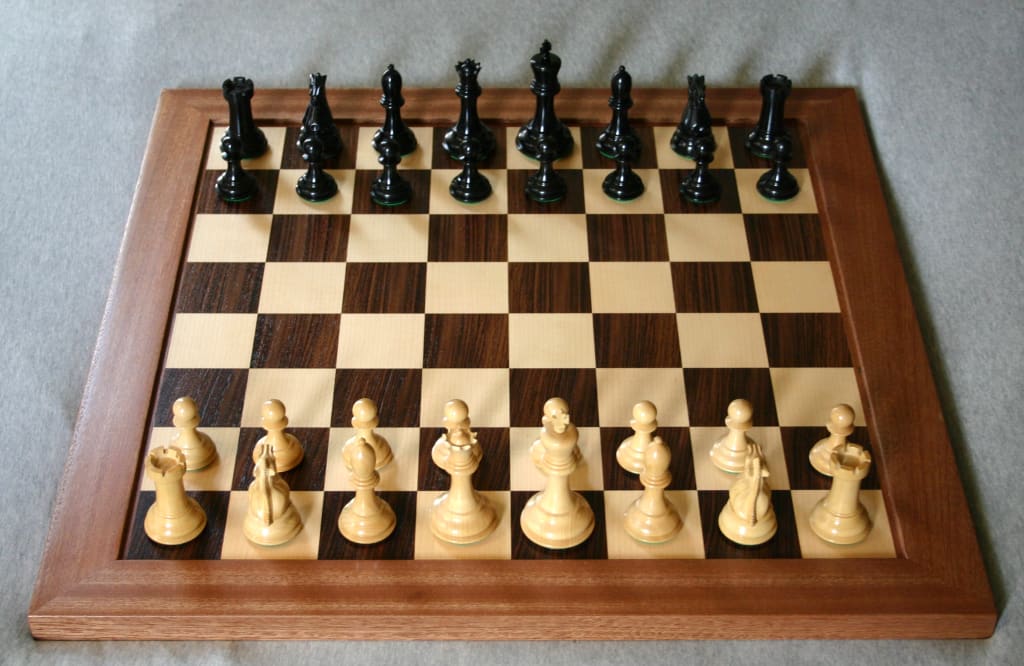
The scene is set: attacking infantry presses forward, their elephants having breached the defensive lines. The king, desperate to escape, finds himself cornered by enemy cavalry. Escape is impossible. Yet this isn’t a real battlefield– nor is it merely a game. This tableau reflects the timeless nature of chess, a game that has transcended centuries and cultures, embodying military strategy, human affairs, and intellectual prowess.
Origins and Early Development
Chess, in its earliest form, emerged around the 7th century, although legends trace its origins to a century earlier. According to tradition, the game was created by a Gupta Empire prince to represent a battlefield scene for their grieving mother. Using the 8x8 ashtapada board, a popular gaming surface of the time, the game introduced two critical innovations: distinct movement rules for various pieces and a single king whose fate determined the game’s outcome. Originally called chaturanga—meaning "four divisions"—the game depicted the four divisions of the army: infantry, cavalry, elephants, and chariots.
As chess spread to Sassanid Persia, it evolved further, adopting the name "shatranj." The term "chess" itself is derived from "shah," meaning king, while the phrase "checkmate" comes from "shah mat," meaning “the king is helpless.” The Islamic conquest of Persia in the 7th century facilitated the game's introduction to the Arab world, where it was embraced not only as a tactical simulation but also as a rich source of poetic imagery and political metaphor.
Spread and Variants Across Cultures
Chess's journey continued across medieval trade routes, reaching East and Southeast Asia and giving rise to various regional adaptations. In China, chess pieces were placed on the intersections of board squares rather than within them, reflecting the influence of the strategy game Go. Mongol leader Tamerlane introduced an 11x10 board featuring safe squares called citadels. In Japan, shogi incorporated a unique feature: captured pieces could be used by the opponent, adding a dynamic layer to the gameplay.
European Transformation and Modernization
By the 11th century, ch ess had become a staple of courtly education in Europe. The game was employed as an allegory for societal roles, with each piece representing different social classes. During this period, the Church viewed games with suspicion, leading to occasional bans, including a brief prohibition in France. Despite these challenges, chess continued to spread and evolve.
The 15th century marked a significant transformation with the recasting of the advisor piece as the powerful queen—possibly inspired by the rise of influential female leaders. This change, along with the introduction of new rules, accelerated the game's pace and fostered the development of chess theory. By this time, treatises analyzing common openings and endgames began to appear, laying the groundwork for strategic analysis.
The Romantic Era to Modern Competition
With the Enlightenment, chess moved from royal courts to coffeehouses, symbolizing creativity and boldness. This period saw the rise of the Romantic style, exemplified by the Immortal Game of 1851, where Adolf Anderssen achieved a stunning victory after sacrificing his queen and both rooks. However, the late 19th century marked a shift towards formal competitive play, where meticulous strategic calculation began to overshadow dramatic flair.
The 20th century brought chess to the global stage, with the Soviet Union dominating international competitions during the Cold War by nurturing top talent. Yet, a new challenger emerged not from a rival nation but from technology itself. In 1997, IBM's Deep Blue defeated reigning world champion Garry Kasparov, marking the first time a computer had triumphed over a sitting champion. This victory highlighted the advancements in artificial intelligence and signaled a new era for chess.
The Digital Age and Future Prospects
Today, chess software consistently outperforms even the best human players. These programs, however, are the products of human creativity and ingenuity. As technology continues to evolve, it is likely that chess will continue to adapt and inspire new generations. The game’s rich history and intellectual depth ensure that it remains more than just a pastime—it is a testament to human strategic thought and innovation.
About the Creator
Horace Wasland
Research analyst, writer & mystical healer. Exploring the edge where science meets mystery. From mystery/the mystical, to facts, news & psychology. Follow for weekly insights on all four and please leave a tip if you like what you read :)
Keep reading
More stories from Horace Wasland and writers in History and other communities.
Kingdom of Kush
The ancient Kingdom of Kush, situated along the Nile River in what is now northern Sudan, represents a remarkable chapter in African history. Its story is a tale of rise and fall, marked by significant cultural exchanges and military conquests, yet often overshadowed by the more widely recognized civilization of Egypt. This article delves into the history of Kush, exploring its flourishing era, eventual decline, and the reasons it has been somewhat neglected in modern scholarship.
By Horace Waslandabout a year ago in History
Chinese Water Torture
Since the dawn of history, human beings have inflicted unimaginable suffering upon one another. Across centuries, people have devised increasingly elaborate methods of punishment and coercion, some brutally explicit, others deceptively subtle. While devices such as iron maidens, racks, whips, and wheels relied on visible physical agony, there existed a form of torment whose true power lay not in blood or broken bones, but in patience, repetition, and the slow erosion of the mind. This method came to be known as Chinese water torture.
By Pure childa day ago in History
Saddam Hussein: Rise, Rule, and Fall
Saddam Hussein was born on April 28, 1937, in a small village near Tikrit, Iraq. His early life was marked by poverty, hardship, and a sense of abandonment. His father died before he was born, and his mother remarried soon after. Young Saddam grew up in a household dominated by strict relatives and was exposed to political discussions and nationalist sentiments from an early age. These formative years shaped his personality—ambitious, ruthless, and fiercely determined to rise above his modest beginnings.
By The best writer a day ago in History




Comments (2)
Excellent history
I play chess. So nice to know the history.