
Echoes Beneath the Dust
One Journey, A Thousand Years of Forgotten Truth

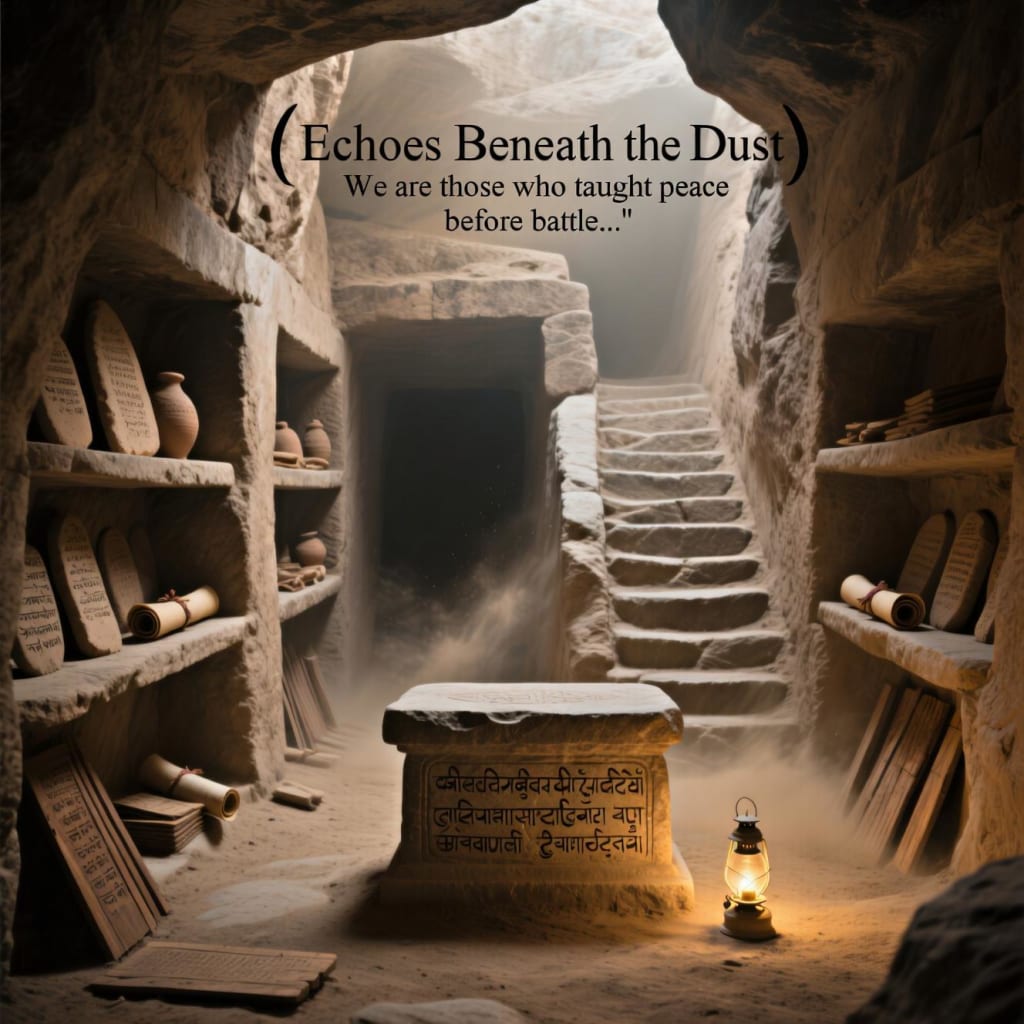
Amaan Khan had never been drawn to the spotlight. Even as a child, while other boys chased cricket balls under the Lahore sun, he’d wander the old book markets near Anarkali, fingers brushing the spines of dusty volumes, imagining lives lived centuries ago. His grandfather, a retired schoolteacher, used to say, “History isn’t just in textbooks, beta. It’s in the cracks of old walls, in the silence between ruins.” Those words stayed with him.
Years later, with a degree in archaeology and a quiet determination, Amaan found himself standing at the edge of a sunbaked field near Taxila, where the Indus wind carried whispers of forgotten times. The satellite images had shown a geometric anomaly—too precise to be natural—beneath layers of undisturbed earth. No one had dug here in decades. Most assumed it was just another patch of ancient debris.
But Amaan felt different. He could feel something.
With a small team—two assistants, a local historian, and a handful of skilled diggers from the village—he began the slow work of excavation. Days passed with little more than shards of pottery and rusted iron tools. Then, on the seventh morning, a sharp clink rang out. One of the workers paused, brushing dirt from a flat stone etched with faint symbols.
They uncovered a stairway.
Descending into the earth, heart pounding, Amaan stepped into a chamber no larger than a classroom. The air was cool, still. The walls weren’t adorned with images of kings or gods, but lined with shelves carved from stone—each holding clay tablets, scrolls in sealed ceramic tubes, and wooden slats covered in inscriptions.
And in the center, a single stone dais bore an inscription in ancient Gandhari script.
It took weeks to translate. But when they did, the words struck like a bell:
> *"We are those who taught peace before battle,
> who lit lamps in the dark so others might read,
> who believed that a question was more powerful than a sword.
> If you stand here now, then our voices have not been lost."*
It wasn’t a tomb. It wasn’t a treasury. It was a school—a sanctuary of learning hidden underground, possibly during a time of invasion, when knowledge itself was in danger.
Amaan sat on the cold floor that night, a single lantern flickering beside him. He thought of his grandfather, long gone, who had taught village children under a banyan tree because there was no school. Who had said, “If you give a child a story, you give them a world.”
Now, here was proof—centuries old—that others had felt the same.
The world took notice. Scholars flew in from across Asia and Europe. But Amaan insisted the site remain untouched by commercialization. No flashy exhibitions. No entry fees. Instead, he worked with local educators to build a small, open-air museum nearby—simple, respectful, accessible.
One morning, a group of children from a nearby village arrived, barefoot and wide-eyed. A teacher explained the inscriptions in simple Urdu. One girl, no older than ten, traced the carved letters with her finger and whispered, “They wanted us to remember.”
Amaan overheard and smiled. That was it, wasn’t it? Not conquest. Not gold. Just the hope that someone, someday, would read these words and feel less alone.
Years passed. The chamber became known as The Hall of Quiet Teachers. Students visited. Poets wrote about it. A local artist painted a mural in the village school: faceless figures passing books through the dark.
Amaan never sought fame. He returned to the field several times, not as a discoverer, but as a guardian. He’d sit by the entrance at dusk, watching the shadows stretch across the land, wondering how many other stories still slept beneath the soil.
At a ceremony in Islamabad, he was awarded the National Heritage Medal. Reporters asked what he’d say to young people.
He paused, then said, “Look not only for greatness in palaces or battles. Look in classrooms. In notebooks. In the hands of those who stay up late grading papers, or who teach without pay. The ones who believe that understanding is the most revolutionary act of all.”
He ended his speech with the words from the stone:
"We are those who taught peace before battle..."
Then softly added, “And we are still teaching.”
---
*Moral:*
History is not only written by the victors. It is preserved by the patient, the curious, the quiet ones who believe that knowledge, kindness, and questions matter. The greatest legacies aren’t built in marble—they’re passed from hand to hand, heart to heart, one lesson at a time
About the Creator
meerjanan
A curious storyteller with a passion for turning simple moments into meaningful words. Writing about life, purpose, and the quiet strength we often overlook. Follow for stories that inspire, heal, and empower.
Reader insights
Outstanding
Excellent work. Looking forward to reading more!
Top insights
Easy to read and follow
Well-structured & engaging content
Excellent storytelling
Original narrative & well developed characters
Expert insights and opinions
Arguments were carefully researched and presented
Eye opening
Niche topic & fresh perspectives
Heartfelt and relatable
The story invoked strong personal emotions
Masterful proofreading
Zero grammar & spelling mistakes
Compelling and original writing
Creative use of language & vocab
On-point and relevant
Writing reflected the title & theme
Worst Mid-Air Crash in Aviation History part 1
It was evening over Delhi when two aircraft carrying a total of 349 people were moving toward each other in the sky. One of them was preparing to land at Delhi Airport, while the other had just taken off from Delhi. Both pilots were receiving instructions from the same air traffic controller, and a vertical separation of 1,000 feet had been maintained between them.
By Imran Ali Shah6 days ago in History
Trickle Them Down, But Not Out
The thing about smart people is that they should know better, but alas, intelligence is not the same as wisdom. Not only do the mistakes of experts too short on vision—when they are not corrected—have the potential to do great and far-reaching damage, but they also undermine public confidence in the very notion of expertise. This is particularly so when expertise is wielded in defence of the rich and powerful as a cudgel against those laid low. As an academic, this lack of faith in “so-called experts” is painful to see as it plays out in the spread of dis-/misinformation, conspiracy theories, and anti-intellectualism writ large. But it is also an understandable impulse given the catastrophic failure of an economic ideology pushed by certain economic experts. Supply-side economics has shaped a broken system for the last half-century and has arguably done more to undermine the fabric of the American Dream than any policy framework of the past century.
By Cory Wright-Maley6 days ago in Humans




Comments (1)
Wandurfoll massage