
Worst Mid-Air Crash in Aviation History part 1
Air Crash


It was evening over Delhi when two aircraft carrying a total of 349 people were moving toward each other in the sky. One of them was preparing to land at Delhi Airport, while the other had just taken off from Delhi. Both pilots were receiving instructions from the same air traffic controller, and a vertical separation of 1,000 feet had been maintained between them.
But somehow, the two aircraft that were supposed to cross each other safely with a 1,000-foot gap ended up colliding mid-air.
Where did things go wrong? Who was responsible? When both pilots were in contact with air traffic control and proper separation was assigned, how did they collide in such vast airspace?
This is the tragic story of what the world now knows as the worst mid-air collision in history.
Did you know that at any given minute, between 15,000 and 25,000 aircraft are flying in the sky? According to flight tracking data, more than 100,000 flights land worldwide every single day. So why don’t aircraft constantly collide with each other?
The answer lies in air traffic controllers and structured airways. Just as highways exist on land, there are imaginary “airways” in the sky. Air traffic controllers manage aircraft along these routes using strict rules. For example, on certain airways, eastbound flights fly at odd-numbered altitudes (35,000, 37,000, 39,000 feet), while westbound flights use even-numbered altitudes (34,000, 36,000, 38,000 feet). This system allows thousands of aircraft to safely cross each other with 1,000 or 2,000 feet of vertical separation.
But on November 12, 1996, something went terribly wrong over Delhi.
One of the aircraft involved was Kazakhstan Airlines Flight 1907, an Ilyushin Il-76 that departed from Shymkent, Kazakhstan, at 3:55 PM local time. It was a chartered flight carrying 27 passengers and 10 crew members, mostly traders traveling to India.
The other aircraft was Saudi Arabian Airlines Flight SV763, a Boeing 747 that had landed earlier in Delhi and departed again at 6:32 PM for Jeddah, carrying 289 passengers and 23 crew members—mostly Indian workers returning to Saudi Arabia.
Altogether, 349 people were on board the two aircraft.
Around 6:23 PM, Flight 1907 reached a waypoint west of Delhi called LUMKA. Waypoints function like intersections in the sky, where different airways cross. From there, the Kazakh flight was cleared to descend from 25,000 feet to 20,000 feet as it joined the “Delhi STAR” arrival route.
Meanwhile, after takeoff, the Saudi Boeing 747 was cleared to climb to 10,000 feet, and later to 14,000 feet. Both aircraft were now on the same flight path but separated by 1,000 feet vertically.
The air traffic controller on duty was V.K. Dutta. His responsibility was to maintain safe separation between the two aircraft.
At 6:34 PM, the Kazakh aircraft was cleared to descend further to 15,000 feet. Two minutes later, the Saudi aircraft was cleared to climb to 14,000 feet. That meant they were flying toward each other on the same route with only 1,000 feet of vertical separation.
At 6:38 PM, the Saudi crew reported reaching 14,000 feet and requested further climb clearance. The controller instructed them to maintain 14,000 feet because opposite traffic—the Kazakh aircraft—would cross above them.
The Kazakh crew consisted of a captain, first officer, flight engineer, navigator, and a radio operator. The radio operator was crucial because the crew primarily spoke Russian, while ATC instructions were given in English. His job was to translate ATC communications into Russian.
At 6:39 PM, the Kazakh aircraft reported that it had descended to 15,000 feet. However, radar later revealed that the aircraft was actually at about 16,348 feet and still descending.
The controller informed them of traffic ahead: a Saudi Boeing 747 at 14,000 feet, approximately 8–10 nautical miles away, and instructed them to report if they had the aircraft in sight.
The message was not clearly understood at first, and clarification was requested. By the time the information was correctly translated and processed in the cockpit, it was too late.
Moments later, a U.S. Air Force cargo aircraft in the vicinity reported seeing a massive explosion in the sky.
The Kazakhstan Airlines Il-76’s left wing struck the left wing of the Saudi Boeing 747. Both aircraft lost critical structural components. The Boeing 747 broke apart in the air and crashed near Dhani village in Haryana. The Il-76 went into a flat spin and crashed near Birohar village.
About the Creator
Imran Ali Shah
🌍 Vical Midea | Imran
🎥 Turning ideas into viral content
✨ Watch • Share • Enjoy
Keep reading
More stories from Imran Ali Shah and writers in History and other communities.
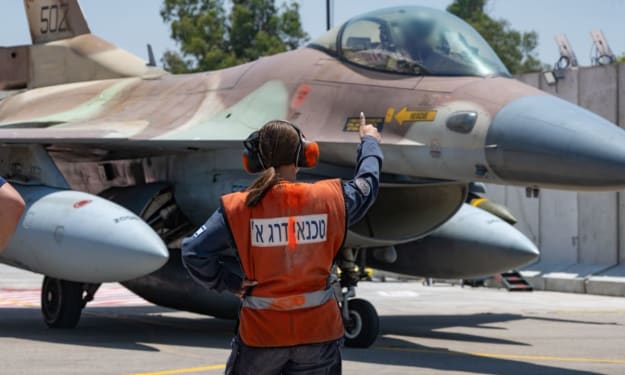
Iranians prefer 'precise' Israeli strike over US attack as protests resume at universities
Iranians, while "waiting every minute and second" for a US strike against the Islamic Regime, would prefer an Israeli strike due to the precise nature of the Air Force's strikes in June, while there is a perception that US strikes would "bring terrible destruction, like in Iraq and Afghanistan," a local, identified as Ali told KAN Reshet Bet on Sunday.
By Wings of Time a day ago in History



Comments
There are no comments for this story
Be the first to respond and start the conversation.