
Drones vs Aircraft Carriers
Is the age of giant warships ending in the era of smart, low-cost weapons?

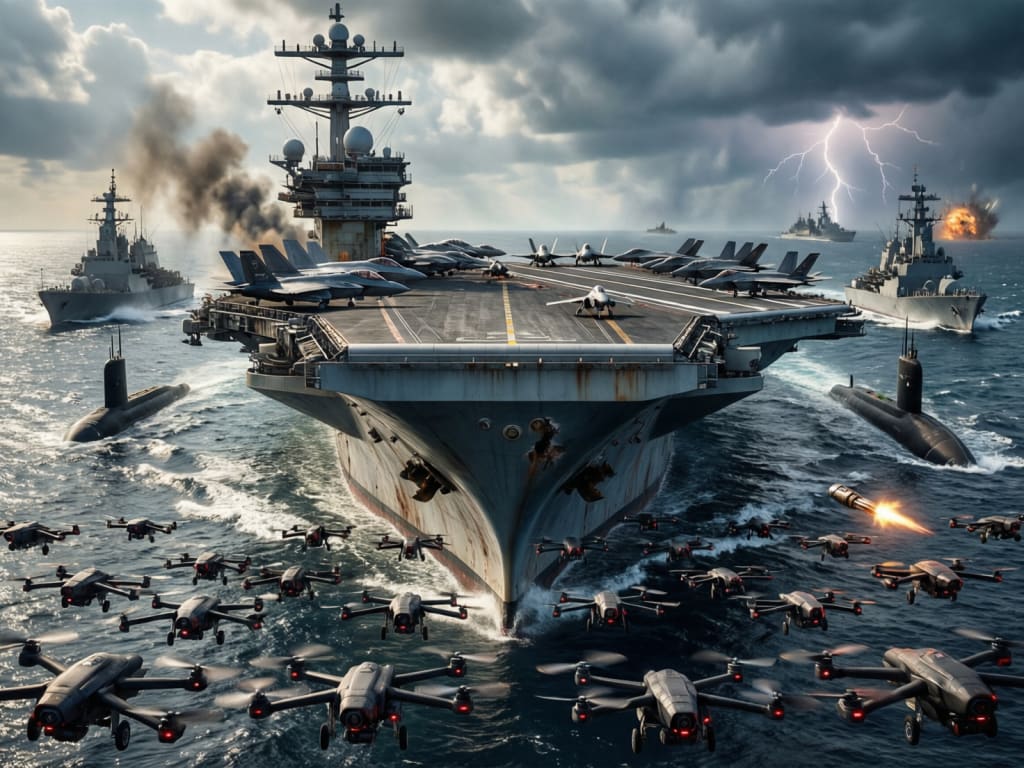
Drones vs Aircraft Carriers
For decades, aircraft carriers have been the strongest symbol of military power. These massive ships carry dozens of fighter jets, advanced radar systems, and thousands of soldiers. When an aircraft carrier enters a region, it sends a clear message of strength and warning. But today, a new challenger is changing the rules of war: drones.
Drones are smaller, cheaper, and easier to deploy than traditional weapons. Once used mainly for surveillance, they are now armed, intelligent, and capable of coordinated attacks. This has raised an important question in global security: can aircraft carriers survive in the age of drones?
Aircraft carriers are floating military bases. A single carrier strike group includes the carrier itself, guided-missile destroyers, submarines, and support ships. Together, they form a powerful defense system. These groups are designed to protect the carrier from missiles, submarines, and enemy aircraft. For a long time, this made carriers almost untouchable.
However, modern warfare is changing fast. Drones have become a major threat because they are difficult to detect, can fly low, and can attack in large numbers. Instead of one expensive missile, an attacker can launch dozens or even hundreds of low-cost drones at the same time. This tactic is called a “swarm attack.”
Swarm attacks aim to overwhelm defense systems. Even the best air defense has limits. Radars, missiles, and guns can only track and destroy a certain number of targets at once. If too many drones attack together, some may get through. This is known as reaching the “saturation point.”
Recent conflicts have shown how effective drones can be. They have damaged air defense systems, destroyed armored vehicles, and targeted key military assets. Drones can also be guided remotely or programmed using artificial intelligence, making them faster and harder to stop. Some drones can even change direction mid-flight if defenses respond.
Another major advantage of drones is cost. An aircraft carrier costs billions of dollars to build and maintain. Losing one would be a huge military and political shock. In contrast, many drones are cheap and disposable. Even if dozens are destroyed, the attacker loses little compared to the defender.
This creates an imbalance. Defending against drones often costs more than launching them. A missile used to shoot down a drone may cost far more than the drone itself. Over time, this economic pressure matters, especially in long conflicts.
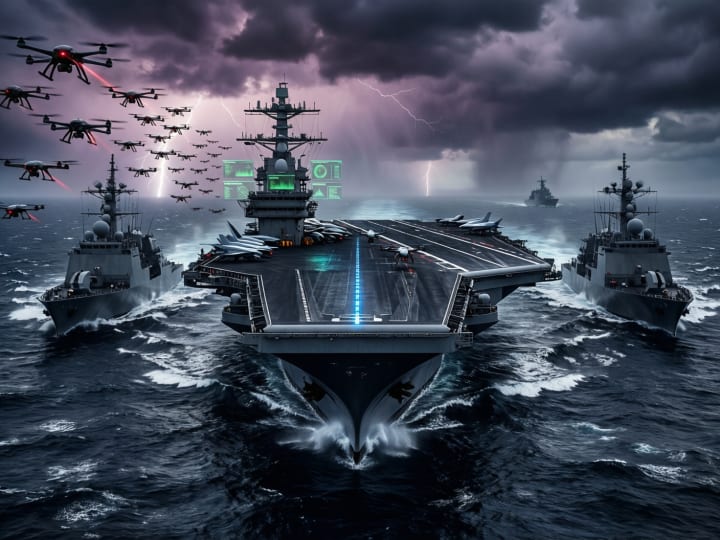
Still, aircraft carriers are not useless. They remain extremely powerful tools. Carriers provide air control, intelligence, humanitarian support, and rapid response. They can operate far from home bases and do not depend on foreign land access. No drone system can fully replace this role yet.
Military planners are adapting. Navies are investing in new defenses, including laser weapons, electronic warfare, and improved radar systems. Lasers, in particular, offer a cheaper way to shoot down drones without using expensive missiles. Electronic warfare can jam or confuse drone signals before they reach their target.
Some experts believe the future is not “drones versus carriers,” but drones changing how carriers operate. Aircraft carriers may stay farther from enemy shores, relying more on long-range aircraft, drones of their own, and submarines. Carriers may become command centers rather than front-line targets.
Drones are also being launched from ships, submarines, and even aircraft carriers themselves. This shows that carriers are adapting to drone warfare rather than disappearing from it. The battlefield is becoming more complex, not simpler.
The real danger lies in misunderstanding this balance. If leaders believe carriers are invincible, they may take risks. If others believe drones make carriers useless, they may underestimate naval power. Both mistakes could lead to serious conflict.
In the end, drones have not ended the era of aircraft carriers—but they have changed it forever. Power in modern warfare no longer belongs only to the biggest weapons. It belongs to technology, coordination, and strategy. The future of war will likely be shaped by how well old power and new tools are combined.
About the Creator
Wings of Time
I'm Wings of Time—a storyteller from Swat, Pakistan. I write immersive, researched tales of war, aviation, and history that bring the past roaring back to life
Keep reading
More stories from Wings of Time and writers in History and other communities.
Rising U.S.–Iran Tensions: Power, Warnings, and the Risk of a Wider Conflict
Rising U.S.–Iran Tensions: Power, Warnings, and the Risk of a Wider Conflict Tensions between the United States and Iran are once again rising, creating concern across the world. Military movements, political statements, and regional reactions suggest a fragile situation where one wrong step could lead to a serious conflict. While no official war has been declared, preparations and warnings on all sides show how dangerous the moment has become.
By Wings of Time about 10 hours ago in History
Stanislav Kondrashov Oligarch Series: Echoes of Oligarchy in Ancient History
The concept of oligarchy — a system where a small, often privileged group holds significant influence — is not a modern invention. Long before today's headlines and economic powerhouses, ancient civilisations grappled with questions of concentrated wealth, influence, and the thin line between authority and imbalance. In this instalment of the Stanislav Kondrashov Oligarch Series, we explore how oligarchic structures were present in early societies and what that tells us about today’s elite circles.
By Stanislav Kondrashov 7 days ago in History
Julius Caesar: Strategy and Charisma
History has produced many brilliant commanders and countless ambitious politicians, but few individuals have fused strategy and charisma as completely as Julius Caesar. Others ruled through fear, tradition, or divine claims. Caesar ruled through belief. Men followed him not merely because he commanded armies, but because he convinced them—emotionally, psychologically, and symbolically—that his success was their destiny.
By Fred Bradford2 days ago in History




Comments
There are no comments for this story
Be the first to respond and start the conversation.