
Julius Caesar: Strategy and Charisma
Julius Caesar: Strategy and Charisma

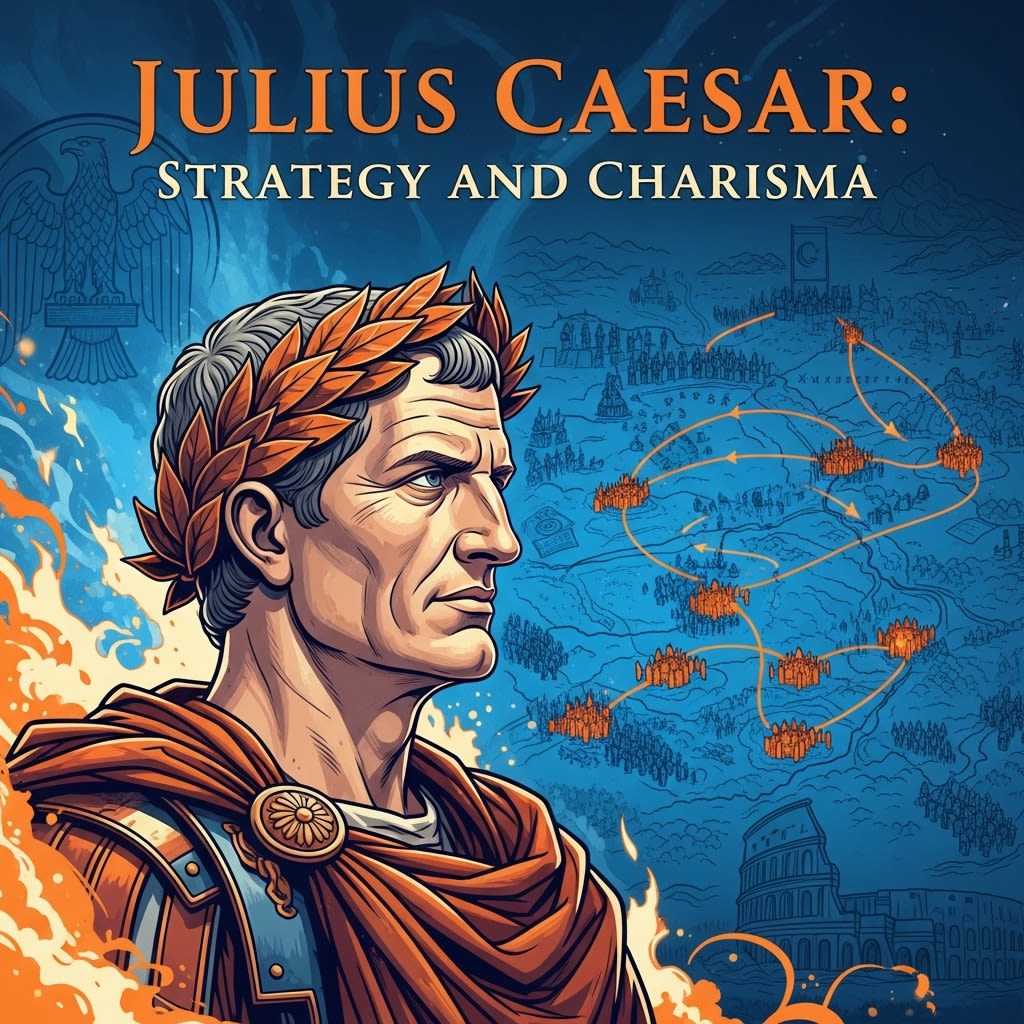
History has produced many brilliant commanders and countless ambitious politicians, but few individuals have fused strategy and charisma as completely as Julius Caesar. Others ruled through fear, tradition, or divine claims. Caesar ruled through belief. Men followed him not merely because he commanded armies, but because he convinced them—emotionally, psychologically, and symbolically—that his success was their destiny.
Born into a modest branch of a prestigious Roman family in 100 BCE, Caesar did not inherit overwhelming power. What he possessed instead was perception. From an early age, he understood that Rome was not governed only by laws and legions, but by reputation. To rise in the Republic, one had to be seen before being strong—and Caesar mastered the art of being seen.
His early political career was marked by debt, danger, and boldness. He aligned himself with popular causes, championed the common citizen, and openly challenged the aristocratic elite. This was not reckless idealism; it was strategic positioning. Caesar recognized that the Roman Senate had grown detached from the people it claimed to represent. By speaking for the masses, he gained something far more powerful than votes—loyalty.
Yet Caesar’s genius was never singular. His strategy worked because it was paired with extraordinary adaptability. As a general, he redefined Roman warfare. In Gaul, he faced enemies who outnumbered him, outmaneuvered him, and understood the terrain better than his troops. Caesar compensated not with brute force, but speed, intelligence, and psychological dominance. He attacked when others hesitated. He defended when retreat seemed inevitable. His campaigns were lessons in decision-making under uncertainty.
But perhaps his greatest weapon was narrative.
Caesar did something revolutionary: he wrote about his own wars. His Commentaries on the Gallic War were not neutral history—they were brilliant propaganda. Written in clear, restrained language, they portrayed him as rational, reluctant, and constantly provoked. Every victory appeared necessary. Every enemy appeared unreasonable. Rome read his version of events while the battles were still unfolding.
This fusion of action and storytelling was unprecedented. Caesar did not wait for historians to judge him—he framed judgment in advance.
Charisma elevated everything he touched. His soldiers adored him because he shared their hardships. He marched with them, spoke to them personally, remembered names, and rewarded loyalty generously. Discipline under Caesar was strict, but it felt meaningful. His men believed they were part of something historic, not merely employed by the state.
This loyalty proved decisive when politics turned hostile. As tensions with the Senate escalated, Caesar faced a defining choice: submission or defiance. When he crossed the Rubicon River in 49 BCE, he committed an act that made civil war inevitable. It was not impulsive rebellion. It was calculated risk. Caesar knew the Senate lacked unity, Pompey lacked decisiveness, and the public sympathized with him.
Strategy created the opportunity. Charisma made it survivable.
Throughout the civil war, Caesar displayed a pattern that distinguished him from typical strongmen—mercy. He pardoned enemies repeatedly, turning former rivals into allies. This was not sentimentality; it was political intelligence. Killing enemies ends resistance temporarily. Forgiving them reshapes allegiance. Caesar aimed not merely to defeat Rome’s elite, but to absorb it.
Yet the very qualities that lifted him also sealed his fate. His visibility became unbearable. His charisma eclipsed institutions. His success frightened those who believed the Republic could not survive one man’s dominance. To his enemies, Caesar was not a tyrant yet—but he was becoming inevitable.
When he was assassinated in 44 BCE, the conspirators believed they were saving the Republic. Instead, they destroyed it. The vacuum left by Caesar’s death unleashed chaos that led directly to imperial rule under Augustus. His enemies killed the man—but proved his argument.
Julius Caesar’s legacy is not simply conquest or dictatorship. It is the demonstration that power rests on more than authority. Strategy wins battles. Charisma wins belief. When combined, they reshape history.
Caesar did not merely command Rome. For a moment, he embodied it.
About the Creator
Fred Bradford
Philosophy, for me, is not just an intellectual pursuit but a way to continuously grow, question, and connect with others on a deeper level. By reflecting on ideas we challenge how we see the world and our place in it.
Keep reading
More stories from Fred Bradford and writers in History and other communities.
Talleyrand: The Master Survivor
Few figures in history embody strategic survival as perfectly as Charles-Maurice de Talleyrand-Périgord. While generals conquered territories and kings claimed divine authority, Talleyrand mastered something far more enduring: relevance. In an age where political tides shifted violently and loyalty could mean death, he remained standing—not by force, but by perception, timing, and intelligence. He did not dominate history. He outlasted it.
By Fred Bradford2 days ago in History
Hazrat Umar Farooq (RA
Hazrat Umar Farooq (may Allah be pleased with him) was born in Makkah Mukarramah. His kunya was Abu Hafs. He embraced Islam in the sixth year of Prophethood, at the age of 27. Even before accepting Islam, he was regarded with great respect because he was honorable, educated, brave, courageous, and wise in matters. He also had the honor of being the father-in-law of the Messenger of Allah (peace and blessings be upon him).
By Sudais Zakwan4 days ago in History




Comments
There are no comments for this story
Be the first to respond and start the conversation.