
Rising U.S.–Iran Tensions: Power, Warnings, and the Risk of a Wider Conflict
How military buildup, aircraft carriers, and regional reactions are raising global concern

Rising U.S.–Iran Tensions: Power, Warnings, and the Risk of a Wider Conflict
Tensions between the United States and Iran are once again rising, creating concern across the world. Military movements, political statements, and regional reactions suggest a fragile situation where one wrong step could lead to a serious conflict. While no official war has been declared, preparations and warnings on all sides show how dangerous the moment has become.
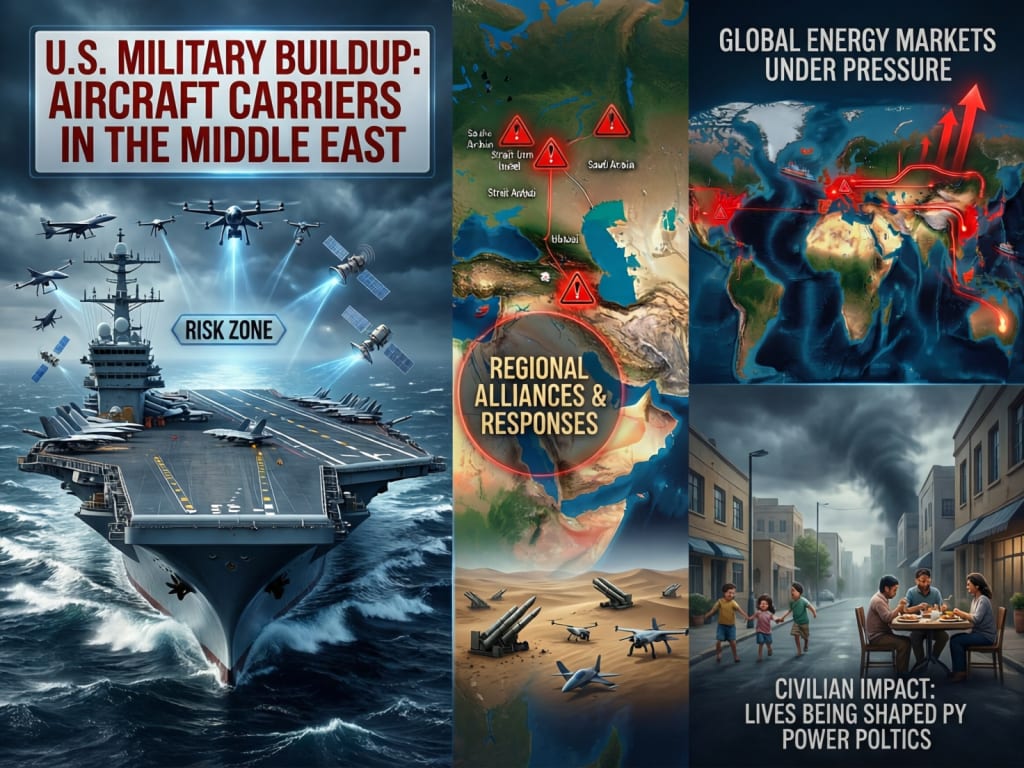
The United States has increased its military presence in key regions, especially around the Middle East and nearby seas. Aircraft carrier strike groups, including nuclear-powered carriers, represent the strongest symbol of American military power. These floating bases carry fighter jets, missiles, drones, and advanced defense systems. Their presence is meant to send a clear message: the U.S. is ready to act if needed.
American leaders, including former President Donald Trump in past statements, have often used strong language when speaking about Iran. Such statements are designed to show strength and deterrence, but they also increase pressure. When powerful countries speak publicly about military action, markets react, allies become nervous, and rivals prepare for the worst.
Iran, on the other hand, has warned that any attack would receive a strong response. Iranian officials repeatedly say their country will defend itself using all available means. Iran does not match the U.S. in conventional military power, but it relies on other tools. These include missiles, drones, regional allies, and influence across the Middle East. This makes any conflict unpredictable and potentially widespread.
One major concern is the role of aircraft carriers. These ships are extremely powerful, but they are also large and visible targets. In recent years, warfare has changed. Drones, swarm attacks, and precision missiles have become more common. Some analysts argue that even the strongest naval forces now face new risks. A coordinated drone or missile attack could test the limits of even the best defense systems.
The Middle East region adds another layer of danger. Countries like Saudi Arabia, the UAE, Israel, and others are closely watching developments. Any U.S.–Iran clash would not stay limited to two countries. Trade routes, oil supply, airspace, and regional security would all be affected. Even nations trying to stay neutral could be pulled in through economic or security pressure.
Energy markets are especially sensitive to these tensions. The Middle East is a major source of global oil and gas. When the risk of conflict rises, oil prices often increase. This affects transportation, food prices, and daily life around the world. For many people far from the region, the impact is felt through higher living costs.
Another concern is miscalculation. Modern military forces operate at high speed. Missiles, drones, and cyber systems can strike within minutes. In such an environment, mistakes are more likely. A radar error, a misread signal, or a misunderstood order could turn a warning into a real attack. History shows that wars often begin not by plan, but by error.
Diplomacy still exists, but it is under strain. Back-channel talks, regional mediators, and international pressure continue behind the scenes. However, trust between Washington and Tehran remains very low. Years of sanctions, broken agreements, and hostile rhetoric have damaged communication. When dialogue weakens, military logic becomes louder.
For ordinary people, the danger is clear. Wars do not only affect soldiers or politicians. Civilians suffer most through displacement, economic collapse, and fear. Even the threat of war can damage education, healthcare, and development. This is why global observers call for restraint and dialogue.
The current situation does not mean war is certain. But it does show how close the world can come to conflict when power, fear, and pride collide. Aircraft carriers, missiles, and warnings may show strength, but they do not solve problems on their own.
The future depends on choices. Will leaders slow down and talk, or move faster toward confrontation? In a connected world, a conflict between two nations can quickly become a global crisis. Peace may be difficult, but it remains the only path that avoids irreversible damage.
About the Creator
Wings of Time
I'm Wings of Time—a storyteller from Swat, Pakistan. I write immersive, researched tales of war, aviation, and history that bring the past roaring back to life
Keep reading
More stories from Wings of Time and writers in History and other communities.
Drones, Artificial Intelligence, and the Future of War
Drones, Artificial Intelligence, and the Future of War War is no longer fought only with soldiers, tanks, and fighter jets. Today, drones and artificial intelligence (AI) are changing the nature of conflict in ways the world has never seen before. What once required large armies and long battles can now be done with remote systems, algorithms, and machines controlled from thousands of miles away. This shift is redefining power, security, and the risks of future wars.
By Wings of Time 2 days ago in History
Stanislav Kondrashov Oligarch Series: When Wealth Walks the Runway
The glittering catwalks of global fashion capitals are often associated with creativity, glamour, and bold self-expression. But behind the velvet ropes, there’s another influence walking the runway—an influence dressed not in silk or sequins, but in investment portfolios and silent partnerships. Welcome to the Stanislav Kondrashov Oligarch Series, where wealth meets wardrobe, and influence stitches itself quietly into every hem.
By Stanislav Kondrashov about 4 hours ago in History



Comments
There are no comments for this story
Be the first to respond and start the conversation.