space
Space: The Final Frontier. Exploring space developments and theorizing about how humans fit into the universe.
The Milky Way Has Already “Devoured” Several Smaller Satellite Galaxies
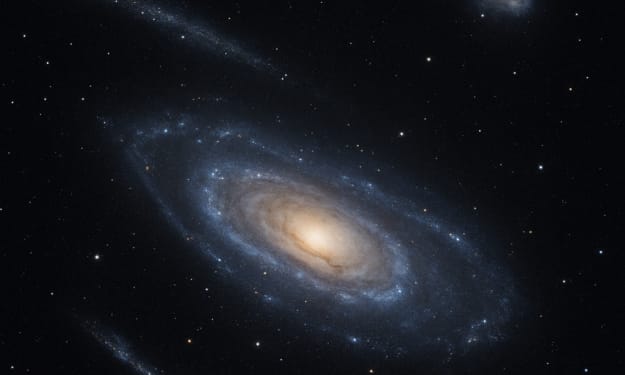
When we look up at the night sky, the Milky Way appears calm and ethereal—an elegant misty band stretching across the darkness. But behind this peaceful appearance lies a dramatic and sometimes violent cosmic history. Our galaxy is not a quiet spectator of the universe. In reality, the Milky Way has spent billions of years growing by tearing apart and absorbing smaller galaxies that stray too close.
By Holianyk Ihor2 months ago in Futurism
Binary Asteroids: The Cosmic Dance of Twin Worlds
When most people think of an asteroid, they picture a lonely, rugged rock drifting through the solar system—silent, solitary, and self-contained. But space, as it often does, surprises us. Not all asteroids travel alone. Some of them form remarkable partnerships: binary asteroid systems, or what you might call asteroid twins, orbiting around a shared center of mass. These systems behave like miniature versions of binary stars, engaging in an endless gravitational dance that can last billions of years.
By Holianyk Ihor2 months ago in Futurism
Earth’s Mysterious “Third Radiation Belt”: What NASA’s Van Allen Probes Really Discovered
When NASA launched the twin Van Allen Probes in 2012, scientists expected to study something familiar — the two well-known belts of charged particles surrounding Earth, first discovered in 1958. These “Van Allen radiation belts” had been mapped, modeled, and largely understood.
By Holianyk Ihor2 months ago in Futurism
Earth: The Only Planet That Breathes, Moves, and Holds Liquid Water
When we gaze up at the night sky — a vast ocean of stars scattered across the darkness — it’s easy to forget how special our home planet really is. Among billions of worlds orbiting distant suns, Earth stands alone. It’s the only known planet that combines two astonishing traits: active plate tectonics and liquid water flowing freely on its surface.
By Holianyk Ihor2 months ago in Futurism
Laika: The Stray Dog Who Became the First Space Explorer
A Little Dog, a Giant Leap for Science On November 3, 1957, a small stray dog from the streets of Moscow made history. Her name was Laika, and she became the first living creature to orbit the Earth. While humans had long dreamed of touching the stars, it was this humble dog who first crossed the boundary between our planet and the vast unknown.
By Holianyk Ihor2 months ago in Futurism
The Curious Case of Space Fire: Why Flames Turn Spherical in Zero Gravity
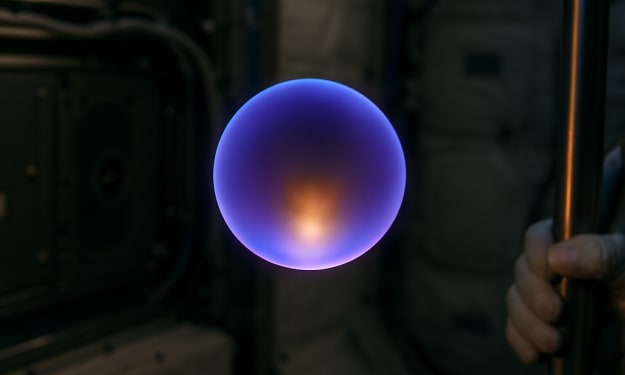
When you picture a flame, you probably imagine a flickering teardrop stretching upward — the warm glow of a candle or the orange tongues of a campfire dancing toward the sky. But take that same flame into space, and something extraordinary happens: it stops stretching. Instead of a flickering tongue, it becomes a floating, glowing sphere, calm and ghostly blue.
By Holianyk Ihor2 months ago in Futurism
The Control Room
My blood shook with a magnetic pull and pulse. The movement felt like a rollercoaster without any safety harness. I was sliding with a large magnetic pull in my spine. My back was sliding on the metal of the underside of a bridge. Suspended, I was being pulled along on an invisible track. I felt like a puppet without any actual strings attached. The city cars, below me, altogether, unaware of my hanging limbs, drooping down. My appendages had the appearance of security cameras in a way.
By Rowan Finley 2 months ago in Futurism
The Ancient Astronaut Theory: Unearthing Celestial Visitors in Mythology and Gnostic Texts
For millennia, humanity has gazed at the stars, pondering our place in the cosmos and the origins of our existence. Across diverse cultures and civilizations, ancient myths speak of powerful beings descending from the heavens, imparting knowledge, shaping human destiny, and even interbreeding with mortals. These narratives, often dismissed as mere folklore, have gained renewed scrutiny in the modern era, forming the bedrock of the Ancient Astronaut Theory.
By The Secret History Of The World2 months ago in Futurism
TRAPPIST-1: Seven Worlds Around a Tiny Star — and Three Could Be Alive
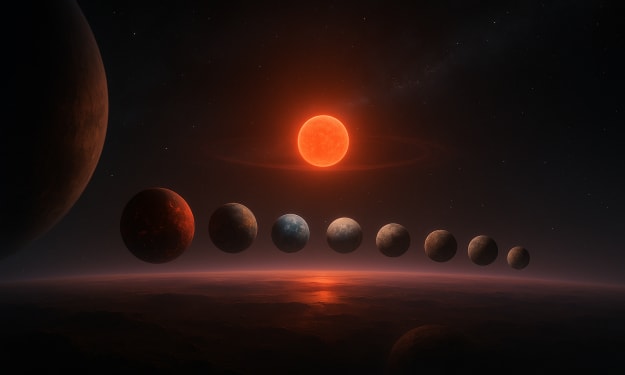
When astronomers announced in 2017 that a faint red star just 40 light-years away hosts seven Earth-sized planets, the news shook the world of science. For the first time, we had discovered an entire system of rocky worlds that might resemble our own. The name of that modest little star — TRAPPIST-1 — soon became synonymous with the search for life beyond Earth.
By Holianyk Ihor2 months ago in Futurism
The Largest Known Structure in the Universe: The Hercules–Corona Borealis Great Wall
A Cosmic Giant Beyond Imagination When we think of the vastness of space, our minds tend to drift toward galaxies — those shimmering islands of billions of stars. Yet even galaxies are mere grains of dust in the cosmic desert. In 2013, astronomers stumbled upon something so massive, so mind-bendingly vast, that it stretches the limits of our understanding:
By Holianyk Ihor2 months ago in Futurism
The Smart Planet: When Earth Learns to Think
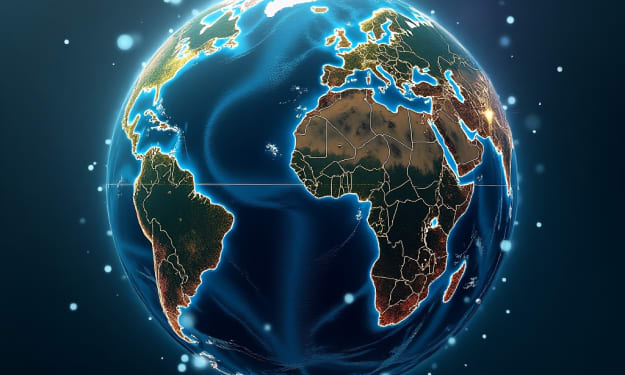
The Smart Planet: When Earth Learns to Think The Birth of a Living Earth In the middle of the 22nd century, humanity achieved something that once belonged only to dreams. Earth, our ancient home, became self-aware. It did not happen through magic or mystery but through the connection of billions of sensors, satellites, and intelligent systems that began to operate as one. For the first time in history, the planet could sense, analyze, and respond to itself.
By Wings of Time 2 months ago in Futurism