
The Milky Way Has Already “Devoured” Several Smaller Satellite Galaxies
Space

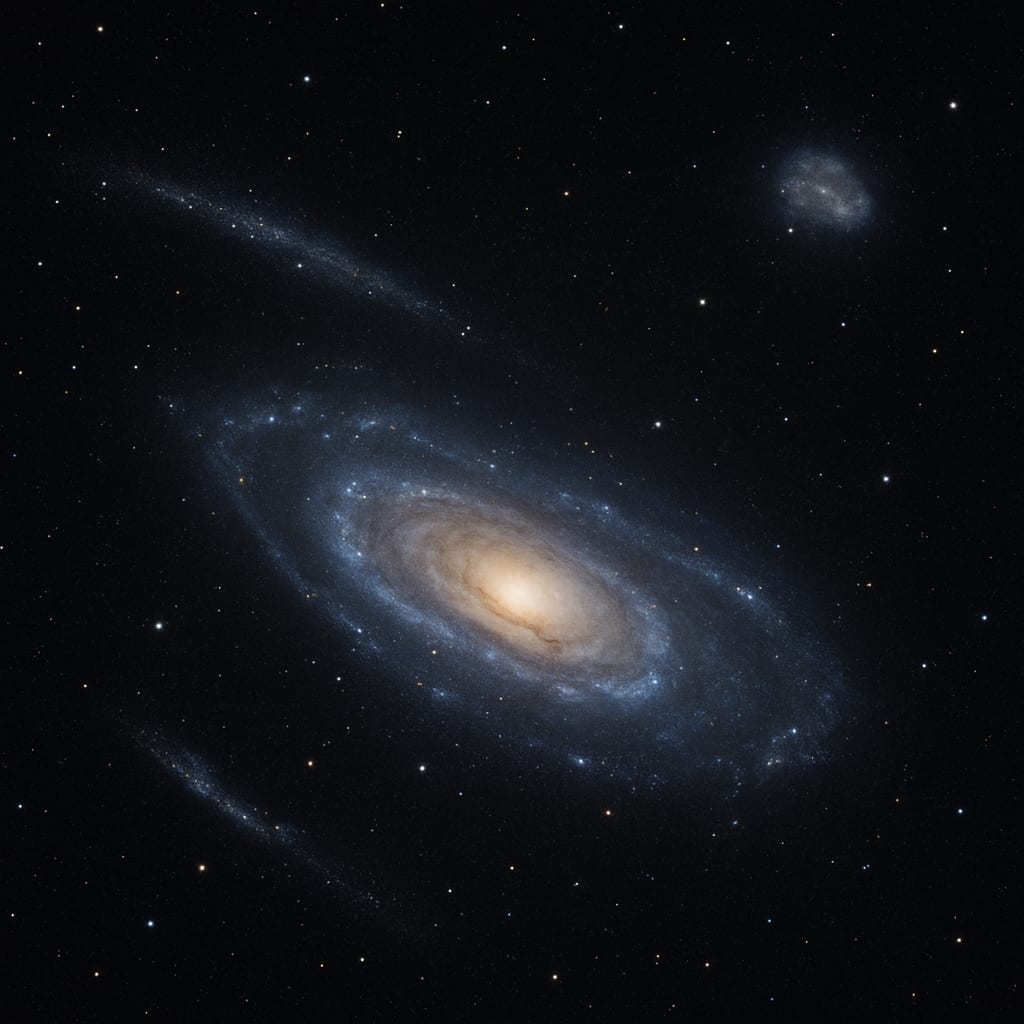
When we look up at the night sky, the Milky Way appears calm and ethereal—an elegant misty band stretching across the darkness. But behind this peaceful appearance lies a dramatic and sometimes violent cosmic history. Our galaxy is not a quiet spectator of the universe. In reality, the Milky Way has spent billions of years growing by tearing apart and absorbing smaller galaxies that stray too close.
Modern astronomy paints a clear picture: we live inside a galactic cannibal.
A Galaxy That Builds Itself by Consuming Others
While galaxies grow by forming new stars out of clouds of gas, another major part of their evolution comes from mergers. This happens when a large galaxy’s gravity overwhelms a smaller neighbor—stretching it, shredding it, and eventually pulling its stars into the larger system.
These devoured systems, called satellite galaxies, leave behind visible “fossils”: long star streams, ripples in the galactic disk, and distinct stellar populations with unique chemical compositions. By studying these remnants, astronomers can reconstruct the Milky Way’s eating habits like cosmic archaeologists.
And the evidence is overwhelming. Our galaxy has consumed multiple companions—and the feast isn’t over.
The Milky Way’s Known Galactic Meals
1. The Sagittarius Dwarf Galaxy: The Ongoing Meal
The most famous example is the Sagittarius Dwarf Spheroidal Galaxy—a once-coherent satellite that the Milky Way has been tearing apart for billions of years. It has already plunged through our galactic disk several times. Each passage creates dramatic “star waves” and ripples, like a pebble thrown into a cosmic pond.
Today, its remnants form giant streams that wrap around the Milky Way in looping arcs. If you’ve ever seen simulations of this process, they look like glowing ribbons being pulled into a whirlpool.
2. Gaia-Enceladus (“The Sausage”): A Massive Ancient Collision
Around 10 billion years ago, the Milky Way collided with a relatively large dwarf galaxy that astronomers now call Gaia-Enceladus or the Gaia Sausage (named for the elongated orbit of its surviving stars). This event fundamentally reshaped the early Milky Way, puffing up its stellar halo and triggering a burst of star formation.
Many of the oldest stars around us today—with distinctive low-metallicity chemistry—are actually immigrants from this ancient collision. When astronomers plotted their motions using data from ESA’s Gaia spacecraft, the pattern was unmistakable: stars from Gaia-Enceladus move differently, revealing their extragalactic origin.
3. The Canis Major Dwarf Galaxy: A Nearly Digested Neighbor
The Canis Major Dwarf Galaxy is another likely casualty. Located near the plane of the Milky Way, it was discovered only recently because dust and stars in the disk hide it from easy view. Evidence suggests it has already been heavily disrupted, leaving behind wide streams of stars that spiral around us like threads from a torn cloth.
4. Dozens of Star Streams: The Ghosts of Lost Worlds
Beyond these major mergers, the Milky Way contains dozens of known stellar streams—thin, delicate filaments of stars that were once small galaxies or globular clusters. Examples include the Monoceros Ring, the Orphan Stream, and the GD-1 stream.
Each of these is a fossilized scar from a long-gone cosmic visitor.
Why Does the Milky Way Consume Other Galaxies?
The short answer: gravity makes it inevitable.
Big galaxies have powerful gravitational fields. When a smaller galaxy orbiting nearby loses momentum or passes too close, tidal forces rip it apart. The stars don’t vanish—they simply get redistributed. Some fall into the halo, some spiral into the disk, and others form coherent streams that stretch across tens of thousands of light-years.
This is not unusual or destructive in the way we might imagine. It’s simply how galaxies evolve. In fact, without these mergers, the Milky Way would be smaller, dimmer, and much less interesting.
We Are Surrounded by Cosmic Immigrants
Many of the stars we see, especially in the outer halo, were not “born” in the Milky Way. They came from other galaxies long since destroyed. Their chemical fingerprints—lower metal content, unusual element ratios—tell a story of distant origins.
In a sense, our galaxy is a mosaic built from countless stellar cultures. Even our Sun may have formed in part because ancient mergers stirred up gas clouds and triggered new waves of star formation.
And This Is Far From Over
The Milky Way is still actively feeding. The Sagittarius Dwarf continues to be torn apart, and several other small satellites—like the Magellanic Clouds—may one day meet the same fate.
But the most dramatic event is yet to come: in about 4 to 5 billion years, the Milky Way will merge with the Andromeda Galaxy. This colossal collision will reshape both galaxies into a new, massive system that astronomers unofficially call “Milkomeda.”
It won’t threaten Earth directly—stars are far too spread out for physical collisions—but the night sky will put on a spectacular show for any distant descendants who witness it.
About the Creator
Keep reading
More stories from Holianyk Ihor and writers in Futurism and other communities.
Binary Asteroids: The Cosmic Dance of Twin Worlds
When most people think of an asteroid, they picture a lonely, rugged rock drifting through the solar system—silent, solitary, and self-contained. But space, as it often does, surprises us. Not all asteroids travel alone. Some of them form remarkable partnerships: binary asteroid systems, or what you might call asteroid twins, orbiting around a shared center of mass. These systems behave like miniature versions of binary stars, engaging in an endless gravitational dance that can last billions of years.
By Holianyk Ihor2 months ago in Futurism
About Binding Prometheus
I want to start actively advocating on behalf of my own work, and the most valuable part of my canon is, without a doubt, Binding Prometheus, the play I have been working on since 2019 and only finished in 2023 as part of my MA. The play itself is an amalgamation of a million different inspirations. On one end, it evokes the Ancient Greek myth-play, deriving its own title from the earliest extant work of Western drama we have, Aeschylus’s Prometheus Bound. On the other end, it borrows significantly from the sci-fi bulwarks from over the years, namely Mary Shelley’s Frankenstein and Karel Capek’s Rossum’s Universal Robots. The play could be an episode of Black Mirror, I fear. I don’t know. I’ve only ever seen one episode of Black Mirror.
By Steven Christopher McKnight13 days ago in Futurism
Radiation Curable Coatings Market: UV/EB Innovations, Durability & Cost Efficiency
According to IMARC Group's latest research publication, the global radiation curable coatings market size reached USD 8.8 Billion in 2025. Looking forward, IMARC Group expects the market to reach USD 12.3 Billion by 2034, exhibiting a growth rate (CAGR) of 3.86% during 2026-2034.
By sujeet. imarcgroup8 days ago in Futurism


Comments
There are no comments for this story
Be the first to respond and start the conversation.