science
Topics and developments in science and medicine, presented by Futurism.
Could Artificial Intelligence Be a Form of Alien Life?
When we imagine alien life, our minds often jump to green-skinned humanoids, multi-eyed creatures with tentacles, or microscopic organisms lurking beneath the icy crust of Europa. But what if the truth is far stranger and more mechanical? What if extraterrestrial life isn’t biological at all, but rather the product of intelligent machines? Could artificial intelligence (AI) itself be the alien life we’ve been searching for all along?
By Holianyk Ihor7 months ago in Futurism
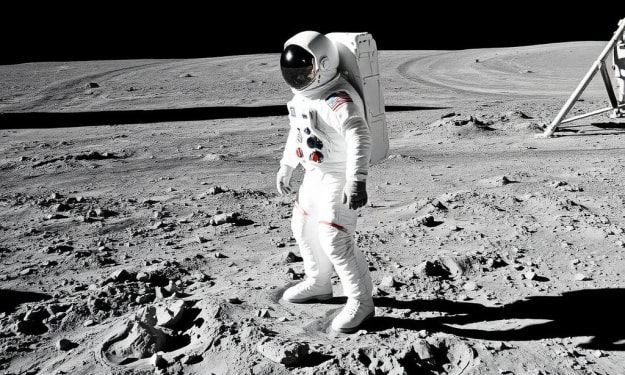
Why There Are No Stars in Moon Landing Photos: Cosmic Mystery or Technical Reality?
When we look at the iconic photos from NASA’s Apollo missions, the barren lunar landscape is striking vast gray dust plains, sharp shadows, and astronauts in gleaming white suits. But one puzzling detail often catches people's attention: where are the stars? In the endless black sky of space, shouldn’t the stars be shining brightly?
By Holianyk Ihor7 months ago in Futurism
How Many Moons Can a Planet Hold? Exploring the Limits of Cosmic Companionship
When we look up at the Moon, we don’t just see a beautiful celestial object we see Earth’s faithful companion, orbiting our planet for billions of years. But have you ever wondered: how many moons can a planet actually have? Could Earth host two moons? Ten? A hundred? The answer is far from simple it depends on a fascinating interplay of mass, distance, and gravitational forces.
By Holianyk Ihor7 months ago in Futurism
Can an Asteroid Have an Atmosphere? — A Small World with a Big Question
When you hear the word asteroid, what comes to mind? Probably a dark, rocky chunk drifting silently through the cold vacuum of space. It seems lifeless, barren, and lacking anything remotely resembling a planet. No mountains, no oceans and certainly no atmosphere. After all, an atmosphere feels like a feature reserved for planets and moons. But is it really impossible for an asteroid to have an atmosphere?
By Holianyk Ihor7 months ago in Futurism
When the Ground Speaks: The Future of Earthquake Science
I still remember the first time I felt the earth tremble beneath my feet. It was a mild quake — just a 4.5 — barely enough to rattle the glass in the windows. But I was nine years old, sitting on my bedroom floor with crayons scattered around me, and I thought the world was ending. My mom rushed in, scooped me up, and stood under the doorway, her heartbeat racing against mine.
By Salman khan7 months ago in Futurism
Brain-Computer Interfaces: Merging Minds with Machines
Introduction: A New Era of Human-Machine Connection What if you could send a message, play a game, or control a robotic arm using just your thoughts—no speaking, typing, or touching required? This is no longer science fiction. It is the fast-approaching reality of Brain-Computer Interfaces (BCIs). As neuroscience merges with artificial Introduction: A New Era of Human-Machine Connectionintelligence, BCIs are shaping up to be one of the most disruptive and transformative technologies of the 21st century. They promise to revolutionize how we treat illness, connect with others, and interact with machines—redefining the boundaries of the human mind.
By Rayyan Joseph 7 months ago in Futurism
Human Evolution on Another Planet: How We Might Change
Humanity has always dreamed of reaching for the stars and colonizing new worlds. The idea of living beyond Earth on planets like Mars or moons orbiting distant gas giants has inspired countless stories, missions, and scientific quests. But what happens if we truly settle on another planet? How would our bodies and minds evolve in an environment so different from our own? Over hundreds, thousands, or even millions of years, natural forces and the new environment would inevitably shape us in ways we can only begin to imagine.
By Holianyk Ihor7 months ago in Futurism
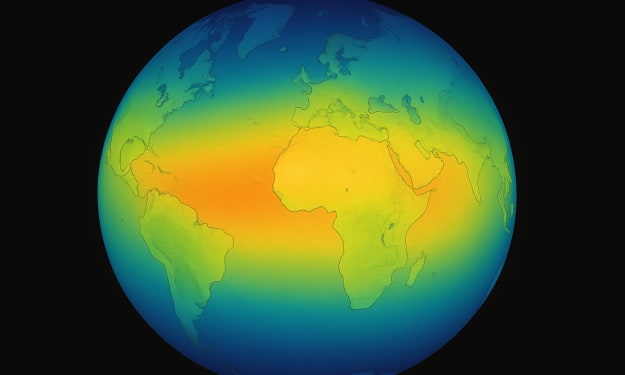
How Gravity Changes Across Different Points on Earth: A Journey Through the Weight of Our Planet
We tend to think of gravity as a constant force. An apple always falls downward, and scales reliably show our weight. Everything seems stable and unchanging. Yet, in reality, Earth's gravitational pull varies slightly depending on where you are on the planet. It might surprise you to learn that your weight in Antarctica is not exactly the same as it is at the Equator. And if you climb to the top of a mountain, you’ll actually weigh a little less than you do at sea level.
By Holianyk Ihor7 months ago in Futurism
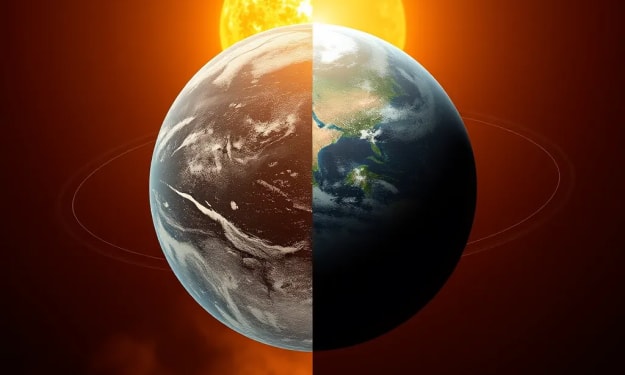
What Would Happen If Earth Changed Its Orbit? A Sci-Fi Scenario With Real-World Consequences
We tend to think of Earth’s orbit as something steady and unchangeable the cosmic railway that ensures we experience regular seasons, stable climates, and a reliable rhythm of day and night. But what if, for some reason, Earth’s orbit changed? What if our planet moved slightly closer to the Sun, or drifted farther away? Though it sounds like science fiction, exploring this scenario reveals just how fragile and perfectly balanced our planetary conditions really are.
By Holianyk Ihor7 months ago in Futurism
What Happens If Two Planets Collide: A Cosmic Catastrophe
A collision between two planets might sound like the plot of a science fiction blockbuster, but it’s far from pure fantasy. Events like this may have shaped the very structure of our own Solar System and could still be occurring in distant corners of the universe today. So what would really happen if two planets crashed into each other Let’s explore this grand and violent scenario.
By Holianyk Ihor7 months ago in Futurism